
Water purification systems: your guide to healthier showers
TL;DR:
- Residual chlorine and metals in municipal shower water can damage skin and hair.
- Water purification systems like carbon and KDF filters effectively reduce these contaminants.
- Regular filter replacement is crucial to maintain their effectiveness and deliver visible health benefits.
Your tap water might meet federal drinking standards and still be doing real damage every time you step into the shower. Chlorine, heavy metals, and volatile organic compounds don’t disappear just because water is technically “safe to drink.” They linger in your shower stream, stripping natural oils from your skin, drying out your hair, and irritating your scalp with every rinse. Water purification systems are technologies that remove these contaminants through physical, chemical, or biological processes like filtration, adsorption, and disinfection. This guide breaks down exactly how they work, which types make sense for your shower, and how to choose the right one.
Table of Contents
- What are water purification systems?
- Key methods used in water purification
- How water quality affects your skin and hair
- How to choose a shower water purification system
- Most shower purification advice misses this crucial point
- Experience the benefits of advanced shower purification
- Frequently asked questions
Key Takeaways
| Point | Details |
|---|---|
| Definition clarified | Water purification systems remove contaminants to improve water quality for bathing and health. |
| Shower filters work | Shower filters targeting chlorine and heavy metals can reduce dryness and irritation. |
| Choose the right filter | Match purification system to your needs, looking for certified and easily maintained options. |
| Maintenance matters | Replace filters regularly for best results; performance drops after several months. |
What are water purification systems?
Water purification is a broad term that covers a wide range of technologies, all sharing one goal: removing unwanted substances from water before it reaches you. Water purification systems remove contaminants to make water safe for consumption, bathing, and other uses through a combination of physical, chemical, and biological processes.
For most people, the phrase brings to mind drinking water filters under the sink or large municipal treatment plants. But the same principles apply directly to your shower. The water coming out of your showerhead has already been treated at a municipal level, yet it still carries residual chlorine used as a disinfectant, trace heavy metals picked up from aging pipes, sediment, and sometimes chloramines (a combination of chlorine and ammonia used in some municipal systems).
The core processes used in purification include:
- Filtration: Physically removes particles by passing water through a porous medium
- Adsorption: Contaminants bind to the surface of a material (like activated carbon) rather than being mechanically trapped
- Reverse osmosis (RO): Forces water through a semi-permeable membrane under pressure to remove dissolved solids
- Disinfection: Uses UV light or chemical agents to neutralize biological threats
- Redox (reduction-oxidation): Chemical reactions that neutralize chlorine and some heavy metals, used in KDF media
For your shower specifically, adsorption and redox are the workhorses. They’re fast enough to handle the flow rate of a showerhead without reducing your water pressure to a trickle.
“Most people assume municipal water treatment handles everything. It treats water to be safe to drink, not necessarily safe to shower in every day for 10 minutes while it’s being absorbed through your open pores and inhaled as steam.”
Understanding the full scope of skin and hair filter benefits starts with knowing what you’re filtering out and why each method matters for your daily routine.
Key methods used in water purification
Not all filtration technologies are created equal, and each one has a specific job it does well. Matching the right technology to your problem is what separates a filter that works from one that just looks good on a shelf.
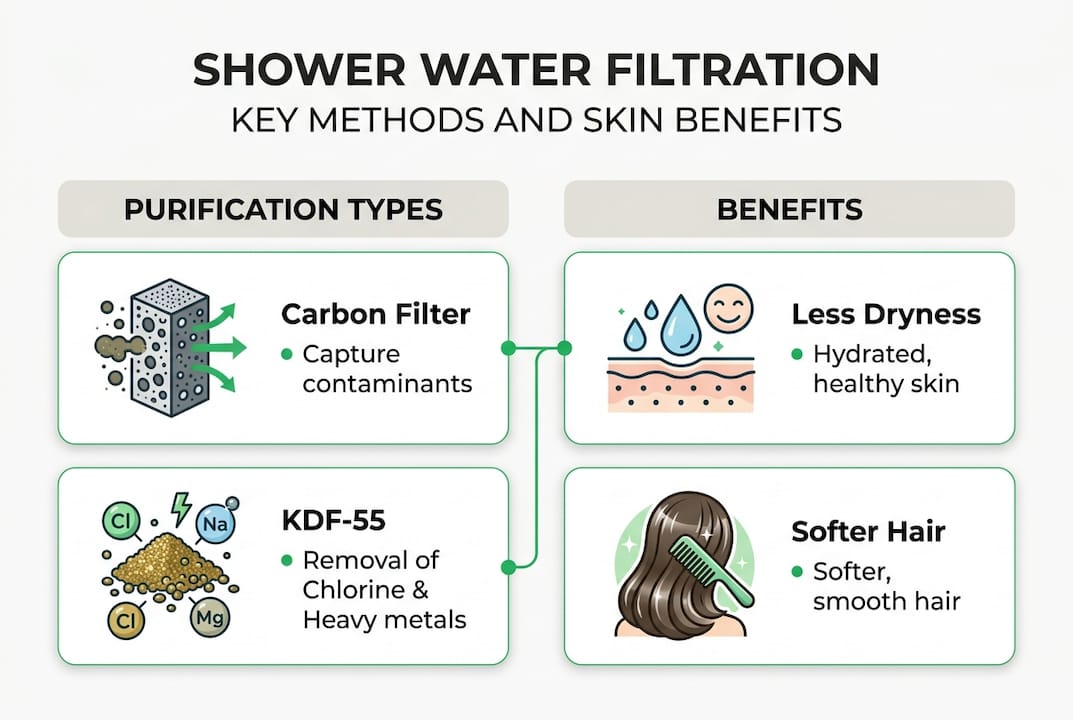
Granular Activated Carbon (GAC) is one of the most widely used purification methods. GAC adsorbs organics, VOCs, chlorine, tastes, and odors using its enormous porous surface area. One gram of activated carbon can have a surface area exceeding 500 square meters, which gives it extraordinary capacity for trapping contaminants. The limitation is that GAC doesn’t remove dissolved minerals, total dissolved solids (TDS), or hardness, so if your main concern is limescale buildup from hard water, carbon alone won’t solve it.
KDF-55 (Kinetic Degradation Fluxion) media uses a copper-zinc alloy to create a redox reaction. This process converts free chlorine into a water-soluble chloride that is harmless and flushes away. KDF also inhibits bacterial growth inside the filter, which is a meaningful advantage in the warm, moist environment of a shower. Point-of-use shower filters using KDF-55, calcium sulfite, and activated carbon can reduce chlorine and chloramine levels by 44 to 99%, while also cutting heavy metals and sediments to improve skin and hair condition. That’s a wide performance range, which is why certifications matter so much (more on that shortly).
Calcium sulfite is a fast-acting chlorine neutralizer that works even in cold water. This makes it especially useful in shower filters because contact time with the filtration media is short. It’s often combined with KDF or carbon for broader coverage.
Reverse osmosis is the gold standard for drinking water purification. It removes nearly everything, including fluoride, nitrates, TDS, and heavy metals. However, it generates a significant amount of wastewater (often 3 to 5 gallons rejected for every gallon filtered) and operates at low flow rates. These two factors make it completely impractical for shower use.
Whole-house systems treat all the water entering your home before it reaches any fixture. They’re excellent for comprehensive coverage but represent a larger investment and professional installation. Point-of-use filters attach directly to your showerhead and target only the water you actually bathe in. They’re affordable, renter-friendly, and easy to replace.
| Technology | Removes chlorine | Removes heavy metals | Removes TDS/fluoride | Suitable for showers |
|---|---|---|---|---|
| GAC (activated carbon) | Yes | Partial | No | Yes |
| KDF-55 | Yes | Yes | No | Yes |
| Calcium sulfite | Yes | No | No | Yes |
| Reverse osmosis | Yes | Yes | Yes | No |
| Whole-house carbon | Yes | Partial | No | Yes |
| Vitamin C (ascorbic acid) | Yes | No | No | Yes |
Pro Tip: For the best water filtration results for skin and hair, look for a shower filter that combines two or more media types, such as KDF with activated carbon or Vitamin C with ceramic balls. Multi-stage designs address a wider range of contaminants in the limited contact time of a shower.
How water quality affects your skin and hair
The chemistry happening in your shower has direct, measurable consequences for how your skin feels and how your hair behaves. Chlorine is the biggest offender in most municipal water supplies. It’s an oxidizing agent, which means it reacts aggressively with organic material, including the natural oils (sebum) that keep your skin barrier intact and your hair shaft sealed and shiny.
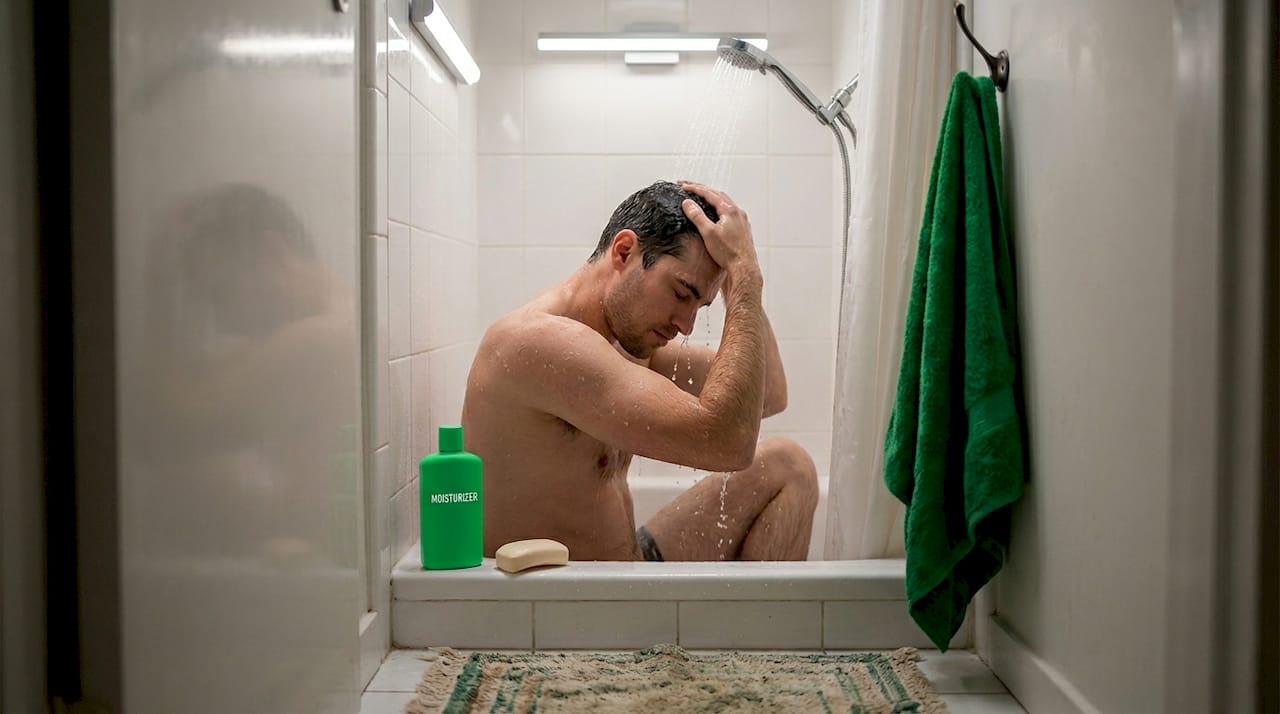
Regular exposure strips the lipid layer from your skin, leaving it dry, tight, and more susceptible to irritation and breakouts. For people with eczema, psoriasis, or sensitive skin, chlorinated shower water can actively trigger flares. Hair exposed to chlorine repeatedly becomes porous, frizzy, and prone to breakage. If you’ve ever noticed your color-treated hair fading faster than expected, chlorine is often a contributing factor.
Heavy metals like lead, copper, and iron can also be present in shower water, particularly in homes with older plumbing. These metals can deposit on hair strands, dulling color and making hair feel rough and heavy. On skin, metal contamination can disrupt the microbiome (the community of beneficial bacteria that live on your skin surface) and trigger inflammation.
Here are three specific ways that filtered shower water produces real, noticeable results:
- Reduced skin dryness and irritation. Removing chlorine and its byproducts allows your skin’s natural moisture barrier to stay intact after showering, rather than being depleted with each wash.
- Stronger, shinier hair. Hair that isn’t repeatedly oxidized by chlorine retains more of its natural protein structure, which translates to improved shine, reduced breakage, and better manageability.
- Calmer scalp. Chlorine and some heavy metals can irritate the scalp, contributing to itching, flaking, and dandruff. Filtered water reduces this irritant load significantly.
Learning more about how to reduce chlorine for healthier skin reveals just how much this one change can shift your daily experience. And the science behind vitamin C shower filter benefits adds another layer: ascorbic acid (Vitamin C) neutralizes both chlorine and chloramines almost instantly on contact, which is faster and more complete than many carbon-based approaches.
One important caveat: shower filter performance degrades over time, with KDF media dropping to less than 10% effectiveness by 60 days in some tests. NSF 177 certification is the standard that verifies a shower filter actually reduces free chlorine by at least 50% under controlled conditions. Filters that carry this certification have been independently tested, not just marketed with bold claims. The comprehensive guide to shower filter benefits outlines exactly what to expect when you make the switch.
How to choose a shower water purification system
Choosing the right filter doesn’t have to be complicated, but a few key decisions make the difference between real results and wasted money. Here’s how to think it through.
Start with your specific water problem. If your water is heavily chlorinated (common in city water), a carbon or Vitamin C filter will address this directly. If you’re in an area with known heavy metal concerns or aging infrastructure, look for KDF-55 or a multi-stage filter that explicitly lists metal reduction. If you have hard water causing limescale and mineral buildup, you’ll need a softener or a filter that includes scale-inhibiting ceramic balls, since most shower filters don’t address TDS or fluoride.
Look for verified certifications. NSF/ANSI 177 is the specific standard for shower filtration. It tests for free chlorine reduction under real flow conditions. Any filter claiming to be effective should back that up with third-party testing, not just brand guarantees.
Consider filter lifespan and replacement ease. RO systems are impractical for showers due to low flow and high water waste, which is why point-of-use shower filters are the practical standard for most households. But even the best shower filter needs regular replacement. Most perform adequately for 3 to 6 months, after which contaminant reduction drops sharply. Filters with a simple refill or cartridge swap design save you the frustration of complicated maintenance.
Check compatibility with your existing shower setup. Most point-of-use filters attach to standard showerhead fittings without tools, making them ideal for renters. Handheld options offer flexibility, while wall-mounted versions suit fixed shower setups. Either way, the filter itself matters more than the form factor.
Here’s a quick decision checklist:
- Does the filter target your specific contaminants (chlorine, metals, sediment)?
- Does it carry NSF 177 or equivalent third-party certification?
- Is the replacement process straightforward and affordable?
- Does it fit your shower type (handheld, fixed, or both)?
- Is a subscription or maintenance plan available to keep performance consistent?
Understanding the workflow for 99% chlorine removal shows how the right filter combination can achieve high-level results consistently. And reading about shower filter benefits for skin and hair helps you set realistic expectations for what a quality filter can actually deliver.
Pro Tip: Set a calendar reminder when you install a new filter cartridge. Even if the filter looks and feels fine, the internal media is losing effectiveness invisibly. Treating it like a subscription renewal rather than a “when I remember” task keeps your water quality consistent year-round.
Most shower purification advice misses this crucial point
Here’s what most filter guides won’t tell you: the difference between a filter that works and one that merely seems to work is entirely invisible to the user. Your water will look the same. It will feel roughly similar. You won’t know you’re showering in 70% less effective filtration until your skin starts feeling dry again or your scalp starts to itch.
The real issue is that most content in this space focuses entirely on initial performance, which is often genuinely impressive, and almost completely ignores the degradation curve. Lab benchmarks show that NSF/ANSI 177-certified shower filters must sustain over 50% free chlorine reduction, but real-world KDF performance can drop below 10% by 60 days under normal use. That’s not a failure of the technology; it’s a feature of how adsorption and redox media work. They have a finite capacity, and once that capacity is used, performance falls off sharply.
This means the most important factor in choosing a shower filter isn’t the media type or even the brand. It’s whether you will actually replace or refill it on schedule. A premium filter used past its life is worse than a mid-range filter replaced on time, because you’re showering with false confidence in protection that no longer exists.
The other thing most guides overstate is the versatility of any single filter. There is no shower filter that removes chlorine, heavy metals, hard water minerals, fluoride, and microplastics equally well. Trying to find one all-in-one solution leads to disappointment. Matching the right technology to your specific water profile, and layering approaches where needed, through multi-stage water filtration, delivers the kind of results that actually show up in your skin and hair over weeks, not just the first shower.
The brands that earn long-term trust are the ones that are honest about filter lifespan, offer easy replacement programs, and don’t claim to solve problems their media isn’t designed to address.
Experience the benefits of advanced shower purification
Knowing what to look for is the first step. Taking action is where real change happens for your skin and hair.
At Vitaclean, our Vitamin C filtered shower heads are built around the exact principles covered in this guide: targeted contaminant removal, verified performance, and easy maintenance. Our filter systems combine Vitamin C, ceramic balls, and multi-stage media to neutralize chlorine and chloramines on contact while supporting a softer, more spa-like shower experience. With our filter subscription service, you never have to worry about tracking replacement schedules because we handle that for you. Whether you’re dealing with dry skin, a sensitive scalp, or dull hair, our solutions are designed to address the root cause at the source.
Frequently asked questions
What do water purification systems remove from shower water?
They target contaminants like chlorine, heavy metals, volatile organic compounds, and sediments that can affect skin and hair. GAC specifically adsorbs organics, VOCs, chlorine, and taste and odor compounds through its high-surface-area porous media.
How often should shower water filters be replaced?
Most shower filters need replacing every 3 to 6 months, since filter performance degrades sharply over time, with KDF media potentially dropping to less than 10% effectiveness by 60 days.
Are reverse osmosis systems good for shower water?
No. RO is impractical for showers because it operates at low flow rates and wastes large volumes of water; point-of-use carbon or Vitamin C filters are far more suitable for shower use.
Do shower water purification systems help with skin and hair problems?
Yes. Filters using KDF-55, calcium sulfite, and activated carbon reduce chlorine and heavy metals that cause dryness and irritation, leading to noticeably healthier skin and hair over consistent use.