
How to reduce chlorine in water for healthier skin
Chlorine keeps municipal water safe from harmful bacteria, but it can wreak havoc on your skin and hair during every shower. Many health-conscious individuals notice dryness, irritation, and brittle hair without realizing their tap water is the culprit. This comprehensive guide walks you through proven filtration methods to reduce chlorine exposure, protect your skin’s moisture barrier, and restore your hair’s natural vitality. You’ll learn which filter technologies work best, how to install and maintain them properly, and what results to expect for your skin and hair health.
Table of Contents
- Key takeaways
- Understanding chlorine in shower water and its effects
- Preparing to reduce chlorine: choosing the right filtration methods
- Execution: installing and maintaining shower filters effectively
- Verifying results and expected benefits for skin and hair
- Explore Vitaclean filtration products for healthier skin and hair
- FAQ
Key Takeaways
| Point | Details |
|---|---|
| Activated carbon performance | Activated carbon filters remove about 95 to 99 percent of free chlorine through adsorption, making them a popular shower filtration choice. |
| Chloramine challenge | Chloramine is harder to remove with standard carbon filters and requires specialized treatment beyond carbon filtration. |
| Filter replacement matters | Filter performance declines over time, so replacing cartridges as recommended improves chlorine removal. |
| Shower benefits | Shower filters can improve skin moisture and hair quality but do not impact drinking water safety. |
Understanding chlorine in shower water and its effects
Municipal water treatment plants add chlorine or chloramine as disinfectants to eliminate dangerous pathogens like bacteria, viruses, and parasites. While chlorine prevents waterborne diseases and makes tap water safe to drink, it creates aesthetic problems for skin and hair during showers. The chemical strips away natural oils that protect your skin’s moisture barrier, leading to dryness, itching, and irritation. Your hair suffers similarly, becoming brittle and losing its natural shine as chlorine oxidizes proteins in the hair shaft.
Chloramine presents an even bigger challenge than free chlorine. Water utilities increasingly use chloramine because it lasts longer in distribution systems and produces fewer disinfection byproducts. However, chloramine bonds more strongly with organic matter, making it significantly harder to remove through standard filtration. Standard carbon filters that easily capture free chlorine struggle with chloramine, removing only 50-70% compared to 95-99% chlorine removal rates.
The chlorine safety and skin impact debate centers on different exposure routes. Drinking chlorinated water poses minimal health risks at municipal treatment levels. Showering creates a different scenario because hot water vaporizes chlorine, allowing inhalation and absorption through skin pores. Your skin absorbs more chlorine during a 10-minute hot shower than drinking eight glasses of the same tap water. This explains why shower filter benefits skin hair quality even though drinking water remains safe.
Key effects of chlorine exposure during showers include:
- Disruption of the skin’s protective lipid layer, causing moisture loss and sensitivity
- Oxidation of hair proteins, leading to weakness, split ends, and color fading
- Aggravation of existing skin conditions like eczema, psoriasis, and dermatitis
- Scalp dryness and irritation that can trigger dandruff and itching
- Accelerated aging signs as chlorine generates free radicals on skin
Understanding these mechanisms helps you appreciate why filtration matters for cosmetic health, even when water safety isn’t compromised. The solution lies in selecting appropriate filtration technology that addresses your specific water chemistry.
Preparing to reduce chlorine: choosing the right filtration methods
Selecting the right shower filter requires understanding your local water chemistry and matching it to appropriate filtration technologies. Start by requesting a water quality report from your utility company or testing your water independently. This report reveals whether your water contains chlorine, chloramine, or both, along with other contaminants that might affect filter selection.
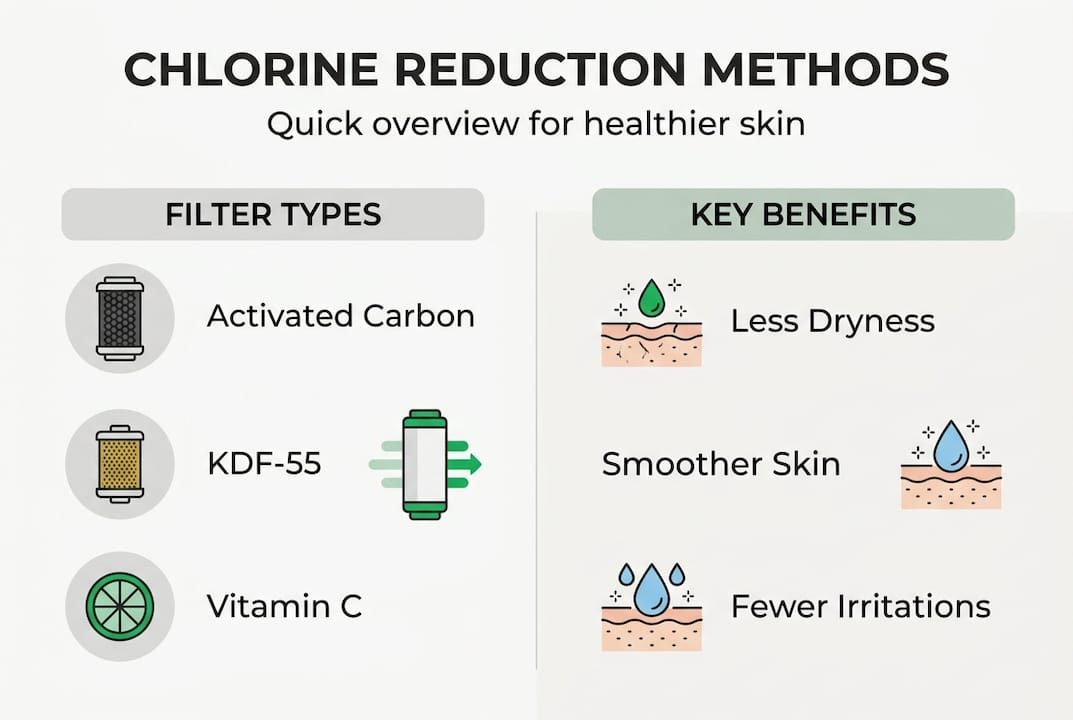
Activated carbon filters remove 95-99% of free chlorine through adsorption, where chlorine molecules bind to the carbon’s porous surface. These filters work exceptionally well for standard chlorinated water and remain the most popular choice for shower filtration. Carbon’s effectiveness increases with contact time, so larger filter cartridges generally outperform compact designs. Temperature plays a crucial role too, as hot shower water actually enhances chlorine removal compared to cold water filtration.
KDF-55 filters use a copper-zinc alloy that removes chlorine through an oxidation-reduction reaction. KDF-55 effective at shower temperatures makes it ideal for hot water applications where other technologies might struggle. KDF filters also inhibit bacterial growth inside the filter housing and remove some heavy metals as a bonus. Many high-performance shower filters combine KDF with activated carbon for comprehensive treatment.
Vitamin C neutralizes chlorine and chloramine instantly through a chemical reaction that converts them to harmless chloride ions. This technology stands out because it works regardless of water temperature or flow rate, unlike carbon filters that require sufficient contact time. Vitamin C filters excel in chloramine-treated water where standard carbon falls short. The benefits of vitamin C shower filters extend beyond chlorine removal to include antioxidant properties that may benefit skin directly.
| Filter Type | Chlorine Removal | Chloramine Removal | Temperature Sensitivity | Lifespan |
|---|---|---|---|---|
| Activated Carbon | 95-99% | 50-70% | Improves with heat | 6 months / 5000L |
| KDF-55 | 95-98% | 60-75% | Excellent at high temps | 6-12 months |
| Vitamin C | 99%+ | 99%+ | No impact | 2-3 months |
| Catalytic Carbon | 90-95% | 85-95% | Moderate sensitivity | 6-9 months |
| Calcium Sulfite | 95-99% | 90-95% | Works at any temp | 6 months |
Catalytic carbon represents an enhanced form of activated carbon specifically engineered for chloramine removal. The catalytic surface promotes chemical reactions that break down chloramine bonds, achieving 85-95% removal compared to 50-70% for standard carbon. Calcium sulfite offers another chloramine solution, working through chemical reduction at any water temperature with 90-95% effectiveness.
Pro Tip: Always choose filters certified to NSF/ANSI Standard 177 for shower filtration, which guarantees tested chlorine removal performance under realistic shower conditions including high temperatures and flow rates.
Consider these factors when selecting your filter:
- Local water chemistry: chlorine only, chloramine, or combination treatment
- Shower temperature preferences: hotter water increases some filter performance
- Household size and shower frequency: affects filter lifespan calculations
- Installation constraints: available space and plumbing compatibility
- Budget for ongoing filter replacements: vitamin C requires more frequent changes
The vitamin C filtration benefits skin hair make it particularly attractive for individuals with sensitive skin or existing dermatological conditions. Matching your specific needs to the right technology ensures optimal chlorine reduction and the best outcomes for your skin and hair health.
Execution: installing and maintaining shower filters effectively
Installing a shower filter requires minimal tools and typically takes 10-15 minutes for most designs. The process remains straightforward enough for renters and homeowners alike, with no permanent plumbing modifications needed. Follow these steps for proper installation:
- Remove your existing shower head by turning it counterclockwise (use a wrench with cloth protection if it’s tight)
- Clean the shower arm threads with a cloth to remove old plumber’s tape and debris
- Wrap 3-4 layers of new plumber’s tape clockwise around the shower arm threads
- Screw the filter housing onto the shower arm by hand, turning clockwise until snug
- Attach your shower head to the filter’s outlet, again using plumber’s tape on threads
- Hand-tighten all connections, then give a quarter turn with a wrench if needed
- Run water for 30 seconds to flush the new filter and check for leaks
Maintaining your shower filter properly ensures consistent chlorine removal throughout its lifespan. Filter chlorine removal performance declines from 98% to 63% after filtering 5000 liters, demonstrating why timely replacement matters more than many users realize. Track your filter usage based on household size and shower frequency to anticipate replacement timing.
Typical filter lifespans vary by technology and usage patterns:
- Activated carbon filters: 6 months or 5000-8000 liters for average households
- KDF filters: 6-12 months depending on water quality and temperature
- Vitamin C filters: 2-3 months or 2000-3000 liters due to faster depletion
- Combination filters: 4-6 months based on the limiting component
Water volume and temperature significantly impact filter longevity. A household with four people taking daily 10-minute showers at 2.5 gallons per minute consumes roughly 3000 gallons monthly, reaching a 5000-liter filter’s capacity in about 4 months. Hotter water accelerates chemical reactions in some filter media, potentially reducing lifespan by 15-20% compared to cooler showers.
Common installation and maintenance mistakes that reduce filter efficiency:
- Skipping plumber’s tape, causing leaks that reduce water pressure through the filter
- Over-tightening connections, which can crack plastic filter housings
- Ignoring replacement schedules, allowing performance to drop below 70%
- Using filters beyond their rated capacity, essentially showering in untreated water
- Failing to flush new filters, leaving carbon fines or manufacturing residue
Pro Tip: Mark your calendar or set a phone reminder when you install a new filter, calculating the replacement date based on your household’s estimated water usage rather than waiting for obvious performance decline.
Filter performance doesn’t fail suddenly. Instead, chlorine removal gradually decreases as the filter media becomes saturated. By the time you notice skin dryness or hair issues returning, your filter may be operating at only 50-60% effectiveness. Proactive replacement based on volume or time prevents this performance gap.
For individuals with chlorine sensitivity shower filters become essential rather than optional. These users should consider shorter replacement intervals, replacing filters at 75-80% of rated capacity to maintain maximum protection. The chlorine sensitivity shower filter guide provides specific recommendations for managing heightened sensitivity through filtration.
Regular visual inspection helps catch issues early. Check monthly for:
- Visible discoloration or sediment buildup on filter housing
- Reduced water pressure indicating clogged media
- Leaks around connection points that need re-taping
- Unusual odors suggesting bacterial growth in the filter
Maintaining optimal filter performance protects your investment in healthier skin and hair while ensuring you receive the full benefits of chlorine reduction throughout the filter’s rated lifespan.
Verifying results and expected benefits for skin and hair
Testing your water before and after installing a shower filter provides objective evidence of chlorine reduction. Pool test strips offer an inexpensive verification method, measuring free chlorine levels in parts per million. Collect water samples in clean containers, test your untreated tap water first to establish a baseline, then test water flowing through your new filter. Most municipal water contains 0.5-2.0 ppm chlorine, and effective filters should reduce this to undetectable levels below 0.1 ppm.
Digital water quality meters provide more precise measurements if you want detailed tracking over time. These devices measure total chlorine, free chlorine, and sometimes chloramine separately. Testing monthly helps you monitor filter performance degradation, signaling when replacement becomes necessary before you notice skin or hair problems returning.
| Filter Technology | Initial Chlorine Removal | After 3 Months | After 6 Months | Chloramine Removal |
|---|---|---|---|---|
| Activated Carbon | 98-99% | 92-95% | 75-85% | 50-70% |
| KDF-55 | 96-98% | 90-94% | 80-88% | 60-75% |
| Vitamin C | 99%+ | 99%+ | N/A (replace at 2-3 months) | 99%+ |
| Catalytic Carbon | 92-95% | 88-92% | 78-85% | 85-95% |
| Calcium Sulfite | 97-99% | 93-96% | 85-90% | 90-95% |
Observable skin improvements typically appear within 1-2 weeks of consistent filtered shower use. Your skin’s moisture barrier begins recovering as chlorine no longer strips away protective oils. Specific benefits include:
- Reduced dryness and flaking, particularly on arms, legs, and torso
- Decreased itching and irritation, especially for sensitive skin types
- Fewer breakouts as chlorine stops disrupting skin’s natural pH balance
- Improved hydration levels that make skin feel softer and more supple
- Reduced redness and inflammation in individuals with rosacea or eczema
Hair transformations often prove even more dramatic than skin improvements. Vitamin C shower filter benefits for hair include 99% chlorine removal that protects hair proteins from oxidative damage. You’ll notice:
- Smoother, more manageable texture as the cuticle layer recovers
- Increased shine and luster from restored natural oils
- Less breakage and fewer split ends over time
- Better color retention for dyed hair, as chlorine no longer fades pigments
- Reduced scalp irritation and dandruff from chlorine-induced dryness
Pro Tip: Combine shower filtration with a simple moisturizing routine for amplified results. Apply body lotion within 3 minutes of showering while skin remains damp, and use a leave-in conditioner to lock in hair’s improved moisture levels.
The benefits for your hair and skin with filters extend beyond immediate cosmetic improvements. Long-term filtered shower use may slow visible aging signs by reducing free radical formation on skin. Hair grows healthier from the follicle when scalp conditions improve, potentially increasing thickness and reducing shedding over months of consistent use.
Individual results vary based on several factors:
- Baseline water quality and chlorine concentration in your area
- Pre-existing skin or hair conditions that may need additional treatment
- Overall skincare and haircare routines complementing filtration
- Shower temperature and duration affecting exposure levels
- Filter maintenance and timely replacement ensuring consistent performance
Documenting your progress with photos and notes helps track improvements objectively. Many users report noticing differences within days, but full benefits accumulate over 4-6 weeks as skin and hair complete their natural renewal cycles under reduced chlorine exposure.
Explore Vitaclean filtration products for healthier skin and hair
Transforming your daily shower into a skin and hair wellness ritual starts with the right filtration technology. Vitaclean specializes in vitamin C shower filtration systems that instantly neutralize chlorine and chloramine, delivering the protection your skin and hair deserve. Our handheld and wall-mounted options install in minutes without tools, making it easy for anyone to upgrade their water quality immediately.
Our replaceable vitamin C shower filter shots provide the most effective chloramine treatment available, with 99%+ removal rates that outperform standard carbon filters. Each refill lasts 2-3 months depending on usage, and our subscription service ensures you never run out. Pair your filter with our curated shower accessories including mineral stones and aromatherapy inserts that enhance your shower experience while protecting your skin and hair. Browse our complete selection of replaceable shower head filters to find the perfect match for your needs and start experiencing noticeably softer skin and shinier hair within weeks.
FAQ
Is chlorine harmful to your skin and hair?
Chlorine strips natural oils from your skin’s protective barrier, causing dryness, irritation, and accelerated aging through free radical formation. Your hair suffers protein damage that leads to brittleness, dullness, and breakage. While chlorine at municipal treatment levels is safe to drink, shower exposure through hot water vapor and skin absorption creates cosmetic problems that filtration effectively addresses.
How often should I replace my shower filter to reduce chlorine?
Most activated carbon and KDF shower filters require replacement every 6 months or after filtering 5000-8000 liters, whichever comes first. Vitamin C filters deplete faster, needing replacement every 2-3 months or 2000-3000 liters. Track your household’s shower frequency and duration to calculate when your specific filter reaches capacity, replacing it proactively before performance drops below 80%.
Can shower filters remove chloramine as well as chlorine?
Standard activated carbon filters remove only 50-70% of chloramine compared to 95-99% chlorine removal. For effective chloramine treatment, choose filters with catalytic carbon, calcium sulfite, or vitamin C technology, which achieve 85-99% removal rates. Check your water utility’s annual quality report to determine if chloramine is present, then select an appropriately rated filter for your water chemistry.
Does hot water affect chlorine removal in shower filters?
Hot water at 103-105°F actually increases chlorine removal efficiency to 96-100% with KDF and activated carbon filters compared to cooler water temperatures. The heat accelerates chemical reactions in the filter media, enhancing performance. However, hot water also vaporizes more chlorine before it reaches the filter, so inhalation exposure remains a concern even with excellent filtration. Balance water temperature for comfort while maximizing filter effectiveness.