
Impurities in Household Water: What You Need to Know
TL;DR:
- Many household water impurities, such as lead and PFAS, are invisible and require testing to detect. These contaminants can harm health and damage skin and hair through daily exposure, especially during showering. Regular testing and matching effective filtration methods, like reverse osmosis and activated carbon, are essential for safe, clean water.
Your tap water looks clear, but that does not mean it is clean. Impurities in household water are far more common than most homeowners realize, and many of the most concerning ones have no taste, odor, or visible color. The technical term for what you are dealing with is drinking water contamination, a category that includes everything from heavy metals and synthetic chemicals to bacteria and sediment. This guide breaks down the main water contamination types, explains how they affect your health and your skin, and gives you a concrete plan for identifying and reducing them.
Key Takeaways
| Point | Details |
|---|---|
| Many impurities are invisible | Lead, PFAS, and nitrates have no taste or odor, making routine testing the only reliable way to detect them. |
| Skin and hair are directly affected | Chlorine, hard water minerals, and metals in shower water strip moisture and disrupt the skin barrier. |
| Filter type must match the contaminant | Activated carbon handles organics, while reverse osmosis is needed for dissolved solids and heavy metals. |
| Boiling is not always the answer | Boiling concentrates nitrates instead of removing them, making it unsafe for infants with nitrate-contaminated water. |
| Testing is your first real step | Start with your city’s Consumer Confidence Report, then move to certified lab testing for a complete picture. |
Common impurities in household water
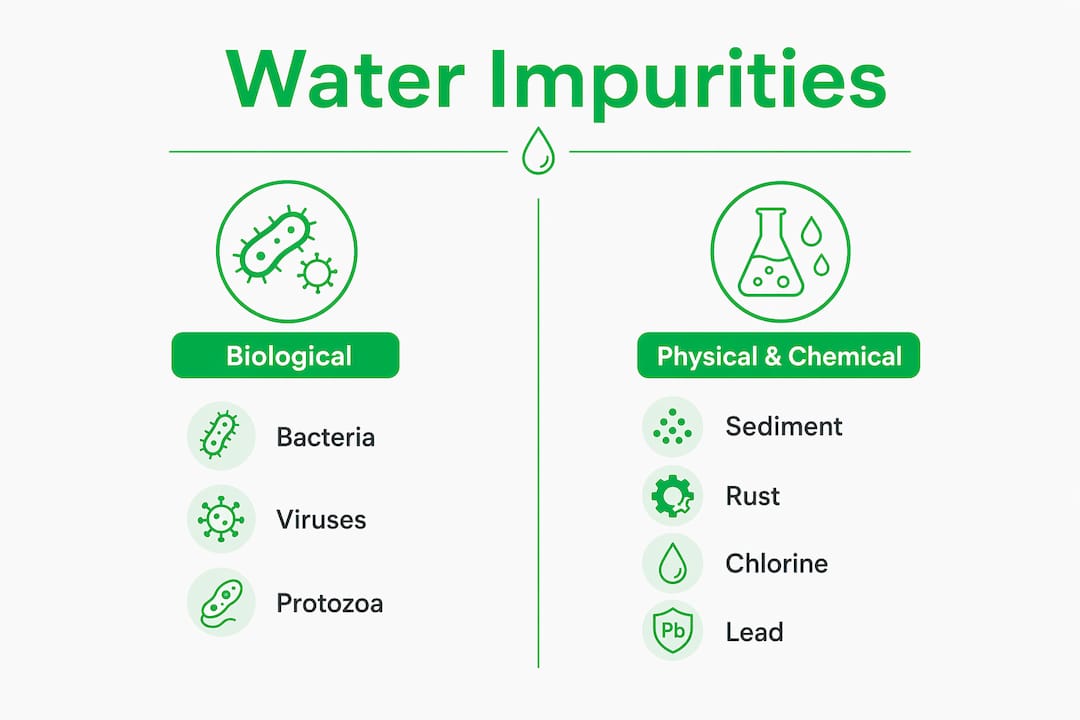
Drinking water contamination falls into three broad categories: chemical, biological, and physical. Understanding which category a contaminant belongs to helps you choose the right removal strategy.
Chemical contaminants are the most varied and often the most serious. They include:
- Lead and arsenic. Both leach from pipes, plumbing fixtures, and natural rock formations into your water supply. There is no safe level of lead exposure.
- Nitrates. Common in rural areas with agricultural runoff, nitrates can reach dangerous levels quickly, especially in private wells.
- PFAS (“forever chemicals”). These synthetic compounds resist breaking down in the environment or in the human body. PFAS appear in at least 45% of US tap water samples nationwide.
- Chlorine and chloramine. Water utilities add these intentionally to kill pathogens, but they create their own set of problems at the tap.
- Pesticides and VOCs. These seep into groundwater from farming, industrial sites, and aging infrastructure.
Biological contaminants include bacteria like E. coli, viruses such as norovirus, and protozoa like Giardia. These are more common in well water or after flooding events, but they can appear in municipal systems during infrastructure failures.
Physical contaminants are things you can sometimes see. Sediment, rust flakes from corroded pipes, and manganese deposits can make water look brown or leave stains in your sink. The EPA sets enforceable standards for over 90 contaminants to protect health across all of these categories, but that still leaves many substances without regulated limits.

Health risks from water contamination
The effects of water impurities on your body depend on which contaminants are present and at what levels. Some cause acute illness. Others build up slowly over years.
Lead is the most documented. It is a neurotoxin with no established safe exposure level. Children absorb it more readily than adults, and even low-level exposure affects brain development, attention, and IQ. Water sitting in pipes longer than six hours accumulates significantly more lead, which is why flushing cold water for 30 to 60 seconds before drinking is a standard precautionary step.
Nitrates present a fast-acting danger for infants under six months. They interfere with red blood cells’ ability to carry oxygen, causing a condition known as methemoglobinemia, or “blue baby syndrome.” Critically, boiling nitrate-contaminated water concentrates the contaminant rather than eliminating it, making it more dangerous.
PFAS are linked to kidney and testicular cancer, thyroid disease, immune suppression, and hormonal disruption with long-term exposure. Because they persist in the body and the environment, even small amounts accumulate over time.
“About 18% of children served by community water systems had at least one drinking water monitoring or reporting violation in 2023.”
Microbial contaminants cause gastrointestinal illness, ranging from mild cramping to severe dehydration, most often in people with weakened immune systems, older adults, and young children. Chlorine disinfection byproducts, which form when chlorine reacts with organic matter in water, carry their own long-term risks, including associations with bladder cancer at high cumulative exposure.
How water impurities affect your skin and hair
This is where household water quality becomes personal in a way most people do not expect. You can filter every drop you drink and still expose your skin to harmful contaminants through your daily shower.
Chlorine and chloramine dry out skin and hair by stripping away natural oils and disrupting the skin’s acid mantle. That tight, itchy feeling after a long shower is not your imagination. The disinfectants that make your tap water microbiologically safe are doing real cosmetic damage.
Hard water compounds the problem. Calcium and magnesium ions bind to soap and shampoo, reducing lather and leaving a film on your skin and scalp. Over time, this film clogs pores and contributes to dullness, dryness, and scalp irritation. People with eczema or psoriasis tend to notice flare-ups correlate directly with water hardness levels.
Metal contaminants add another layer of concern:
- Iron can cause a yellowish tint to skin and hair, and its pro-oxidant properties accelerate skin aging by generating free radicals.
- Manganese in water has been linked to scalp irritation and may contribute to hair thinning with prolonged exposure.
- Copper from corroding pipes can discolor blonde or chemically treated hair, turning it greenish.
The connection between water quality and skin conditions is increasingly recognized by dermatologists. Studies on eczema patients show that showering in filtered water significantly reduces flare frequency and severity.
Pro Tip: If your skin feels cleaner and softer when you shower at a hotel or gym, the water quality there may be genuinely different from your home supply. That difference is worth investigating.
How to test your household water quality
Most homeowners skip water testing entirely until something looks or smells wrong. That is the wrong approach, because the most dangerous contaminants give no sensory warning at all.
Here is how to approach testing in a logical sequence:
- Read your Consumer Confidence Report (CCR). Municipal water suppliers are legally required to send this annual report to customers. It lists detected contaminants and how they compare to EPA limits. You can usually find it on your utility’s website if you did not receive a paper copy.
- Look for red flags at home. Cloudy water, a bleach or sulfur smell, rust-colored staining in sinks or toilets, and a metallic taste are all signs worth acting on. These signal physical or chemical contamination you can trace to your pipes or source water.
- Buy a basic home test kit. These detect pH, hardness, chlorine, lead, bacteria, nitrates, and a few other parameters. They are useful for a quick snapshot but cannot detect PFAS, many pesticides, or VOCs.
- Commission a certified lab test. For complete peace of mind, send a sample to a state-certified lab. These tests cover dozens of contaminants, including PFAS. Your state environmental agency maintains a list of certified labs.
- Retest after any changes. New plumbing work, changes to your water source, or recent flooding all warrant a fresh test.
| Testing method | What it detects | Reliability |
|---|---|---|
| Consumer Confidence Report | Most regulated contaminants | High for municipal water |
| Home test kit | Chlorine, pH, lead, bacteria, nitrates | Moderate; limited scope |
| Certified lab test | Full contaminant panel including PFAS | Highest; recommended for wells |
Pro Tip: If you have a private well, test annually at minimum. Well water is not regulated by the EPA, so the testing responsibility falls entirely on you.
Not all water filters marketed for “water quality” effectively remove PFAS. Checking for NSF/ANSI certifications that specifically mention PFAS reduction, such as NSF/ANSI 53 or 58, is the only reliable way to know your filter is actually doing the job.
Effective methods for removing water impurities
Once you know what is in your water, removing water impurities becomes a matter of matching the right technology to the right contaminant. There is no single filter that handles everything equally well.
Activated carbon filtration
Granular activated carbon (GAC) filters remove taste and odor compounds, VOCs, and disinfection byproducts with efficiencies up to 99.9%. They work by adsorbing organic molecules onto a porous carbon surface. This makes them excellent for chlorine, chloramine, pesticides, and many synthetic organics. What they cannot do is remove heavy metals, nitrates, or dissolved solids.
Reverse osmosis
Reverse osmosis (RO) systems push water through a semi-permeable membrane that blocks nearly everything larger than a water molecule. RO reduces contaminants including nitrates, radionuclides, dissolved solids, arsenic, and many inorganic chemicals. These systems work best under your kitchen sink for drinking water. They are slow and produce wastewater, but the coverage is hard to beat.
Ion exchange
Ion exchange resins swap harmful ions for harmless ones. They are the primary technology inside water softeners, and they are also one of the recommended treatments for nitrates and PFAS when paired with the right resin type. Water softeners specifically target calcium and magnesium hardness, which benefits both your plumbing and your skin.
A few important cautions for choosing and maintaining filters:
- Replace filter cartridges on schedule. An overloaded filter can release contaminants back into the water instead of catching them.
- Matching filter type to contaminant chemistry is not optional. Using a carbon filter to address lead, or a softener to address bacteria, will not solve your problem.
- Multi-stage filtration systems that combine carbon and membrane technologies address the widest range of contaminants.
- Shower filters are a distinct category. Because you absorb chlorine and chloramine through skin and inhalation during showers, filtering at the showerhead addresses an exposure route that a kitchen filter completely misses.
My honest take on a problem most homeowners ignore
I have followed household water quality research closely for years, and the most consistent pattern I see is this: people treat water testing as an emergency response rather than a regular practice. They only test after a neighbor reports a problem, after a news story about local contamination, or after they notice a change in taste. By then, they have already had months or years of undetected exposure.
What genuinely surprises me about the skin and hair angle is how quickly people see results after filtering their shower water. They spend hundreds on serums and treatments, but no topical product can fully compensate for daily chlorine exposure stripping moisture from the skin barrier. It is the equivalent of moisturizing with one hand while drying yourself out with the other.
The other mistake I see repeatedly is over-relying on boiling. People treat it as a catch-all fix, but it only kills microbes. It concentrates nitrates. It does nothing for lead, PFAS, or chlorine. Knowing what boiling does and does not do can protect a household from a false sense of security.
My advice: start with your CCR, order a lab test if you have any doubts, and treat your shower water as seriously as your drinking water. Your skin is absorbing what your showerhead delivers every single day.
— Sara
How Vitacleanhq can help
Once you know what is coming out of your showerhead, the next step is doing something about it. Vitacleanhq’s Vitamin C shower filter shots are specifically designed to neutralize chlorine and chloramine at the point of contact, before they reach your skin and hair. The Vitamin C reaction is one of the most effective methods for eliminating these disinfectants quickly and completely. Vitacleanhq also offers ceramic filter options that target sediment and other physical contaminants. For ongoing protection without the hassle of remembering when to reorder, the filter refill plan keeps your filtration system performing at full capacity year-round.
FAQ
What are the most common impurities in tap water?
The most common include chlorine and chloramine, lead, nitrates, PFAS, hardness minerals like calcium and magnesium, and sediment. The specific mix depends on your location and plumbing.
How do water impurities affect skin and hair?
Chlorine strips natural oils from skin and hair, while hard water minerals leave a residue that clogs pores and reduces lather. Metals like iron and manganese can irritate the scalp and cause discoloration.
How do I find out what is in my household water?
Start with your utility’s annual Consumer Confidence Report for municipal water. For a full contaminant picture, including PFAS, use a state-certified lab test. Home test kits offer a basic but limited starting point.
Does boiling water remove all impurities?
No. Boiling kills microbes but does not remove lead, PFAS, or nitrates. It actually concentrates nitrates, making boiling dangerous for treating water that infants will consume.
What type of filter removes the most contaminants?
Reverse osmosis systems cover the broadest range, including dissolved solids, heavy metals, nitrates, and many organic chemicals. Pairing an RO system with a granular activated carbon stage extends coverage to VOCs and chlorine as well.