
Why Water Quality Affects Skin: What You Need to Know
TL;DR:
- Water quality significantly impacts skin health by disrupting the skin’s protective barrier through mineral buildup and chemical oxidation. Using filters like Vitamin C and ceramic options can reduce harmful substances, improving hydration and reducing irritation. Drinking adequate water helps hydrate from within, but external water chemistry is crucial for barrier repair and ongoing skin health.
Your skin reacts to the water it touches every single day, yet most skin care conversations focus entirely on products and diet. Understanding why water quality affects skin can change how you approach persistent dryness, breakouts, and irritation that no serum seems to fix. Hard water minerals, chlorine disinfectants, and chemical byproducts in tap water all interact with your skin’s protective barrier in ways that are measurable and often overlooked. What follows is a clear breakdown of the science, the symptoms, and what you can actually do about it.
Table of Contents
- Key takeaways
- Why water quality affects skin at the barrier level
- Drinking water and skin hydration: what the research actually says
- Signs your skin problems are linked to water quality
- Practical strategies to protect your skin from poor water quality
- My perspective: stop blaming your products first
- How Vitacleanhq can help you take action
- FAQ
Key takeaways
| Point | Details |
|---|---|
| Hard water damages your barrier | Calcium and magnesium minerals react with soap to leave residue that strips and irritates your skin daily. |
| Chlorine amplifies moisture loss | Oxidizing disinfectants in tap water accelerate transepidermal water loss and weaken skin lipid structure. |
| Drinking water has limits | Increased water intake improves skin hydration mainly when correcting a dehydration deficit, not when barrier damage is the root cause. |
| Symptoms are recognizable | Tight, itchy skin after showering and persistent dryness are reliable signals that water chemistry may be the culprit. |
| Filters offer real protection | Vitamin C and ceramic shower filters reduce chlorine and mineral contact, giving your skin’s barrier a genuine chance to recover. |
Why water quality affects skin at the barrier level
Your skin’s outermost layer, the stratum corneum, acts as a physical shield. It holds moisture in and keeps irritants out. What damages it most is not always what you put on your skin. Often, it is what you wash with.
Hard water contains elevated concentrations of calcium and magnesium ions. When these minerals mix with soap or cleanser, they form insoluble compounds that do not rinse away cleanly. The result is a thin, alkaline film left on the skin surface after every shower. Hard water mineral residue causes dryness, tightness, and increased barrier sensitivity with repeated exposure. That is not a product problem. That is a water chemistry problem.
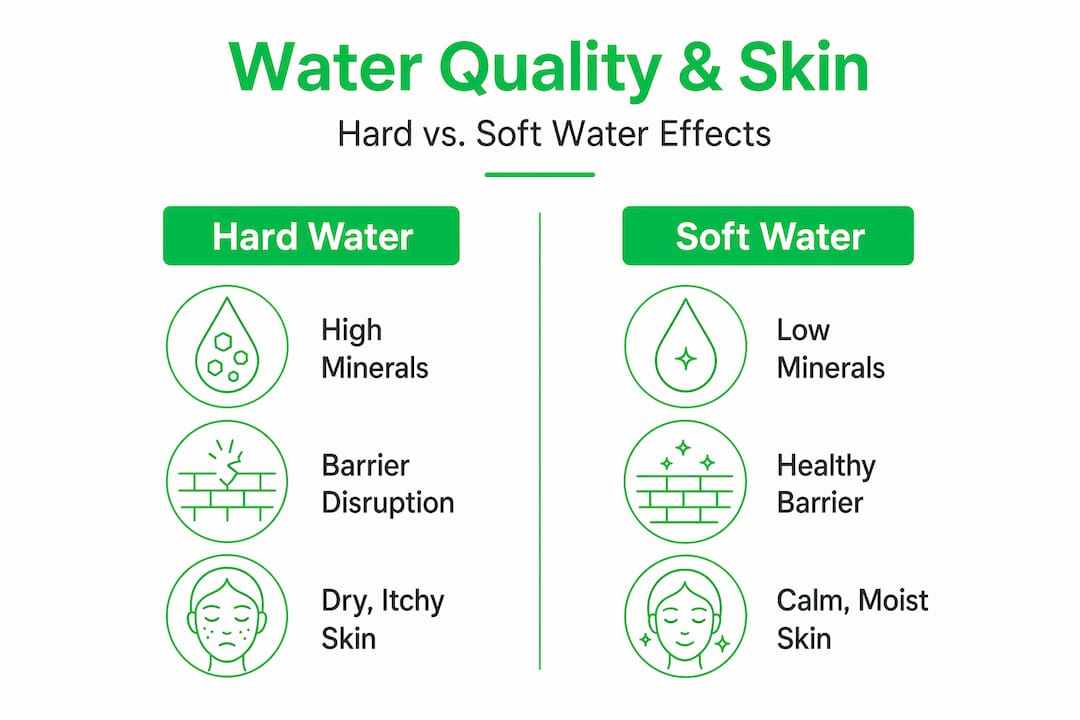
Chlorine compounds work differently but cause equally real damage. Municipal water suppliers use chlorine and chloramines to kill pathogens, which is necessary for safe drinking water. But those same disinfectants are oxidizing agents. When they contact skin during a shower, chlorinated water increases TEWL (transepidermal water loss) and degrades the lipid matrix that seals moisture inside your skin cells.
Here is how the damage unfolds at the surface level:
- Acid mantle disruption: Healthy skin has a slightly acidic pH between 4.5 and 5.5. Hard water and chlorinated tap water are both more alkaline, pulling skin pH upward and destabilizing the barrier environment where beneficial bacteria thrive.
- Lipid oxidation: Chlorine oxidizes skin lipid proteins, breaking down the structural fats that hold skin cells together and increasing fragility over time.
- Soap scum formation: Hard water minerals interact with cleansing surfactants, preventing complete soap rinsing and leaving residue that continuously stresses the barrier after you step out of the shower.
- TEWL acceleration: Once the barrier is compromised, water escapes the skin faster than it can be replenished through normal cellular processes.
The difference between soft and hard water is not subtle over time. People who move from soft water regions to hard water areas frequently report new skin problems within weeks. That timeline is not coincidence.
| Water type | Mineral content | Barrier effect | Common skin outcome |
|---|---|---|---|
| Soft water | Low calcium/magnesium | Minimal disruption | Better hydration, less irritation |
| Hard water | High calcium/magnesium | Residue buildup, pH disruption | Dryness, tightness, eczema flares |
| Chlorinated tap water | Chlorine/chloramine | Lipid oxidation, TEWL increase | Irritation, sensitivity, dehydration |
| Filtered water | Reduced minerals and chemicals | Barrier-protective | Improved hydration and comfort |
Pro Tip: If you travel frequently and notice your skin behaves differently in different cities, water hardness is likely a contributing factor. Check your destination’s water hardness index before assuming a new product is causing the change.
Drinking water and skin hydration: what the research actually says
There is a widespread belief that drinking more water solves dry or dull skin. The reality is more nuanced and worth understanding clearly.
Your skin receives moisture through the bloodstream, not directly from the water you drink. Once absorbed in the gut, water travels through the circulatory system and reaches skin cells via aquaporin channels, specialized proteins that regulate water transport across cell membranes. Skin is one of the last organs to receive hydration from blood, which means systemic dehydration shows up on your face only after your kidneys, muscles, and brain have already taken priority.
Drinking an extra 2 liters daily significantly increased both superficial and deep skin hydration in women with low baseline water intake. That is a real finding. But the study population matters: women who were already adequately hydrated showed far smaller benefits. Drinking water improves skin primarily when you are correcting a hydration deficit, not when you are already drinking enough.
“Water affects skin through two separate pathways: internal hydration via drinking, and external exposure via bathing water chemistry. These must be addressed distinctly.” — Preventive Medicine Daily
This distinction matters practically. If your skin is dry and tight despite drinking plenty of water, the problem almost certainly lives at the external exposure level, not your hydration intake. No amount of extra glasses of water will repair a skin barrier that is being degraded by minerals and oxidizing chemicals every time you shower.
What systemic hydration does support:
- Maintaining skin elasticity and density through adequate cellular water volume
- Supporting skin cell turnover and repair processes
- Reducing the appearance of fine lines that worsen under dehydration conditions
- Keeping mucous membranes and sebaceous function regulated
The importance of clean water for skin applies on both fronts. Drink enough of it, yes. But also pay attention to what is in the water touching your skin from the outside.
Signs your skin problems are linked to water quality
Most people blame their moisturizer or cleanser first. Water chemistry is rarely the first suspect. But there are clear patterns that point directly to the impact of water on skin when you know what to look for.
Here is a step-by-step way to assess whether water quality is behind your skin problems:
- Notice the timing. Does your skin feel tight, dry, or itchy specifically after showering rather than throughout the day? Barrier compromise from chlorine and hard water intensifies irritation and moisture loss immediately after bathing. That post-shower tightness is a direct signal.
- Check for a filmy or residue feeling. If your skin feels like it was not fully rinsed clean, even after thorough washing, that is often hard water soap scum. The minerals prevent surfactants from rinsing properly, leaving a coating behind.
- Track flare patterns with your water exposure. Hard water exposure correlates with eczema and psoriasis flare frequency. If your eczema worsens after a string of showers but improves during travel, water hardness at home may be the trigger.
- Consider your genetics. People with filaggrin gene mutations, which reduce the skin’s natural structural protein, have greater barrier fragility and higher sensitivity to hard water irritants. If you have a family history of eczema or atopic dermatitis, water quality deserves extra attention.
- Run a temporary filter or bottled water trial. Temporarily switching to softened or filtered water can reveal whether water chemistry is the source of irritation. If your skin improves within one to two weeks of switching shower water, you have your answer without needing a dermatologist visit.
Water pollution and skin issues extend beyond hard water and chlorine. Some regions have tap water with elevated heavy metals, agricultural runoff, or disinfection byproducts that can also contribute to skin sensitivity and breakouts. Can water quality cause acne? Yes, when mineral buildup or residue clogs pores or disrupts the skin environment that allows acne bacteria to thrive.
Pro Tip: Buy an inexpensive hard water test strip to check your tap water at home. Most hardware stores carry them. Knowing your water hardness number gives you a concrete baseline for understanding your skin’s external environment.

Practical strategies to protect your skin from poor water quality
You do not need to move cities to solve a water quality problem. There are several approaches that work, ranging from low-effort habit changes to longer-term solutions.
Adjust your shower habits first
Keep showers short and use lukewarm water rather than hot. Hot water strips natural oils faster and increases the penetration of chlorine into skin. Rinse thoroughly to remove as much residue as possible. Pat dry rather than rubbing, and apply moisturizer within three minutes of stepping out while skin is still slightly damp.
Choose cleansers that work against mineral interference
Standard bar soaps react worst with hard water minerals. Switching to a pH-balanced liquid cleanser or a soap-free formula significantly reduces residue formation. Syndet bars (synthetic detergent bars) are formulated to rinse cleanly in hard water and are a good middle ground.
Rebuild the barrier with the right moisturizer
Humectants, emollients, and occlusives work as a three-layer system: humectants like hyaluronic acid draw water in, emollients like ceramides fill structural gaps in the barrier, and occlusives like petrolatum seal everything in. Using all three is the standard of care when barrier damage from water quality is ongoing.
Install a shower filter for lasting protection
Here is where filtered water transforms skincare in a measurable way. Vitamin C filter cartridges neutralize chlorine and chloramines on contact through a chemical reduction reaction. Ceramic ball filters address mineral load and microbial content. Softened or filtered water consistently shows improvement in skin hydration and reduced dryness in user studies.
| Solution | Targets | Effort level | Best for |
|---|---|---|---|
| Vitamin C shower filter | Chlorine, chloramines | Low, replaceable cartridges | Daily chlorine protection |
| Ceramic ball filter | Minerals, bacteria | Low, long-lasting | Hard water and microbial load |
| Water softener system | Calcium, magnesium at source | Medium, whole-house | Severe hard water households |
| pH-balanced cleanser | Soap-mineral residue | Very low | Immediate barrier support |
| Prompt moisturizing | Barrier repair after exposure | Very low | Daily maintenance |
For eczema-prone individuals, altering water hardness can reduce barrier irritation, particularly during vulnerable periods. It is not a cure for eczema, but it removes a consistent aggravator from the equation.
My perspective: stop blaming your products first
I have spent years looking at the intersection of everyday habits and skin health, and the pattern I see most often is this: people spend hundreds of dollars trying new moisturizers, serums, and cleansers for skin that never seems to improve. What they have not done is look at the water.
The conventional advice to “drink more water for better skin” is not wrong, but it is incomplete to the point of being misleading for people with barrier issues. I have seen readers document remarkable improvements simply by addressing their shower water chemistry. Not a new retinol. Not a change in diet. A filter and a gentle cleanser.
What frustrates me is the tendency to treat water as a neutral background variable. It is not. Every shower deposits minerals and oxidizing agents on skin that was already fighting to stay intact. And if you have a genetic predisposition toward barrier fragility, that daily exposure is not a minor inconvenience. It is a chronic stressor.
My honest take: if your skin trouble persists despite a solid routine, test your water hardness before you buy anything else. It is a $5 test strip that could save you months of frustration and trial-and-error product spending. Integrate barrier-aware products and address the water source simultaneously. That combination works. Each in isolation often does not.
— Sara
How Vitacleanhq can help you take action
If the chemistry of your shower water is working against your skin, changing products alone will not get you there. Vitacleanhq was built specifically for this problem.
Vitacleanhq’s Vitamin C shower filter shots neutralize chlorine and chloramines on contact, protecting your skin’s lipid barrier from oxidative damage with every shower. The ceramic filter options target mineral content and microbial load for households dealing with hard water. Both systems are designed for easy installation and simple cartridge replacement, so you stay protected without any technical fuss. For sensitive skin, eczema-prone skin, or anyone who has tried everything and still struggles, addressing the water itself is the logical and evidence-based next step.
FAQ
What does hard water actually do to your skin?
Hard water leaves calcium and magnesium residue on skin after showering, disrupting the moisture barrier and causing dryness, tightness, and increased sensitivity. Repeated exposure can worsen conditions like eczema and psoriasis.
Can water quality cause acne or breakouts?
Yes. Mineral and soap residue from hard water can clog pores and alter the skin’s surface environment, potentially promoting acne-causing bacteria. Chlorine can also disrupt the skin’s natural microbiome balance.
Does drinking more water fix dry skin?
Drinking water helps skin hydration mainly when you are correcting a genuine dehydration deficit. If you already drink adequate water, extra intake has limited visible effect, especially when external barrier damage from hard or chlorinated water is the real cause.
How do I know if hard water is causing my skin problems?
The clearest signs are tight or itchy skin immediately after showering, a filmy feeling after washing, and skin conditions that flare at home but improve during travel. Using filtered or bottled water for two weeks is a simple diagnostic test.
What is the best water for skin health during showers?
Soft or filtered water that has been treated to reduce chlorine, chloramines, and mineral content causes significantly less barrier disruption. Vitamin C shower filters and ceramic filters are two practical options for improving shower water quality without a whole-house system.