
How filtered water transforms your skincare routine (2026)
TL;DR:
- Hard water and chlorine damage skin and hair by stripping oils and disrupting the microbiome.
- Using filtered water with specific filters improves hydration and reduces irritation.
- Proper filtration is a simple, effective step to enhance skincare and hair health.
You spend real money on serums, moisturizers, and cleansers, yet your skin still feels tight after every shower. Your hair looks dull no matter which conditioner you try. The culprit is often hiding in plain sight: the water itself. Hard water and chlorine strip natural oils, disrupt your skin’s protective barrier, and leave mineral deposits that block even the best skincare products from doing their job. Switching to filtered water is one of the simplest, most overlooked upgrades you can make for sensitive skin and hair.
Table of Contents
- How tap water affects sensitive skin and hair
- What is filtered water, and what does it remove?
- Benefits of filtered water in your skincare routine
- Filtered water vs. other solutions: Which approach is right for you?
- Our perspective: Why water quality is the real skin and hair game-changer
- Ready for visibly healthier skin and hair? Start with filtered water
- Frequently asked questions
Key Takeaways
| Point | Details |
|---|---|
| Invisible irritants matter | Chlorine, heavy metals, and hard minerals in tap water can silently sabotage sensitive skin and hair. |
| Filtration brings real benefits | Switching to filtered water often leads to less dryness, reduced irritation, and better results from your products. |
| No one-size-fits-all | For most, a quality shower filter is enough, but those with severe hard water may need a softener for best results. |
| Start simple | The easiest step to healthier skin and hair is trying a filtration solution matched to your water type. |
How tap water affects sensitive skin and hair
Most people never question what’s actually coming out of their showerhead. But tap water is far from pure, and for anyone with sensitive skin, the contents matter a great deal.
The three main offenders are chlorine, heavy metals, and hard water minerals. Water treatment facilities add chlorine to kill bacteria, which is great for safety but rough on skin. Chlorine strips away your skin’s natural oils and throws off the delicate balance of your skin microbiome, the ecosystem of beneficial bacteria that keeps your barrier strong. Heavy metals like lead and copper can show up in older plumbing and create low-grade irritation over time.
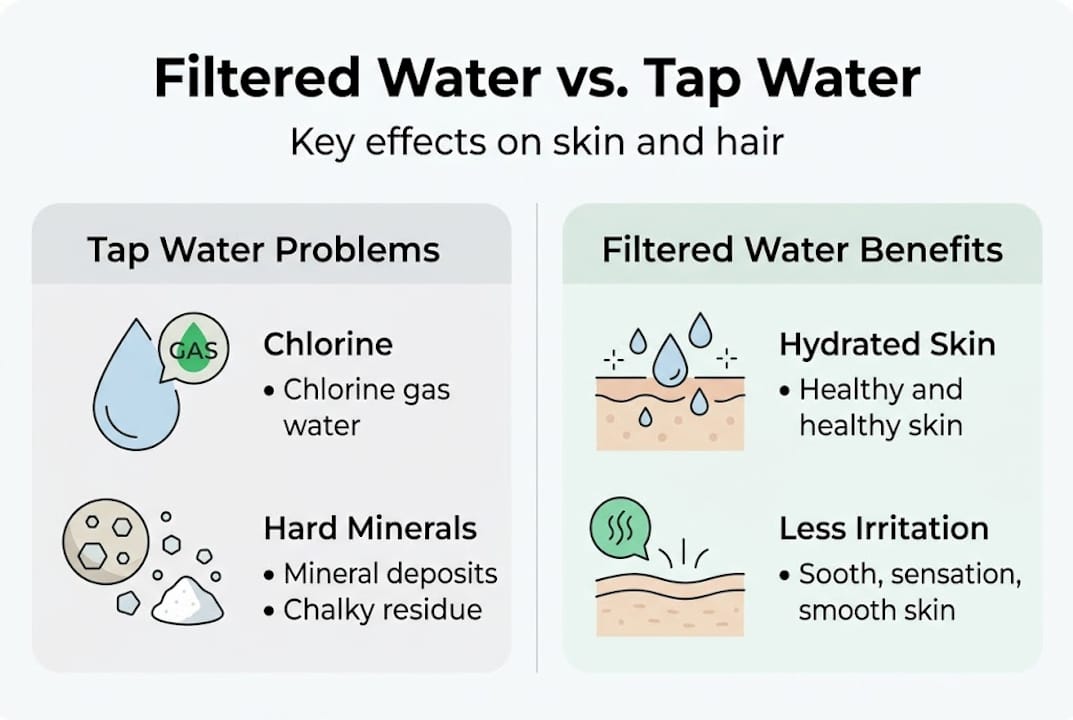
Hard water is the most widespread issue. It contains high levels of calcium and magnesium, which don’t rinse cleanly from skin or hair. They leave behind a film that raises your skin’s pH, making it more alkaline than it should be. Your skin barrier functions best at a slightly acidic pH of around 4.5 to 5.5. Push it higher and you get dryness, flakiness, and a compromised barrier that lets irritants in.
Here’s what hard water minerals and chlorine can do to sensitive skin:
- Strip the skin’s natural lipid (oil) layer, causing dryness and tightness
- Disrupt the skin microbiome, making the barrier weaker
- Leave calcium and magnesium residue that blocks skincare absorption
- Raise skin pH, triggering sensitivity and inflammation
- Worsen existing conditions like eczema, psoriasis, and acne
- Leave hair feeling rough and looking flat due to mineral buildup
The numbers are striking. Every 50mg/L increase in water hardness (measured as CaCO3) raises psoriasis risk by 3%, and very hard water raises that risk by 20% compared to soft water areas. The same research links hard water to higher eczema prevalence in adults.
Understanding the shower filter benefits starts with recognizing that what you wash with shapes your skin just as much as what you apply to it. And if you want to understand why filtered water for hair is gaining so much attention, the mineral buildup story is exactly why.
What is filtered water, and what does it remove?
Understanding why tap water causes issues sets the stage for the real solution: proper filtration.
Filtered water simply means water that has passed through a system designed to remove specific contaminants before it reaches your skin. There are several filter types, each working differently and targeting different substances.
Mechanical filters trap particles and sediment through a physical barrier. Activated carbon filters use a porous carbon material to absorb chlorine, chloramines, and some volatile organic compounds. Vitamin C filters neutralize chlorine and chloramines through a chemical reaction, making them especially effective in the shower where contact time is short. Ceramic filters use natural ceramic media, often combined with other materials, to reduce bacteria, sediment, and some metals. Reverse osmosis (RO) forces water through a semi-permeable membrane, removing nearly everything including minerals.
Here’s a quick breakdown of what each filter type removes:
- Activated carbon: Chlorine, chloramines, some heavy metals, sediment
- Vitamin C: Chlorine and chloramines (highly effective, fast-acting)
- Ceramic: Bacteria, sediment, some heavy metals
- Reverse osmosis: Chlorine, heavy metals, most minerals, and many contaminants
| Filter type | Chlorine removal | Heavy metals | Hard water minerals |
|---|---|---|---|
| Activated carbon | High | Moderate | Low |
| Vitamin C | Very high | None | None |
| Ceramic | Moderate | Moderate | Low |
| Reverse osmosis | Very high | High | High |
As the research on hard water effects on hair confirms, chlorine dries skin by stripping oils and disrupting the microbiome, while hard minerals leave residue that interferes with skincare absorption and raises pH. Knowing which problem you’re solving helps you pick the right filter.
Pro Tip: Not all filters address water hardness. If you’re in a hard water area, a Vitamin C or carbon filter will improve chlorine-related irritation, but you may also need a water softener for the full mineral picture. Check your local water quality report first.
For a deeper look at how water quality connects to daily skincare outcomes, the water quality and skin health guide is a solid next read.
Benefits of filtered water in your skincare routine
Now that you know what filtered water removes, here’s how it translates into real results you can see and feel.
The most immediate change most people notice is less tightness and dryness after showering. Without chlorine stripping your oils and minerals blocking your barrier, your skin retains moisture far more effectively. That means your moisturizer actually penetrates instead of sitting on top of a mineral film.
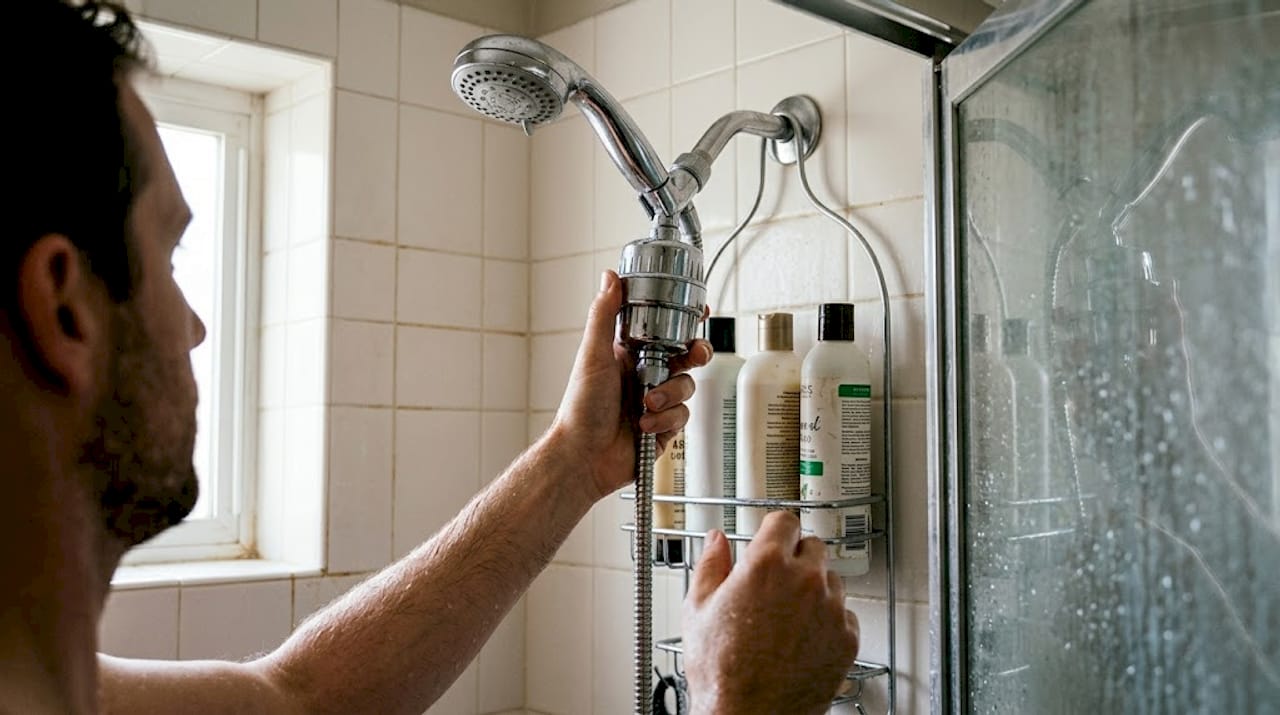
| Outcome | Unfiltered water | Filtered water |
|---|---|---|
| Post-shower dryness | Common | Significantly reduced |
| Skincare absorption | Blocked by mineral film | Improved |
| Eczema or rosacea flares | Frequent | Less frequent |
| Hair texture | Rough, dull | Softer, shinier |
| Scalp irritation | Persistent | Reduced |
Here are the core benefits in the order most people experience them:
- Reduced dryness and itchiness within the first week, especially post-shower
- Better product absorption as the mineral film barrier disappears
- Fewer flare-ups for eczema, rosacea, and acne-prone skin
- Improved hair texture as buildup clears from strands and scalp
- A calmer scalp with less flaking and irritation over time
Clinically tested filters show improved skin hydration within two weeks for users with acne, eczema, and rosacea. That timeline is consistent with what many users report after making the switch.
Pro Tip: If you have severe, active flares, RO or distilled water works well short-term to give your skin a break from all minerals. Just don’t use it exclusively long-term, as it can strip beneficial trace minerals your skin barrier actually needs.
Real experiences back up what the research shows. Reading about a shower head filter transformation gives you a sense of what a simple swap can do. For hair specifically, the filtered water for hair benefits are well documented and often the first thing people notice.
It’s also worth knowing that hard water’s effects reach beyond skin, influencing everything from how your soap lathers to how clean your clothes get.
Filtered water vs. other solutions: Which approach is right for you?
You might wonder if filtered water alone is enough, or if other strategies make more sense for your situation.
There are three main approaches most people consider: shower filters, whole-house water softeners, and high-end skincare products. Each has its place, and the right choice depends on your water and your symptoms.
- Shower filters: Affordable, easy to install, renter-friendly. Great for chlorine removal and reducing skin irritation. Limited impact on heavy mineral content in very hard water areas.
- Whole-house water softeners: Highly effective at removing calcium and magnesium. Higher upfront cost ($800 to $2,500+), requires installation, and uses salt. Best for persistent hard water problems throughout the home.
- Product-only routines: Barrier creams, pH-balancing toners, and hydrating serums can compensate partially, but they fight an uphill battle if you’re washing with harsh water twice a day.
“For most sensitive skin and hair, filtration offers noticeable benefit, but severe cases may need a water softener to fully address hard water exposure.”
While there are no robust randomized trials specifically on shower filters, dermatologist consensus supports filtration for sensitive skin, with water softeners recommended for severe hard water situations.
Filters are not a cure-all. They work best when combined with a consistent skincare routine suited to your skin type. Think of filtration as removing a major obstacle, not replacing the rest of your routine. You can explore practical shower filtration steps to see how it fits into your daily habits, or read up on what water softening involves if your water is particularly hard. For a structured overview, the hard water solutions checklist breaks down your options clearly.
Our perspective: Why water quality is the real skin and hair game-changer
Here’s what we’ve observed after working with hundreds of customers dealing with persistent skin and hair struggles: most of them had already tried everything on the product side. Different cleansers, more expensive serums, dermatologist-recommended creams. Many got partial results at best.
Water touches your skin and hair every single day, often twice. No serum does that. And yet it’s almost never part of the conversation when people troubleshoot their skincare routines. That’s a real blind spot.
The hard-won lesson is simple. Persistent improvement tends to come from addressing what your skin is exposed to routinely, not from chasing the next breakthrough product. When you remove a daily irritant, your skin finally gets the chance to behave the way it’s supposed to.
If you’re serious about your skin and hair, consider making the case to invest in water filters before reaching for another high-priced cream.
Pro Tip: Test your tap water. Many people are genuinely surprised by their hardness level. Free test kits are available online, and your municipality is required to publish annual water quality reports.
Ready for visibly healthier skin and hair? Start with filtered water
If the science resonates, the next step is straightforward. Swap out your current showerhead for one that actually works for your skin and hair, not against them.
Vitaclean’s Vitamin C shower filters neutralize chlorine on contact, making them one of the fastest-acting options for sensitive skin. If you want broader protection, the ceramic shower filter adds another layer by reducing sediment and bacteria. Both are easy to install and designed to work in standard shower setups without tools or a plumber. Explore the full range of filtered shower heads and find the fit for your routine, your bathroom, and your skin type. The research is clear, the technology is proven, and the upgrade is simpler than you’d expect.
Frequently asked questions
Can using filtered water really help with acne or eczema?
Yes. Hard water raises eczema prevalence and is linked to higher psoriasis risk, while clinical evidence supports improved skin hydration after filter use in as little as two weeks.
Do shower filters remove all hard water minerals?
Most shower filters target chlorine effectively but have limited impact on calcium and magnesium. For significant mineral removal from hard water, a whole-house water softener is typically more effective.
How soon will I notice improvements after switching to filtered water?
Many users with sensitive skin, eczema, or rosacea notice reduced dryness and fewer flare-ups within one to two weeks, consistent with clinical findings on improved hydration after filtration.
Is filtered water better for hair health too?
Filtered water reduces mineral buildup and dryness on the scalp and strands. Research shows no direct link to hair loss prevention, but texture, softness, and scalp comfort often improve noticeably.
Are there risks to using RO or distilled water long-term for skin and hair?
RO and distilled water are useful for short-term relief during severe flares, but long-term exclusive use may strip trace minerals that support a healthy skin barrier, so they’re best used sparingly.
Recommended
- Can a Shower Filter Help Acne-Prone Skin? A Science-Backed Deep Dive
- Multi-stage water filtration: better skin & hair in 2026
- How Shower Filters Improve Skin Hydration: Complete Guide
- 2026 Shower Filtration Trends for Healthier Skin and Hair
- How to Boost Beauty With Collagen for Radiant Skin Naturally