
Showerhead build-up: impact on wellness and how to manage it
TL;DR:
- Showerhead build-up includes mineral deposits and biofilm that can affect health and performance.
- Hard water and warmth promote mineral accumulation and bacterial biofilm formation inside showerheads.
- Regular cleaning, thermal disinfection, and water filtration help prevent build-up and maintain shower hygiene.
Your bathroom might look spotless, but inside your showerhead, something invisible could be affecting your skin, hair, and health every single day. Showerhead build-up forms quietly, without any obvious warning signs, until your water pressure drops or your skin starts feeling drier than usual. Mineral deposits and bacterial biofilms are the two main culprits, and most people never think to check. This guide covers what build-up actually is, what causes it, how it affects your wellness, and exactly what you can do about it.
Table of Contents
- What is build-up in showerheads?
- What causes showerhead build-up?
- How does build-up impact your shower and your wellness?
- Detection and prevention: How to keep your shower safe and clean
- A fresh perspective on showerhead hygiene: What most guides miss
- Upgrade your shower experience for healthier hair and skin
- Frequently asked questions
Key Takeaways
| Point | Details |
|---|---|
| Mineral and biofilm issues | Both limescale and bacterial layers can build up in showerheads, affecting water quality and maintenance. |
| Health and beauty impact | Build-up may reduce water flow, worsen skin and hair condition, and expose users to potentially harmful bacteria. |
| Routine cleaning matters | Cleaning frequency should match your water hardness level to keep your shower clean and safe. |
| Filters boost defense | Using shower filters reduces build-up but works best alongside regular hygiene practices. |
What is build-up in showerheads?
Now that you know build-up can lurk out of sight, let’s define exactly what it is and why it forms.
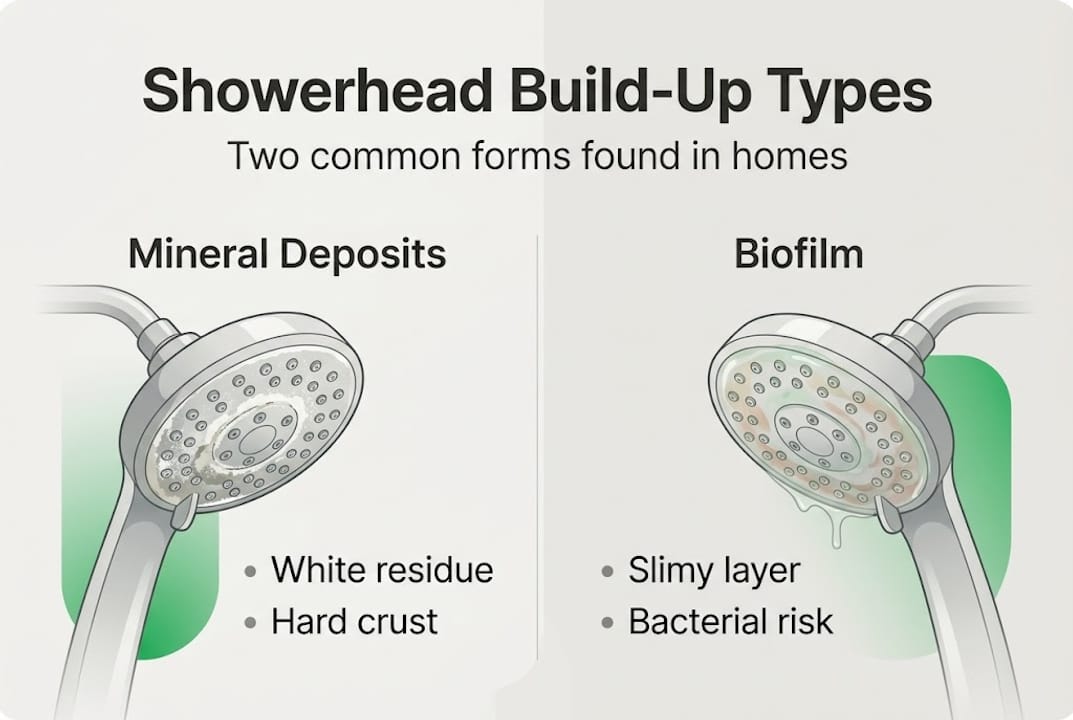
Showerhead build-up comes in two distinct forms: mineral deposits and biofilm. Mineral deposits are the chalky, white or yellowish crust you might notice around nozzles or on the showerhead face. They form when calcium and magnesium in your tap water are left behind after the water evaporates or heats up. Biofilm is something different and frankly more concerning. It’s a thin, slimy layer of bacteria and other microorganisms that attach to wet surfaces and multiply over time.
The shower head filter benefits go beyond just better-smelling water. Filtration actually reduces the mineral load entering your showerhead in the first place, which slows both mineral and biofilm accumulation significantly.
| Feature | Mineral build-up | Biofilm |
|---|---|---|
| Appearance | White, chalky, crusty | Slimy, thin, often pinkish or gray |
| Source | Hard water (calcium, magnesium) | Bacteria, fungi, organic matter |
| Health relevance | Skin and hair irritation | Potential bacterial exposure |
| Ease of removal | Dissolves with vinegar | Requires mechanical scrubbing or heat |
Signs your showerhead may have build-up:
- Noticeably weaker water flow than before
- White or yellow crusty spots on nozzles
- Slimy or slippery texture on the showerhead body
- Uneven or misdirected spray pattern
- A slightly musty smell from the water
Research shows that biofilms colonize over a third of household showerheads, and bacterial cell counts can reach up to 100 million cells per square centimeter. That’s not a small number.
Understanding hard water and hair condition also helps clarify why mineral deposits do more than just clog your showerhead. The same minerals that crust over your nozzles coat your hair strands and scalp with every shower.
What causes showerhead build-up?
Having defined build-up, it’s important to understand exactly how it develops in your showerhead.
Mineral build-up starts at the water source. If your home receives hard water, which is water with elevated calcium and magnesium concentrations, those dissolved minerals travel through your pipes and into your showerhead every single day. When water heats up or evaporates inside the showerhead, the minerals precipitate out of solution and stick to the internal surfaces. Over time, those thin layers accumulate into visible scale.
Hard water over 120 mg/L CaCO3 causes especially rapid mineral deposits, and this effect is even more pronounced in warmer climates where water temperature inside pipes tends to run higher. Water that sits stagnant inside the showerhead overnight also leaves behind concentrated deposits.
Biofilm formation follows a different but related path. Moisture and warmth create the ideal environment for bacteria to attach to showerhead surfaces. Once a few bacterial cells anchor themselves to a surface, they secrete a protective gel-like coating and begin reproducing. This structure, the biofilm, becomes increasingly difficult to remove over time.
The benefits of shower filters include reducing the mineral content of incoming water, which directly lowers the rate at which scale accumulates and gives biofilm fewer rough surfaces to cling to.
How build-up forms step by step:
- Hard water enters your home from the municipal supply or a well
- Water flows through pipes and into the showerhead, carrying dissolved minerals
- Heat and evaporation cause minerals to crystallize and stick to interior surfaces
- Rough mineral deposits create ideal anchor points for bacteria
- Bacteria form a protective biofilm layer, trapping more particles over time
- Flow becomes restricted, spray becomes uneven, and contamination risk rises
| Water type | Hardness (mg/L) | Expected build-up rate | Suggested cleaning frequency |
|---|---|---|---|
| Soft water | 0 to 60 | Minimal | Every 12 weeks |
| Moderately hard | 61 to 120 | Moderate | Every 4 to 6 weeks |
| Hard water | 121 to 180 | Significant | Every 4 weeks |
| Very hard water | Over 180 | Rapid | Weekly |
Pro Tip: If you live in a hard water area, clean your showerhead monthly at minimum. Even a quick soak in white vinegar overnight makes a visible difference in flow and nozzle clarity.
How does build-up impact your shower and your wellness?
Understanding the sources of build-up highlights why it shouldn’t be ignored. Here’s what it means for you and your home.
The performance impact is immediate and measurable. Severe build-up can cut shower flow by up to 40%, and biofilms are present in roughly 60% of showerheads that haven’t been cleaned regularly. Less pressure means less rinsing power, which leaves shampoo, conditioner, and soap residue on your skin and hair longer.
Mineral residue has its own direct effect. The same calcium and magnesium that crust over your showerhead nozzles deposit onto your skin and hair during every shower. This can disrupt your skin’s natural moisture barrier, leaving it feeling tight, itchy, or rough. For people already managing eczema or sensitive skin, these mineral residues add an extra layer of irritation.
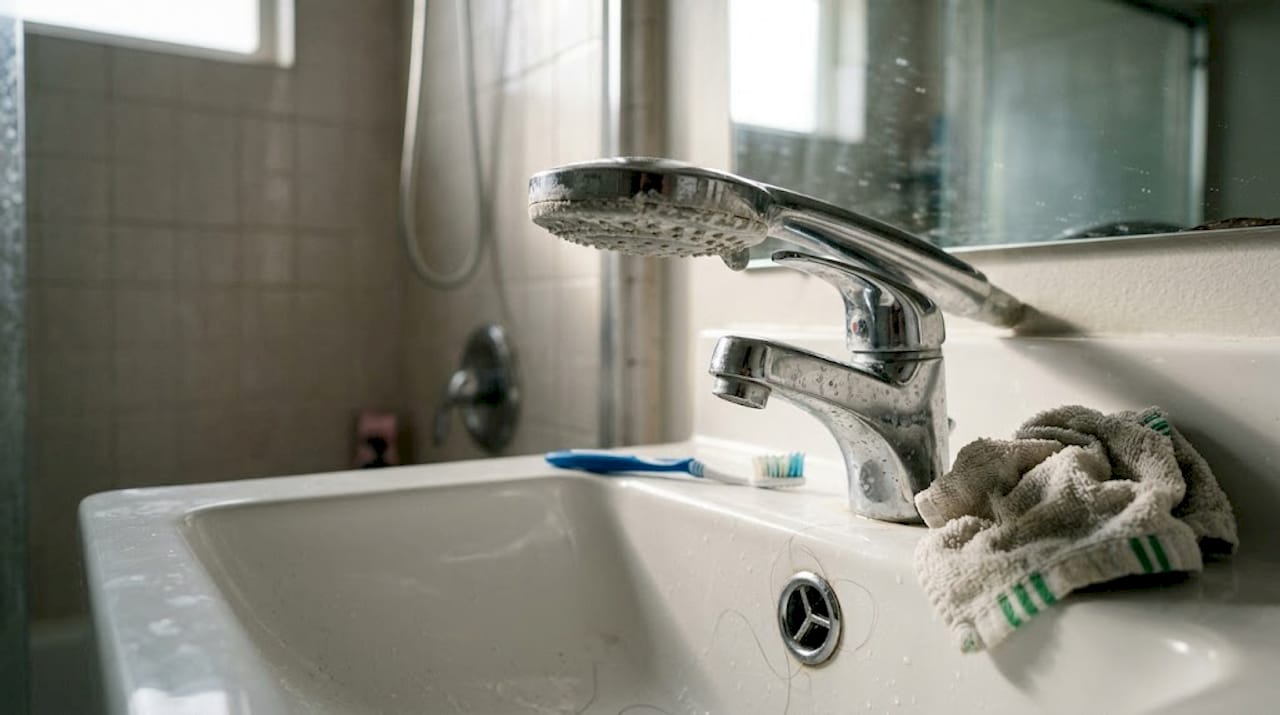
The contaminants’ effects on skin and hair are well documented, and build-up essentially concentrates those effects by reducing filtration efficiency and exposing you to more residue per shower.
Biofilm introduces a different category of concern. When you shower, water aerosolizes, meaning it turns into a fine mist that you inhale. If that mist passes through a biofilm-coated showerhead, it can carry bacteria directly into your respiratory system. For most healthy adults, this poses a low risk. For immunocompromised individuals, the elderly, or those with respiratory conditions, the risk is meaningfully higher.
Common wellness impacts of showerhead build-up:
- Dry, flaky, or irritated skin after showering
- Dull, brittle hair with reduced shine
- Itchy or flaking scalp
- Respiratory irritation, especially in enclosed bathrooms
- Potential exposure to bacteria including Legionella and Mycobacterium
The effects of hard water on hair include breakage and color fading, both of which are made worse when a build-up-clogged showerhead reduces the rinsing effectiveness you rely on.
Pro Tip: If you or someone in your household is immunocompromised, let the shower run for at least 30 seconds before stepping in. This flushes stagnant water and reduces the concentration of microbes from overnight biofilm activity.
Detection and prevention: How to keep your shower safe and clean
Given the real risks and annoyances build-up causes, here’s how you can keep your showerhead and your skin and hair protected.
Detecting build-up is straightforward once you know what to look for. Run your finger across the nozzle tips. If they feel rough, crusty, or coated in a slippery film, build-up is already present. Check your water pressure against what it felt like when the showerhead was new. A noticeable drop is a reliable signal.
Step-by-step routine for removing build-up:
- Remove the showerhead if possible, or tie a bag of white vinegar around it overnight
- Submerge the showerhead in undiluted white vinegar for 6 to 8 hours to dissolve mineral scale
- Scrub nozzles with an old toothbrush, focusing on any remaining chalky residue
- Rinse thoroughly with hot water to flush loosened deposits
- For biofilm, use thermal disinfection by running the hottest water your system allows for several minutes
- Allow the showerhead to dry partially before reinstalling to discourage immediate microbial regrowth
Cleaning frequency depends on your water hardness. In very hard water over 180 mg/L, clean weekly. In soft water at 0 to 60 mg/L, every 12 weeks is sufficient. The same research confirms that vapor and thermal disinfection outperform chlorine-based cleaners for eliminating biofilm in showerheads.
Filtration is where long-term prevention really begins. Using filter cartridges for clean showers reduces the mineral load in your water before it ever reaches the showerhead interior. Less mineral content means slower scale formation and fewer anchor points for bacteria. You can also check protecting skin and hair from build-up for a deeper look at how filtration works in your daily routine.
Ongoing maintenance tips:
- Clean monthly if you live in a hard water area
- Replace filter cartridges on schedule to maintain filtration performance
- Flush the showerhead for 30 seconds each morning if it sits unused overnight
- Address any blocked shower drain issues promptly, since standing water accelerates biofilm growth
- Dry the showerhead exterior after use to reduce moisture exposure
Pro Tip: Thermal disinfection, running near-boiling water through the showerhead for a few minutes, is study-backed as the most effective method for disrupting established biofilms without damaging your fixtures.
A fresh perspective on showerhead hygiene: What most guides miss
Now that you have clear, practical strategies, here’s a holistic perspective on why next-level showerhead hygiene matters.
Most cleaning guides treat build-up as an aesthetic problem. The focus is almost always on white stains, low pressure, and how the showerhead looks. That framing misses the real issue entirely. Limescale by itself is not a health hazard. It’s annoying, and it damages hair and skin over time, but it won’t make you sick. What it does do is create the ideal physical environment for biofilm to take hold and thrive.
The dangerous part of showerhead neglect is not the mineral crust. It’s what grows inside it. Mineral build-up enables bacterial colonization, and for people with weakened immune systems, vapor disinfection is critical, not optional. Conventional chlorine-based cleaning, which most households rely on, is actually less effective against established biofilm than heat-based methods.
Why invest in water filters becomes a much easier question to answer when you understand that filtration reduces the mineral foundation that biofilm needs. It’s not just about softer skin or shinier hair. It’s about removing the conditions that let dangerous microbes build up over weeks and months.
Pro Tip: For real peace of mind, pair a monthly vinegar soak with a quality shower filter and occasional high-heat rinse cycles. Each of these steps targets a different part of the build-up problem, and together they’re far more effective than any single approach.
Upgrade your shower experience for healthier hair and skin
Ready to apply these lessons? Here’s how to make a meaningful change with targeted solutions.
Cleaning your showerhead regularly is essential, but pairing that habit with the right filtration system takes your results to a completely different level. Vitaclean’s vitamin C shower filter shots neutralize chlorine and reduce oxidative stress on your skin and hair with every shower. For mineral control, the ceramic shower filters add an extra layer of protection by targeting impurities before they ever reach your showerhead.

If your current showerhead has seen better days, browsing shower head replacement parts is a simple way to restore full performance without replacing the entire unit. Every upgrade you make to your shower setup is an investment in cleaner water and healthier skin.
Frequently asked questions
How do I know if my showerhead has build-up?
If your shower flow is weak, you notice white chalky spots, or the nozzles feel slimy, you likely have mineral or biofilm build-up present.
Is showerhead build-up dangerous to my health?
Mineral limescale is unsightly but not hazardous on its own, while biofilm can harbor bacteria such as Legionella and Mycobacterium that may pose a risk for people with weakened immune systems.
How often should I clean my showerhead?
Clean weekly for very hard water areas, or every 12 weeks if your water is soft, to keep both mineral and bacterial build-up under control.
Will using a shower filter prevent all build-up?
A shower filter can greatly reduce mineral deposits and certain contaminants, but routine cleaning is still recommended alongside filtration to fully manage build-up over time.