
How showers impact scalp health: risks and solutions
TL;DR:
- Hard water and chlorinated water can cause scalp buildup, dryness, and irritation over time.
- People with sensitive scalp conditions or chemically treated hair are most at risk from water quality effects.
- Using water tests and installing effective filters can prevent scalp issues caused by mineral and chemical exposure.
Your showerhead might be one of the biggest factors in your scalp health that you’ve never seriously considered. Most people spend real money on shampoos, serums, and scalp treatments while completely ignoring what the water itself is doing to their skin and follicles every single day. The minerals, chemicals, and temperature of your shower water interact with your scalp in ways that research is only now fully mapping. This article breaks down the science, identifies who’s most at risk, separates proven facts from popular myths, and gives you practical steps to protect your scalp starting with your next shower.
Table of Contents
- The science behind shower water and scalp health
- Who is most affected? Risks for sensitive scalps and hair types
- Sorting fact from fiction: What the research really says
- Practical strategies: Managing scalp health in your shower routine
- Why most people miss the real impact of shower water on scalp health
- Upgrade your shower, improve your scalp health
- Frequently asked questions
Key Takeaways
| Point | Details |
|---|---|
| Water quality matters | Shower water’s mineral content and chemical makeup can significantly influence scalp condition and irritation risk. |
| Sensitive groups at risk | Those with eczema, psoriasis, colored or curly hair, and certain demographics face higher scalp risks from hard water. |
| Filters and routines help | Using the right shower filter and adjusting shower routines can noticeably improve scalp health for most people. |
| Short-term vs. long-term | While hair strength changes are minimal with water quality short-term, scalp irritation and buildup increase with ongoing exposure. |
The science behind shower water and scalp health
Before we get into what you can do about it, it helps to understand what’s actually happening at the skin level. Your shower water is not neutral. It carries minerals, added chemicals, and a pH level that all interact with your scalp’s natural environment.
Hard water refers to water with high concentrations of dissolved calcium and magnesium ions, typically measured in milligrams of calcium carbonate (CaCO3) per liter. In much of the United States, tap water is considered moderately to very hard. You can usually spot it by the white residue it leaves on showerheads or glass doors. On your scalp, that mineral residue doesn’t rinse away cleanly. It clings to hair shafts and skin, creating a film that blocks moisture, clogs follicles, and raises the surface pH of your skin.
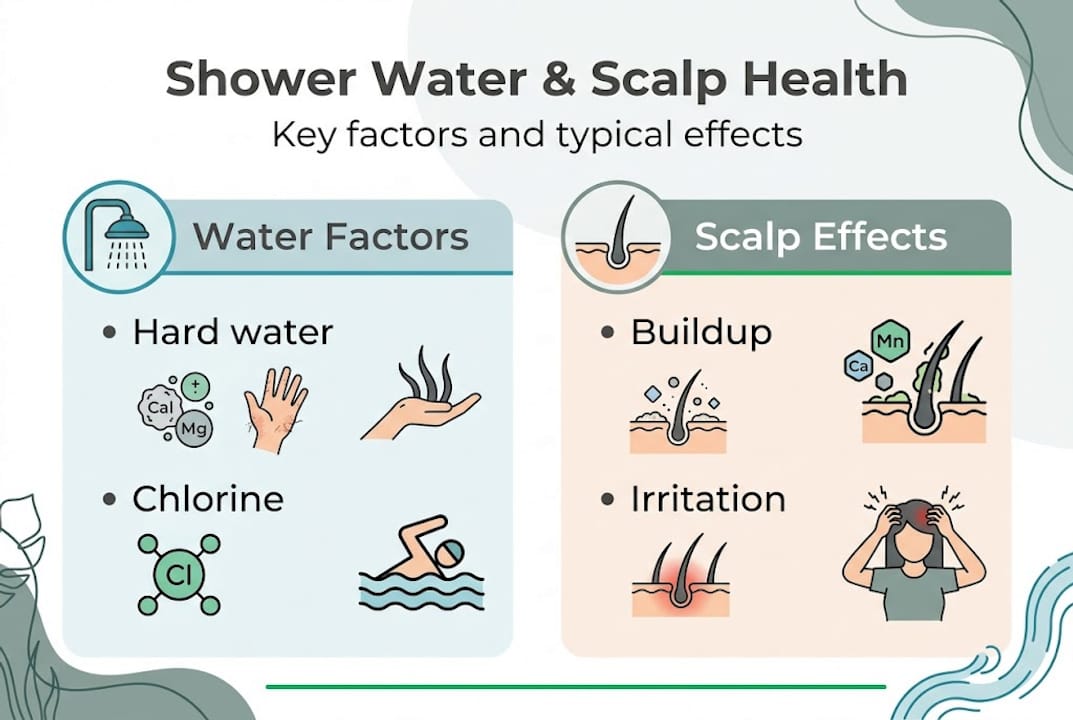
Chlorine is added to municipal water to kill bacteria, which is important for drinking safety. But your scalp doesn’t benefit from that chlorine exposure. It strips away natural oils (sebum) that protect the scalp barrier, and when those oils are removed repeatedly, the skin becomes dry, reactive, and prone to irritation. The hard water and hair condition relationship is well documented, and chlorine makes the problem noticeably worse.
Water temperature is a factor people consistently underestimate. Hot showers feel great, but heat dilates blood vessels, increases water loss through the skin, and accelerates oil stripping. The primary mechanisms behind shower-related scalp issues include residue from hard and chlorinated water, oil stripping, pH shifts, and hot water worsening each of those effects.
Here’s a quick breakdown of how each water quality factor affects your scalp and hair:
| Water quality factor | Typical scalp/hair effect |
|---|---|
| High mineral content (hard water) | Residue buildup, dryness, follicle blockage |
| Chlorine | Oil stripping, barrier disruption, irritation |
| High water temperature | Increased moisture loss, worsening of dryness |
| Elevated pH | Disrupts scalp microbiome, roughens hair cuticle |
One important nuance: no significant difference in hair tensile strength or elasticity was found after 30 days of hard versus distilled water exposure. That means hard water is less likely to snap your hair off and more likely to quietly irritate your scalp over time. These are two very different problems requiring different responses. Expert views on shower filters consistently point to irritation and buildup as the primary concerns, not structural hair damage.
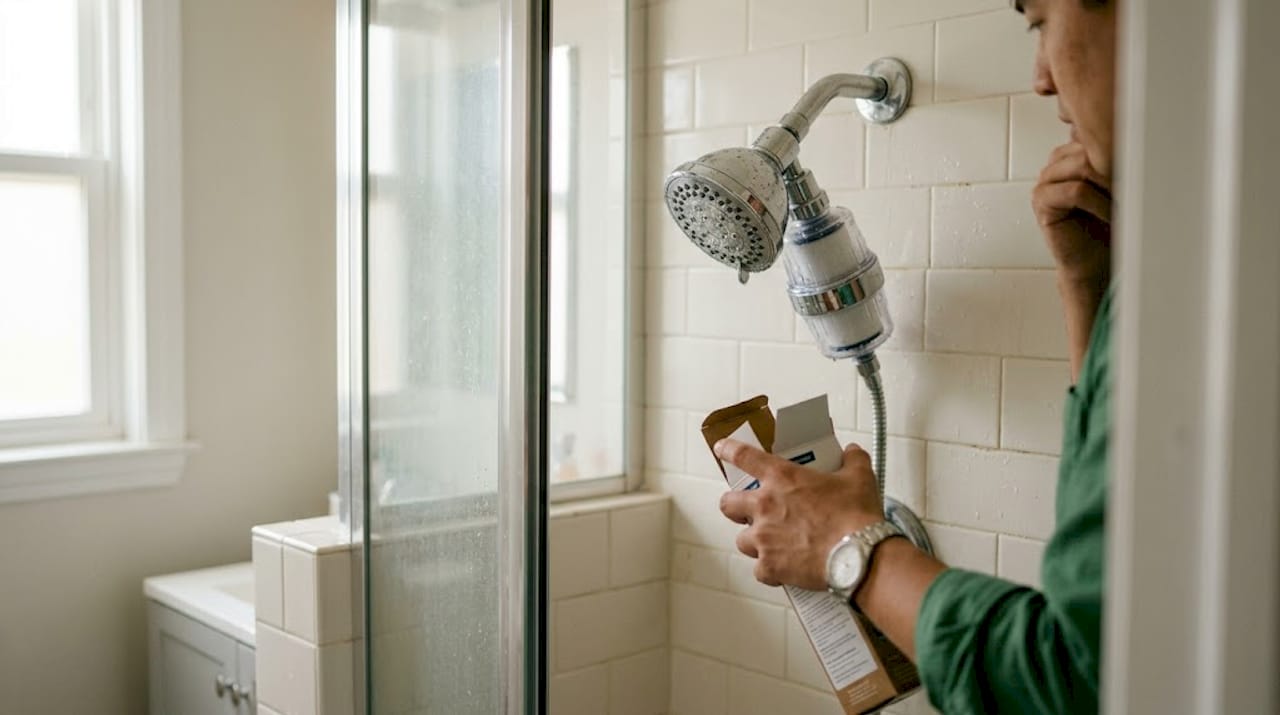
The shower filter benefits for scalp health go beyond just removing minerals. Filters that neutralize chlorine and balance pH can help maintain the scalp’s natural protective environment.
Who is most affected? Risks for sensitive scalps and hair types
Not everyone reacts the same way to hard or chlorinated water. Some people shower with highly mineralized water their whole lives and never notice a problem. Others feel the effects within days of moving to a new city with different water. The difference usually comes down to your scalp’s baseline condition and your hair’s physical structure.
People with pre-existing scalp conditions are the most vulnerable group. If you have eczema, psoriasis, seborrheic dermatitis, or a history of scalp sensitivity, unfiltered shower water can actively trigger or worsen flares. Psoriasis risk rises 3% for every 50mg/L increase in water hardness (measured as CaCO3), with even higher risk in very hard water areas and among people with sensitive skin.
Here’s a comparison of how different scalp types and demographics are affected:
| Profile | Risk level | Key concern |
|---|---|---|
| Eczema/psoriasis-prone scalp | Very high | Flare-ups, barrier disruption |
| Color-treated or bleached hair | High | Increased porosity, mineral absorption |
| Curly or coily hair types | High | Mineral buildup, moisture loss |
| Elderly individuals | Moderate to high | Thinning skin barrier |
| Women (hormonal variability) | Moderate | Increased scalp sensitivity |
| Healthy scalps with no conditions | Low to moderate | Gradual buildup, mild dryness |
Color-treated and bleached hair is particularly susceptible because the chemical processing opens the hair cuticle, making it far more porous. That increased porosity means the hair absorbs mineral deposits and chlorine more readily, leading to faster discoloration, increased brittleness, and a rough texture that doesn’t respond well to conditioners.
Curly and coily hair types already tend toward dryness because natural scalp oils have a harder time traveling down a curved hair shaft. Hard water compounds that problem by adding a mineral layer that repels moisture even further. Demographic risk stratification confirms that women, older individuals, and people with certain skin conditions experience more significant water-related scalp effects than the general population.
The hard water hair loss risks are more nuanced than most articles admit. Hair loss directly caused by water chemistry is rare, but scalp irritation leading to scratching, inflammation, and weakened follicles can contribute to shedding over time.
- Persistent itching after every shower
- Flaking that gets worse, not better, with standard dandruff shampoo
- Hair that feels rough or straw-like despite conditioning
- Scalp redness or sensitivity concentrated in the areas water hits most
Sorting fact from fiction: What the research really says
There’s a lot of noise online about shower water and hair health, and it’s easy to draw the wrong conclusions from partial information. Let’s clear up what the evidence actually supports.
Myth: Hard water breaks your hair. Research finds no significant change in hair tensile strength after regular hard water exposure. Breakage from hard water alone is not well supported by short-term controlled studies.
Myth: A shower filter will regrow hair. Filters reduce irritants but they are not hair growth treatments. Their value lies in creating a less hostile scalp environment, which supports healthier growth conditions over time.
Myth: Cold water closes your hair cuticle permanently. Temperature affects cuticle behavior temporarily. It doesn’t lock in a permanently smooth cuticle.
Fact: Irritation and buildup are the real problems. Expert consensus consistently points to scalp irritation and mineral buildup as far more common effects than breakage or structural hair damage.
Fact: The Wirecutter guide to filters confirms that not all shower filters perform equally, and some marketed solutions do little to address actual water chemistry.
Pro Tip: Test your home water hardness before investing in any products. Simple at-home test strips cost under $10 and give you a clear baseline. This one step can save you from spending money on solutions that don’t match your actual problem.
The shower filter benefits become most meaningful when you pair them with realistic expectations. Filters are preventive tools, not corrective ones. And for those wondering, filters for hair growth work best when combined with a consistent overall scalp care routine.
The scalp is skin first. What irritates skin will irritate your scalp, and daily exposure adds up faster than most people expect.
Practical strategies: Managing scalp health in your shower routine
Now that you know what you’re dealing with, here’s how to actually address it.
- Test your water. Get a home water hardness test kit. Knowing your exact mineral load tells you which solutions are worth pursuing.
- Install a quality shower filter. NSF-certified KDF and calcium sulfite filters are the most efficient options for removing chlorine and reducing mineral impact without causing allergic reactions that some silver-based elements can trigger.
- Lower your shower temperature. Lukewarm water, not hot, is the single easiest change you can make. It reduces oil stripping and lowers moisture loss immediately.
- Use a chelating or clarifying shampoo weekly. Chelating shampoos are specifically formulated to bind to and remove mineral deposits from hair and scalp. They’re especially useful in hard water areas.
- Finish with an acidic rinse. A diluted apple cider vinegar rinse or a pH-balanced conditioner helps restore your scalp’s natural acid mantle after exposure to alkaline hard water.
Signs your scalp may be reacting to your shower water:
- Itching or tightness that starts soon after showering
- Buildup that returns quickly even after washing
- Dullness or roughness in hair texture
- Sensitivity that worsens in winter when showers tend to run hotter
Pro Tip: Dermatologists often recommend starting with water quality assessment before adding new scalp products. Most people layer on more shampoos and treatments without realizing the water is undoing their progress every shower.
For a broader look at how water affects your results, filtered water for hair explains why the medium matters as much as the products. And if you want a deeper look at routine optimization, supporting hair vitality covers daily habits that compound over time.
Allure’s filter notes also point out that silver-based filter elements can be problematic for those with metal sensitivities, so always check the filter materials if you have known skin reactivity.
Why most people miss the real impact of shower water on scalp health
Here’s what most scalp health guides won’t tell you: the wellness industry has a strong incentive to sell you products rather than point you toward your plumbing. People spend hundreds of dollars on serums and supplements while the water stripping away their scalp’s protective oils gets zero attention.
The cumulative effect is the part that catches people off guard. A single shower with hard, chlorinated water causes no visible damage. But 365 showers a year over several years? That’s consistent, daily exposure that gradually degrades your scalp barrier, shifts your microbiome, and worsens whatever sensitivities you already have.
We think the smarter approach starts upstream, literally. Investing in water filters is a preventive strategy that reduces the daily stress load on your scalp before any damage accumulates. The science supports prevention over correction every time. Treating the water before it reaches your scalp is simply more efficient than trying to repair the scalp after repeated exposure.
Upgrade your shower, improve your scalp health
For those ready to take action, here’s how you can start transforming your shower routine for healthier scalp and hair.
If the research in this article resonated with you, the next step is straightforward. Vitaclean’s vitamin C shower filter neutralizes chlorine on contact, which is one of the most direct ways to reduce scalp irritation from unfiltered tap water. For a mineral-focused solution, the ceramic shower filter targets hard water deposits effectively.
Maintaining your filter matters as much as installing it. Vitaclean’s replaceable head filters make it easy to stay consistent without hassle. Cleaner water every day means your scalp gets the chance to recover, stabilize, and thrive rather than constantly fighting the same daily irritants.
Frequently asked questions
Does hard water cause hair loss or scalp problems?
Hard water does not directly cause hair loss, but it creates buildup and irritation that can weaken the scalp environment over time, particularly in people with pre-existing sensitivity.
What type of shower filter is best for scalp health?
NSF-certified filters using KDF or calcium sulfite media are the most effective and allergy-safe options, removing chlorine and reducing mineral load without the risks associated with silver-based elements.
Is hot water worse for my scalp than cold water?
Yes. Hot water raises trans-epidermal water loss and strips scalp oils more aggressively than lukewarm water, making dryness and irritation noticeably worse with regular hot showers.
How do I know if my shower water is harming my scalp?
The most telling signs are persistent itching or tightness immediately after showering, flaking that doesn’t respond to standard treatments, and hair texture that feels rough despite regular conditioning.