
Ceramic Filtration Balls: Benefits for Skin and Hair
TL;DR:
- Ceramic filtration balls are alumina-based media used in water filters to trap particles and support filter beds. Inert balls provide structural support, while porous ones actively capture contaminants like sediment and heavy metals. When combined with chemical adsorbers such as activated carbon or vitamin C, they improve water quality for healthier skin and hair.
Ceramic filtration balls are spherical ceramic media used in water filtration systems to remove impurities, support filter beds, and improve water quality for healthier skin and hair. Made primarily from alumina (aluminum oxide), these small but precisely engineered components appear in everything from industrial petrochemical reactors to the shower filter cartridge in your bathroom. Understanding what they actually do, and what they cannot do alone, is the difference between choosing a filter that works and one that just looks good on a shelf.
What are ceramic filtration balls and how are they made?
Ceramic filtration balls are small, spherical ceramic media made mostly from alumina (Al2O3), engineered to serve as stable support beds that resist wear and maintain predictable fluid flow in filtration systems. The term “ceramic filter media” is the recognized industry label, and ceramic balls are one specific form within that broader category. Two distinct types exist, and confusing them leads to mismatched expectations.

Inert alumina ceramic balls are chemically stable and do not react with the fluids they contact. Their job is structural: they hold the filtration bed in place, distribute flow evenly, and protect more reactive media layers from physical damage. Inert balls resist high temperatures, abrasion, and chemical attack, which makes them reliable in demanding conditions. In a shower filter, they function as the backbone of a multi-layer cartridge.
Porous or perforated ceramic balls are a different story. These are engineered with internal pore networks, giving them 20 to 30% porosity designed to trap particulates and adsorb impurities. The pores create surface area that physically captures contaminants as water passes through. This is where the active filtration work happens.
| Type | Primary function | Best used for |
|---|---|---|
| Inert alumina balls | Structural support, flow distribution | Protecting reactive media, bed stability |
| Porous ceramic balls | Particulate capture, impurity adsorption | Removing fine solids, heavy metals |
| Activated alumina balls | Chemical adsorption of specific contaminants | Fluoride, arsenic, heavy metal removal |
Pro Tip: When evaluating a shower filter, check whether the product specifies inert or porous ceramic balls. A cartridge listing only “ceramic balls” without clarification is likely using inert media, which supports the filter bed but does not actively remove contaminants on its own.
How do ceramic balls work in water purification systems?
The ceramic ball filter process works differently depending on which type of ball is in play. Porous ceramic balls trap suspended solids and fine particulates as water is forced through their internal pore networks. Porous balls capture particulates under 25 microns, which includes fine sediment, some heavy metal ions, and iron particles. That 25-micron threshold matters because it covers a wide range of common tap water contaminants that affect both taste and skin feel.
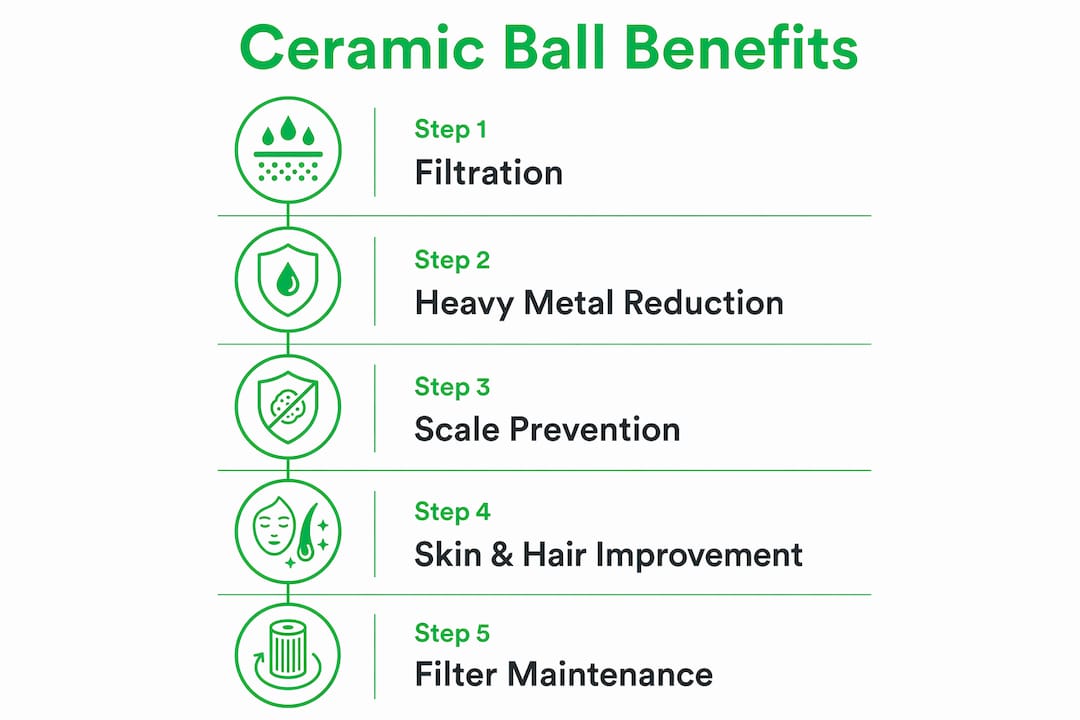
Inert ceramic balls operate on a completely different principle. Rather than capturing contaminants, they maintain the physical structure of the filter bed so that water flows evenly through every layer. Without this support layer, reactive media like activated carbon or vitamin C can compact unevenly, creating channels where water bypasses filtration entirely. Inert balls prevent biofilm buildup while still allowing beneficial bacteria colonization in biological treatment systems, showing their dual functional role.
Here is how the ceramic ball filter process typically unfolds in a consumer shower cartridge:
- Water enters the cartridge and passes through an initial layer of inert ceramic balls, which distribute flow and protect the layers below.
- Porous ceramic balls in the next stage trap suspended solids, sediment, and fine particulates under 25 microns.
- Complementary media such as activated carbon or vitamin C adsorb chlorine, chloramines, and organic compounds that ceramic balls cannot capture alone.
- The filtered water exits with reduced particulate load, lower chemical irritant levels, and improved mineral balance.
- Over time, pore saturation in the ceramic layer reduces efficiency, signaling the need for cartridge replacement.
Pore size and saturation are the two variables that determine how long a ceramic filter media layer performs at full capacity. Higher porosity increases initial filtration capacity but also means the media saturates faster. This is not a flaw in the design. It is a predictable trade-off that informs replacement schedules.
What are the benefits of ceramic filtration balls for skin and hair?
The skin and hair benefits of ceramic filtration balls are real, but they are conditional. Ceramic balls help remove chlorine, chloramines, and heavy metals, which reduces skin irritation and hair dryness when used in shower filtration systems. Chlorine strips the natural oils from hair and skin, leaving hair brittle and skin tight after every shower. Heavy metals like iron and copper contribute to discoloration, scalp irritation, and accelerated hair protein breakdown.
Mineral scale is the other major culprit. Hard water deposits calcium and magnesium onto hair strands, making them feel rough and look dull. Ceramic filtration, particularly when combined with other media, reduces the mineral load that reaches your scalp and skin. The result is water that feels softer and behaves more like the filtered water used in professional salon treatments. You can read more about how filtered water affects skin in daily routines.
The critical caveat is this: ceramic media alone cannot remove all harmful substances without complementary filtration stages. Chlorine and chloramines require adsorptive media like activated carbon or ascorbic acid (vitamin C) to neutralize effectively. Ceramic balls set the stage by removing particulates and supporting the filter structure, but the chemical work requires a different tool.
Key benefits when ceramic balls are part of a multi-stage shower filter:
- Reduced particulate load: Fine sediment, rust, and suspended solids are physically trapped before reaching your skin.
- Lower heavy metal exposure: Iron ions and other metals are captured in the porous ceramic layer, reducing scalp and skin contact.
- Improved mineral balance: Combined with softening media, ceramic filtration reduces the scale-forming minerals that roughen hair.
- Better performance of complementary media: By removing solids first, ceramic balls extend the effective life of activated carbon and vitamin C layers.
- Consistent water flow: Inert ceramic balls maintain even distribution so no layer of the cartridge is bypassed.
Pro Tip: If you have color-treated hair, the heavy metal reduction from porous ceramic filtration is particularly worth prioritizing. Iron and copper ions accelerate color fade and can shift tone. A multi-stage filter with ceramic and activated carbon media addresses both concerns simultaneously.
How to choose and maintain ceramic filtration balls for optimal water quality
Selecting the right ceramic filter ball starts with identifying your primary water quality concern. If your tap water has visible sediment or rust, porous ceramic balls are the priority. If your concern is chlorine sensitivity or dry skin, the ceramic layer matters less than the adsorptive media it supports. Alumina content, ball size, and packing all affect filtration efficiency, with higher alumina percentages offering better chemical and thermal resistance at higher cost.
For home shower filters, the practical decision is simpler: evaluate the full cartridge, not just the ceramic component. A product that lists ceramic balls alongside activated carbon or vitamin C media is built for chemical contaminant removal. A product listing only ceramic balls is primarily a mechanical filter. Both have value, but they solve different problems.
Maintenance follows a straightforward logic:
- Replace on schedule, not on appearance. Ceramic filter media looks clean long after its pores are saturated. Follow the manufacturer’s replacement interval, typically every two to three months for shower filters under regular use.
- Monitor water feel, not just clarity. When skin starts feeling tight again or hair loses its post-filter softness, the ceramic layer may be saturated even if the water looks clear.
- Avoid backflushing consumer-grade ceramic balls. Industrial ceramic media can sometimes be cleaned and reused, but consumer shower filter cartridges are designed for single-use replacement cycles. Backflushing can redistribute trapped contaminants rather than removing them.
- Store replacement cartridges dry. Moisture promotes microbial growth in porous media before installation. Keep spares sealed until use.
For guidance on keeping your filter performing between replacements, Vitacleanhq covers filter maintenance practices that apply directly to ceramic-based shower systems.
| Maintenance factor | Recommended action |
|---|---|
| Replacement interval | Every 2 to 3 months under regular shower use |
| Performance signal | Skin tightness or hair roughness returning after showers |
| Storage | Keep replacement cartridges sealed and dry until use |
| Cleaning | Do not backflush consumer cartridges; replace instead |
How ceramic balls compare to other filtration media
Bio balls are non-porous and primarily support biological filtration, whereas ceramic filtration balls have engineered porosity that traps solids and adsorbs impurities. That distinction matters in practice. Bio balls cultivate beneficial bacteria colonies for biological waste breakdown, which is useful in aquariums and wastewater systems but irrelevant in a shower filter designed to protect skin.
Activated carbon outperforms ceramic balls for chemical adsorption. Carbon media removes chlorine, chloramines, volatile organic compounds, and many pharmaceuticals through adsorption. Ceramic balls cannot match this chemical removal capacity. What ceramic balls do better is mechanical filtration of particulates and structural support for the carbon layer itself.
Ceramic rings, used widely in aquarium filtration, share the same alumina-based composition as ceramic balls but differ in shape and surface area geometry. Rings offer slightly more surface area per unit volume, which benefits biological filtration. For mechanical particulate capture in a shower filter, the spherical ball format provides more consistent packing density and flow distribution.
The honest summary: ceramic filtration balls excel at particulate removal and bed support. They are not a standalone solution for chemical contaminants. The filters that deliver real skin and hair benefits combine ceramic media with activated carbon, vitamin C, or both.
Key takeaways
Ceramic filtration balls work best as part of a multi-stage system, where their mechanical filtration and structural support amplify the performance of adsorptive media like activated carbon or vitamin C.
| Point | Details |
|---|---|
| Two distinct types exist | Inert balls provide structural support; porous balls actively capture particulates and impurities. |
| Pore size determines performance | Porous ceramic balls capture particles under 25 microns, including fine sediment and heavy metal ions. |
| Skin and hair benefits are conditional | Ceramic balls reduce particulates and heavy metals, but chlorine removal requires complementary adsorptive media. |
| Replacement timing matters | Pores saturate before media looks dirty; replace on schedule, not on appearance. |
| Multi-stage filters outperform single media | Combining ceramic balls with activated carbon or vitamin C delivers the broadest contaminant removal for skin and hair health. |
Why I think most people underestimate what’s actually in their shower filter
Most consumers assume that any filter labeled “ceramic” is doing the heavy lifting on chlorine. It is not. After years of examining how filtration media works in personal care applications, the single most common misconception I encounter is treating ceramic balls as a complete solution rather than one layer in a system.
The ceramics do their job well. Particulate capture, bed stability, flow distribution. These are not glamorous functions, but they are what make the rest of the cartridge work properly. The real performance comes from what sits alongside the ceramic layer. A shower filter combining porous ceramic balls with vitamin C or activated carbon addresses both mechanical and chemical contamination. That combination is what produces the skin and hair results people are actually looking for.
If you are evaluating a shower filter and the product page does not specify what accompanies the ceramic media, that is your signal to dig deeper. The ceramic component is the foundation. What gets built on top of it determines whether your skin and hair actually benefit. For a detailed look at how mineral buildup specifically affects your shower experience, Vitacleanhq’s guide on reducing mineral scale is worth reading before you buy.
— Sara
Upgrade your shower with Vitacleanhq’s ceramic and vitamin C filtration
Vitacleanhq builds shower filters that put the science of ceramic filtration to work alongside vitamin C media for real, measurable improvements in water quality.
The Vitacleanhq ceramic filter collection uses porous ceramic balls to capture sediment, rust, and heavy metals before water reaches your skin. Paired with the vitamin C shower filter shots, the system neutralizes chlorine and chloramines that ceramic media alone cannot address. The result is softer water, calmer skin, and hair that holds moisture the way it should. Replacement cartridges are available on a subscription schedule so your filter never quietly stops working between replacements.
FAQ
What are ceramic filtration balls made of?
Ceramic filtration balls are made primarily from alumina (aluminum oxide, Al2O3), a chemically stable material that resists wear, heat, and chemical attack. Higher alumina content improves durability and chemical resistance, which affects both performance and cost.
Do ceramic filter balls remove chlorine?
Ceramic balls do not effectively remove chlorine or chloramines on their own. They require complementary adsorptive media such as activated carbon or vitamin C to neutralize these chemical contaminants in shower filters.
How often should ceramic shower filter balls be replaced?
Consumer shower filter cartridges containing ceramic balls should typically be replaced every two to three months under regular use. Pores saturate before the media visibly appears dirty, so replacing on a schedule rather than by appearance preserves filtration performance.
What is the difference between inert and porous ceramic balls?
Inert ceramic balls are non-reactive and provide structural support and flow distribution within a filter bed. Porous ceramic balls contain engineered internal pore networks that actively trap particulates and adsorb impurities, making them the active filtration component.
Are ceramic filtration balls safe for skin and hair contact?
Yes. Inert alumina ceramic balls are chemically stable and do not leach compounds into filtered water. Porous ceramic balls are equally non-toxic and are widely used in consumer water filtration products designed for daily shower use.