
Why Water Pressure Affects Filtration in Your Home
Water pressure is the engine behind every drop your filtration system processes. Without adequate force pushing water through filter media, contaminants slip through, flow becomes uneven, and the filter never does its full job. Too much pressure, and you risk cracked housings, blown seals, and water bypassing the media entirely. The relationship between pressure and filtration efficiency is direct: get the pressure wrong in either direction, and your filter underperforms or breaks down faster than it should.
Here is what that means practically for your home:
- Insufficient pressure causes channeling, where water carves narrow paths through filter media instead of flowing evenly, leaving large portions of the filter unused and contaminants in your water.
- Excessive pressure stresses filter housings, fittings, and membranes, shortening their lifespan and risking leaks.
- Pressure drives flow rate, and changes in flow rate directly affect how long water contacts filter media, which determines how thoroughly contaminants are removed.
- The EPA sets the ideal residential range at 40–60 PSI, with anything above 80 PSI flagged as a damage risk.
Understanding why water pressure affects filtration gives you the diagnostic framework to keep your system running at its best.
What is the ideal water pressure for home filtration systems?
Residential filtration systems perform best between 40 and 60 PSI, the range the EPA identifies as the standard for safe, comfortable home water delivery. Flow feels weak at fixtures and filtration becomes inconsistent when water pressure falls below 50 PSI. Excessively high pressure can stress mechanical components, leading to possible damage such as cracked housings and failing seals over time.
| Pressure Range | Effect on Filtration | Effect on Plumbing |
|---|---|---|
| Low pressure may cause channeling and poor contaminant removal, resulting in weak flow at fixtures. | ||
| Moderate pressure supports consistent media contact and comfortable flow throughout the home. | ||
| Slightly elevated pressure is acceptable but should be monitored as it may cause minor stress on fittings. | ||
| High pressure risks water bypassing media and possible damage such as housing cracks and leaks. |
Staying within the 40–60 PSI window also protects your filter cartridges. Cartridges exposed to chronic high pressure wear out faster, and the cost of replacing them more often adds up quickly. A pressure regulator set correctly at the main line is the simplest way to keep the system in this range.
- Low pressure often feels insufficient at fixtures, sometimes leading homeowners to misattribute issues to the filter rather than supply.
- Pressure above 80 PSI is the threshold where filter and plumbing damage becomes likely.
- Proper filter sizing matched to your home’s flow demand keeps pressure drop minimal across the system.
What causes low or fluctuating pressure in filtration systems?
Pressure problems rarely have a single cause. Most homes with filtration complaints are dealing with two or three overlapping issues at once.
- Clogged filter cartridges are the most common culprit. As media fills with captured particles, resistance increases and pressure drops across the filter. A cartridge past its service life can cut downstream pressure noticeably.
- Undersized filter vessels create a bottleneck. When the vessel diameter or media volume is too small for the home’s peak flow demand, pressure drop spikes during high-use periods like morning showers.
- Scale buildup inside pipes narrows the effective diameter of your plumbing long before water reaches the filter. Scale buildup is frequently mistaken for a filtration problem when the real restriction is upstream in older iron or galvanized pipes.
- Faulty or misadjusted pressure regulators can let incoming municipal pressure swing widely, sending surges or sustained low pressure through the system.
- Municipal supply variation is real, especially during peak demand hours in summer. Well systems face similar swings tied to pump cycling and aquifer draw.
One pattern experienced installers see repeatedly: a new filter gets installed, pressure drops slightly, and the homeowner assumes the filter caused the problem. In many cases, the filter simply revealed a pipe restriction that was already there. Replacing scaled pipes often restores pressure to levels better than before the filter was added.
How does low pressure hurt filtration effectiveness and daily water use?
Low pressure does more damage to filtration quality than most homeowners realize. When water pressure drives flow unevenly through filter media, channeling occurs: water finds the path of least resistance and bypasses large sections of the filter bed. Contaminants that should be captured pass straight through.

Beyond filtration quality, low pressure affects daily life in concrete ways. Showers pulse or sputter. Washing machines and dishwashers take longer to fill. Hot and cold taps deliver uneven flow. These symptoms are easy to notice but easy to misattribute.
There is also an important distinction between pressure and flow rate that trips up a lot of homeowners. Pressure is the force pushing water; flow rate is the volume delivered per minute. A clean filter creates a modest pressure drop that is entirely normal, not a sign of malfunction. The filter is doing its job by creating resistance. The problem starts when that pressure drop grows beyond the expected range, signaling a clogged cartridge or an undersized system.
Slow flow also puts indirect stress on pumps and valves that compensate by working harder, which shortens their service life.
How do you fix and prevent low water pressure in filtration systems?
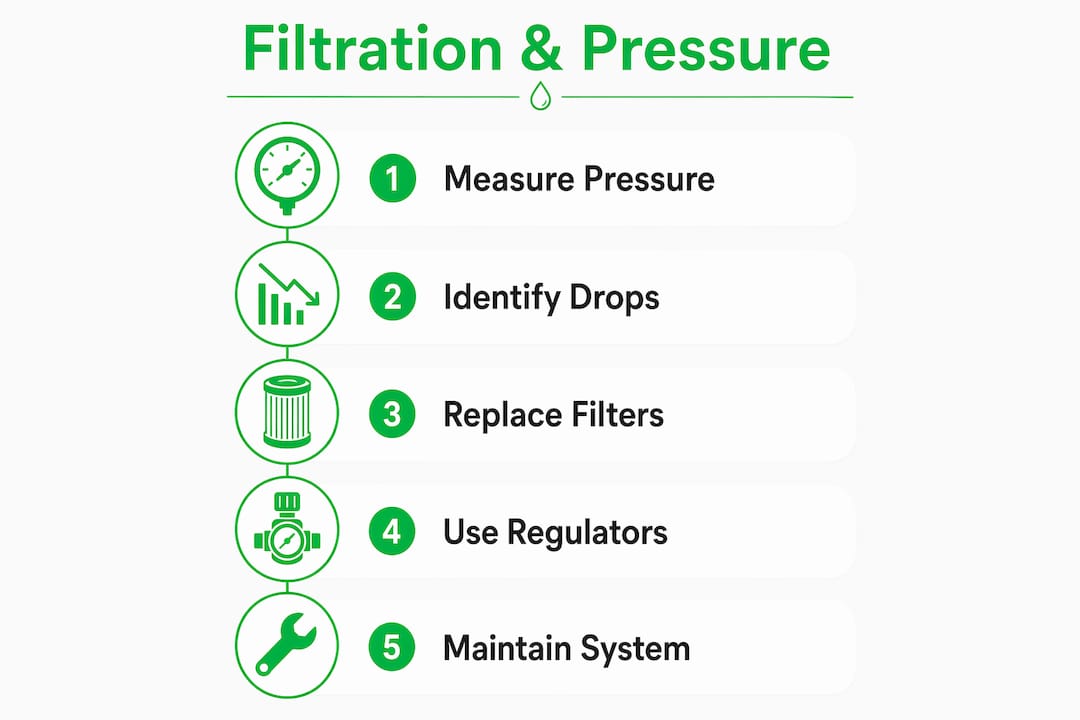
Most pressure problems in home filtration systems are fixable with straightforward maintenance and a few targeted upgrades.
- Replace filter cartridges on schedule. A saturated cartridge is the single most common cause of pressure drop. Do not wait for visible discoloration; the media fills from the inside out.
- Size the filter to your home’s actual flow demand. A filter rated for a small apartment will choke a four-bathroom house during peak morning use. Match the system’s gallons-per-minute rating to your household’s peak demand.
- Check your pressure regulator. Regulators wear out and drift over time. A simple pressure gauge at the main line tells you whether the regulator is holding its set point.
- Install pressure gauges before and after the filter. Pre- and post-filter gauges give you an objective reading of pressure drop across the system, removing the guesswork from maintenance decisions.
- Add a booster pump if your incoming municipal or well pressure consistently runs below 40 PSI. Booster pumps are straightforward to install and sized by flow rate, not just pressure.
- Flush the media bed periodically to clear sediment and air pockets that increase resistance without actually clogging the cartridge.
Pro Tip: A pressure drop beyond a certain threshold across your filter signals that service or cartridge replacement is due. If your pre-filter gauge reads 60 PSI and your post-filter gauge reads 44 PSI, change the cartridge now, even if the water looks clear. Visual inspection alone is unreliable for timing replacement.
Advanced insights on how pressure behaves inside filtration systems
The physics of pressure drop across filter media is not linear, and that detail matters for anyone managing a home system seriously. Pressure drop increases roughly with the square of flow rate (ΔP ∝ Q²). That means doubling your flow rate does not double the pressure drop; it quadruples it. A small increase in household water demand during peak hours can dramatically accelerate filter clogging and system wear.
Temperature adds another variable. Colder water is more viscous, which increases resistance through filter media. Homes in colder climates may notice higher pressure drops in winter even with a clean cartridge, simply because the water is thicker at lower temperatures.
Transient pressure spikes, sometimes called water hammer, occur when valves close suddenly or appliances cycle on and off. These brief surges can exceed 80 PSI even in systems where the average pressure is well within range. A pressure surge arrester or expansion tank on the supply line absorbs these spikes before they stress filter housings.
Efficient system design accounts for all of these variables. Balancing filter media and vessel sizing with your home’s actual flow demand protects both pressure and filtration quality simultaneously. A well-designed system does not force you to choose between clean water and comfortable flow.
How to measure water pressure accurately for filtration purposes
Measuring pressure accurately takes about five minutes and costs less than $20 for a basic gauge. Attach a threaded pressure gauge to an outdoor hose bib or the test port on your main shutoff, making sure all fixtures in the house are off when you take the reading. That static reading gives you your baseline incoming pressure.
For filtration diagnostics, you need two readings: one at the inlet of the filter housing and one at the outlet. The difference between those two numbers is your pressure drop. A drop of 10–15 PSI across the filter signals that cartridge replacement is needed. A drop larger than that means the cartridge is overdue or the system is undersized for your flow demand.
Take readings at two different times: once during low-demand hours (early morning) and once during peak use. If the pressure drop spikes significantly during peak hours, the filter vessel is too small for your household’s simultaneous demand. Digital pressure gauges with a memory function make this comparison easy, since you can log both readings without being at the gauge at the same moment.
What devices help you regulate water pressure for better filtration?
A pressure-reducing valve (PRV) installed at the main water entry point is the most effective single device for protecting your filtration system. It keeps incoming pressure within the 40–60 PSI range regardless of what the municipal supply sends. Most homes built before 1990 either lack a PRV or have one that has never been serviced.
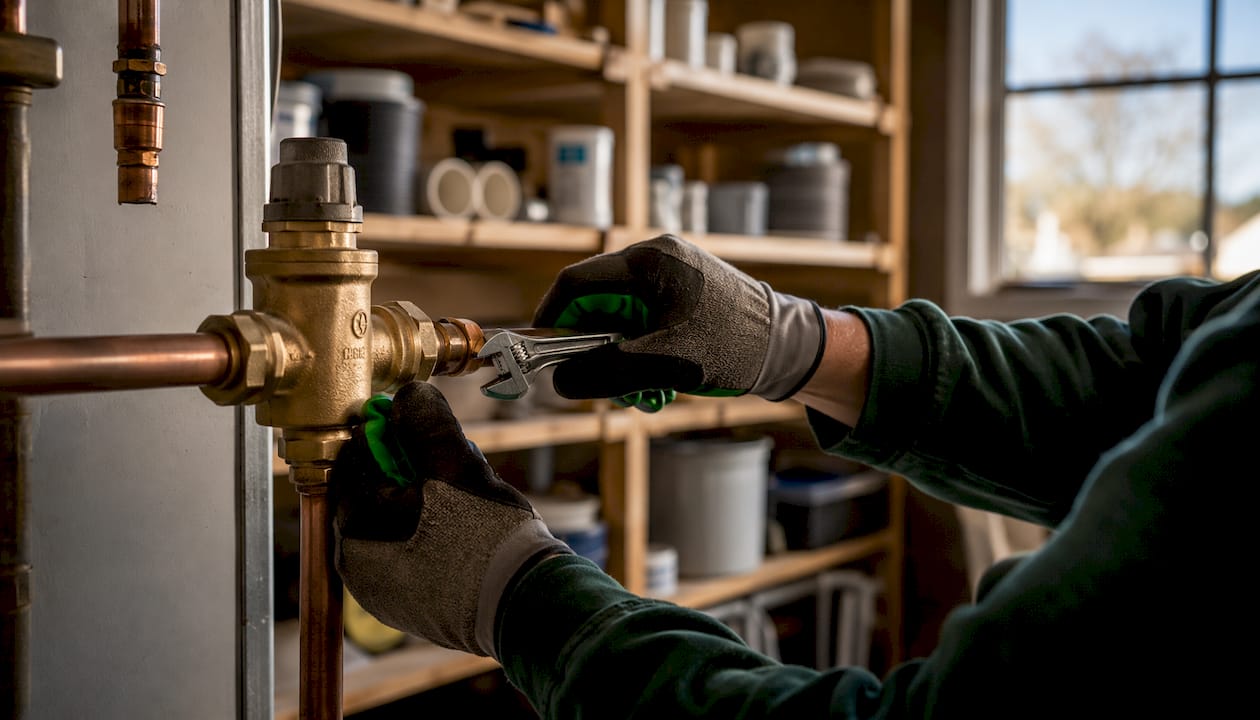
Expansion tanks work alongside PRVs to absorb thermal expansion and pressure surges in closed plumbing systems. Without one, pressure spikes from a water heater cycling on can travel back through the filter and stress the housing. For homes with well pumps, a pressure tank with a properly charged bladder serves a similar function, smoothing out the pump’s on/off cycling.
For homes with chronically low incoming pressure, a booster pump with a built-in pressure switch maintains a consistent outlet pressure regardless of supply variation. Pair it with a pressure gauge downstream of the filter to confirm the system is holding its target range. For shower-specific filtration, understanding how shower filters affect pressure helps you choose the right setup for your bathroom without sacrificing flow.
How does fluctuating pressure damage filter media over time?
Pressure swings are harder on filter media than steady high or low pressure. Each surge compresses the media bed; each drop allows it to relax. Over repeated cycles, this mechanical stress causes media to compact unevenly, creating preferential flow channels where water moves through the path of least resistance. Once channeling develops, it tends to worsen with each pressure cycle.
Granular activated carbon (GAC) media is particularly vulnerable. The granules shift and settle under pressure fluctuations, leaving gaps that water exploits. Sediment filters with pleated membranes can develop micro-tears at fold points when pressure spikes repeatedly stress the material.
The practical consequence is that a filter in a high-fluctuation environment needs more frequent replacement than the manufacturer’s standard schedule assumes. That schedule is typically based on steady-state conditions. If your home experiences daily pressure swings from municipal demand variation or well pump cycling, shorten your replacement interval accordingly. A healthy home environment depends on filtration that actually keeps pace with real-world conditions, not ideal lab assumptions.
Safety considerations when water pressure is wrong in filtration systems
High pressure is the more immediate safety concern. Filter housings rated for 80 PSI that routinely see 90–100 PSI can fail suddenly, sending water and housing fragments under pressure. Always verify that your filter housing’s pressure rating exceeds your maximum incoming pressure, including surge conditions, not just the average reading.
Low pressure carries a subtler safety risk: inadequate contaminant removal. A system running below its designed operating pressure may pass bacteria, sediment, or chemical contaminants that it would capture at proper pressure. This is especially relevant for households relying on filtration as their primary treatment step for well water.
Bypass conditions, where water routes around filter media due to a failed seal or improperly seated cartridge, can occur at any pressure but become more likely when pressure fluctuations loosen fittings over time. Inspect O-rings and housing threads during every cartridge change. For shower filtration specifically, the connection between filtration mechanics and water quality depends on maintaining a proper seal at every service interval. A filter that looks installed but is not sealed correctly offers no protection at all.
Keep your filter running at the right pressure with Vitacleanhq
Vitacleanhq designs shower filtration systems built to perform within the pressure ranges real homes actually see. The ceramic filter collection removes contaminants with minimal pressure drop, so you get clean water without sacrificing shower flow. The Vitamin C shower filter shots neutralize chlorine at the point of use, protecting your skin and hair from the effects of unfiltered tap water. And the filter refill plan keeps your cartridges on a replacement schedule that matches real-world use, not just ideal lab conditions.
Pressure management starts with the right filter and the right maintenance rhythm. Vitacleanhq makes both straightforward.
Key Takeaways
Water pressure directly controls filtration efficiency: too low causes channeling and poor contaminant removal, while too high risks housing failure and media bypass.
| Point | Details |
|---|---|
| Ideal pressure range | Keep residential water pressure between 40 and 60 PSI for consistent filtration and comfortable flow. |
| Service signal | A pressure drop of 10–15 PSI across the filter is the standard benchmark for cartridge replacement. |
| Nonlinear pressure drop | Pressure drop increases roughly with the square of flow rate, so small demand spikes cause outsized stress on filter media. |
| Fluctuation damage | Repeated pressure swings compact and channel filter media, requiring shorter replacement intervals than manufacturer schedules assume. |
| Safety at both extremes | High pressure risks housing failure; low pressure risks inadequate contaminant removal, especially in well-water systems. |