
Water Filter Pore Size: What Micron Ratings Really Mean
Water filter pore size is the diameter of the tiny openings in a filter membrane, measured in microns, and it determines exactly which particles get blocked and which pass through. A micron equals one-millionth of a meter, written as μm, which is the standard unit you will see on every filter specification. The smaller the pore, the finer the filtration. That single number on a filter label tells you more about performance than almost any other spec.
A few things to keep in mind before you shop:
- Pore size physically blocks particles larger than the opening; it does not absorb or chemically neutralize them.
- Micron rating is the manufacturer’s stated pore size, either nominal or absolute.
- Nominal ratings capture roughly 85% of particles at the stated size; absolute ratings capture 99.9% of particles.
- Smaller pores mean finer filtration but slower flow and more frequent filter changes.
- Micron ratings measure sediment removal, not dissolved chemicals or viruses, which require additional treatment stages.
How micron size scales work in water filtration
To put micron sizes in perspective: a single strand of human hair is roughly 100 microns wide. Most particles you actually care about in drinking water sit well below that threshold, which is why water filtration operates at scales invisible to the naked eye. Anything under about 40 microns cannot be seen without a microscope.
Microfiltration membranes span a pore size range of 0.1 to 10 microns, while ultrafiltration drops to around 0.01 microns. Reverse osmosis goes even smaller, effectively removing dissolved salts that no membrane filter can touch. As pore size decreases, contaminant removal improves, but water pushes through more slowly and filters clog faster.
| Micron size | What it compares to | Typical particles removed |
|---|---|---|
| 100 microns | Width of a human hair | Coarse sand, large debris |
| 25–50 microns | Barely visible to the eye | Fine sand, silt |
| 5–10 microns | Invisible without magnification | Rust flakes, mold spores, fine silt |
| 1 micron | Far below naked-eye visibility | Bacteria, some protozoan cysts (absolute-rated only) |
| 0.5 micron | Advanced filtration for Cryptosporidium, Giardia cysts | |
| 0.01 micron | Ultrafiltration range | Very fine colloids, some virus-size particles |
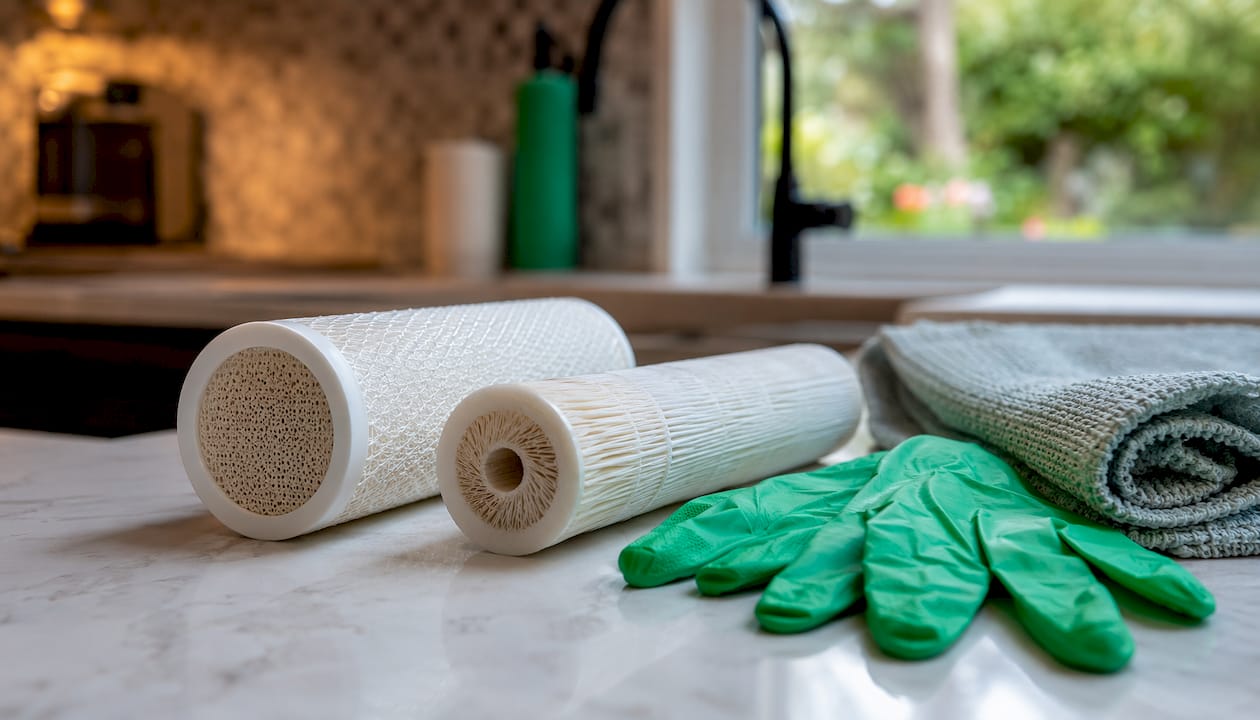
Smaller pore sizes increase flow resistance and require more frequent cleaning or replacement. The practical takeaway: choose the largest pore size that still removes your target contaminants. That balance keeps water pressure reasonable and extends filter life.
Pro Tip: If your water supply is municipally treated and not visibly cloudy, a 1-micron absolute filter often hits the sweet spot between protection and flow rate for point-of-use applications.

Common types of micron-rated water filters and their pore sizes
Different filter types target different problems, and their pore sizes reflect that. Here is how the main categories break down:
-
Sediment filters (5–50 microns): The workhorses of pre-filtration. A 5-micron filter removes rust flakes and silt; a 25-micron or larger filter handles coarse sand and visible debris. These are typically installed as whole-house pre-filters to protect downstream equipment.
-
Carbon block filters (0.5–5 microns): Carbon block filters combine physical pore filtration with chemical adsorption. A 0.5-micron carbon block pairs well with other stages to reduce chlorine, chloramine, lead, and some PFAS compounds, while also catching fine sediment.
-
Microfiltration membranes (0.1–10 microns): Used in both whole-house and point-of-use systems, these membranes target bacteria, protozoa, and fine suspended solids. They are common in under-sink units and inline systems.
-
Ultrafiltration (around 0.01 micron): Ultrafiltration filters remove very fine particles and some virus-size colloids but do not remove dissolved salts. They work well for households on well water or in areas with biological contamination concerns.
-
Nanofiltration (0.001–0.01 micron): Sits between ultrafiltration and reverse osmosis. Nanofiltration removes most bacteria, viruses, and some dissolved minerals, making it useful for softening hard water while retaining beneficial minerals.
-
Reverse osmosis (0.0001 micron): The most thorough membrane technology available for residential use. Reverse osmosis removes dissolved salts, heavy metals, nitrates, and most contaminants that other filters miss. The trade-off is slower flow and a significant volume of reject water.
-
Ceramic filters (0.2–0.5 micron): Ceramic filters use a rigid porous structure to physically block bacteria and protozoa. They are durable, cleanable, and effective for biological filtration. Vitacleanhq’s ceramic filter range applies this principle to shower filtration, targeting impurities that affect skin and hair.
Filter construction matters as much as the rated pore size. A hollow fiber membrane, for example, bundles hundreds of tiny tubes whose walls are perforated with microscopic pores, using size exclusion to trap pathogens while water passes through. A pleated sediment cartridge works more like a layered screen. Same micron rating, different mechanisms, and different real-world performance.
Nominal vs. absolute micron ratings and what they mean for filtration reliability
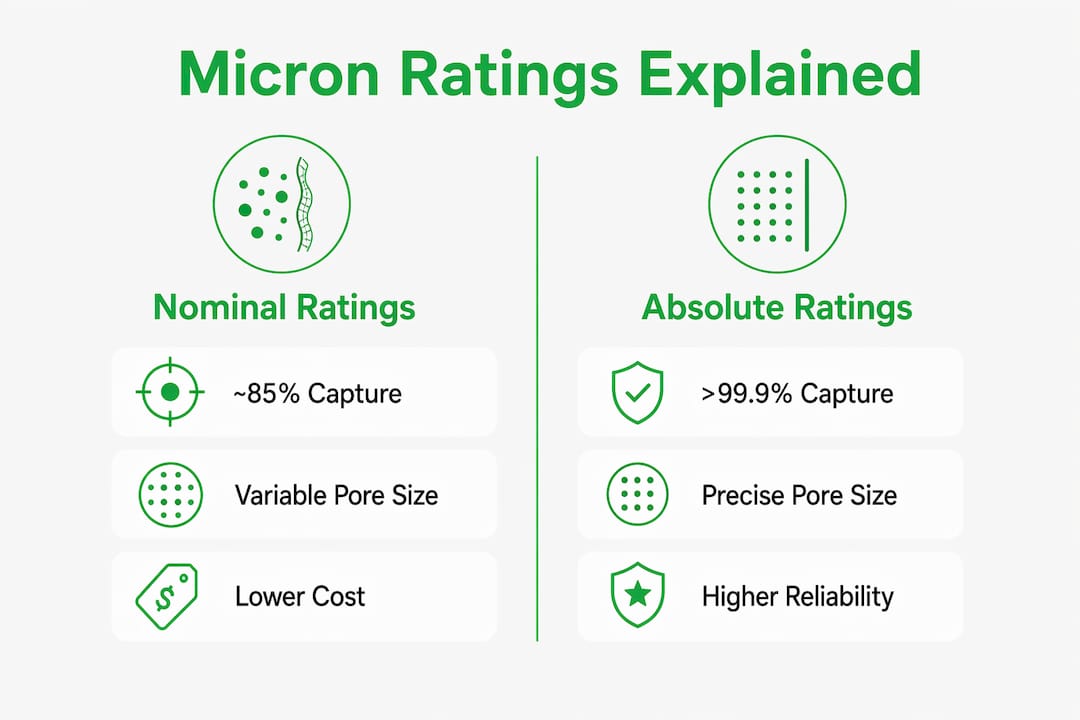
This distinction is where most consumers get tripped up. Both ratings describe pore size, but they tell you very different things about how consistently a filter performs.
A nominal rating means the filter captures approximately 85% of particles at the stated size. Some pores in the membrane are larger than the rated size, so a portion of same-size particles slips through. Nominal filters work fine for general sediment reduction, where catching most of the debris is good enough.
An absolute rating means every pore in the filter is at or below the stated size. Absolute-rated filters trap 99.9% of particles at the rated micron, with no oversized pores to let contaminants through. For health-critical applications, that difference is not cosmetic.
Key distinctions at a glance:
- Nominal: Average pore size; some pores larger than rated; ~85% capture efficiency; suited for pre-filtration and general sediment.
- Absolute: Maximum pore size; no pores exceed the rating; ~99.9% capture efficiency; required for pathogen and cyst removal.
- Trust signals: The CDC and EPA recommend absolute pore size of 1 micron or smaller for removing parasites and cysts, with NSF/ANSI certifications 53 or 58 as the verification standard.
A common mistake is buying a nominal 1-micron filter expecting it to block Cryptosporidium or Giardia cysts. A nominal filter at that rating will let some 1-micron particles through. Only an absolute 1-micron or smaller filter, certified to NSF/ANSI 53 or 58, reliably removes those parasites. When the label says “nominal,” treat it as approximate, not guaranteed.
What different micron ratings actually remove from your water
Pore size maps directly to contaminant size, and contaminant size maps directly to health risk. Here is how the numbers translate to real-world removal:
| Micron rating | Contaminants removed | Typical application |
|---|---|---|
| 20–50 microns | Sand, coarse silt, visible rust | Whole-house pre-filter |
| 5–10 microns | Fine silt, mold spores, rust flakes | General household sediment filter |
| 1 micron (absolute) | Bacteria, some protozoan cysts | Point-of-use drinking water |
| 0.5 micron (absolute) | Cryptosporidium, Giardia cysts | Advanced drinking water filtration |
| 0.01 micron | Very fine colloids, some virus-size particles | Ultrafiltration systems |
One thing micron ratings do not cover: dissolved chemicals, chlorine, chloramine, heavy metals, and viruses. Micron ratings measure physical sediment removal only. Removing chlorine requires activated carbon. Removing viruses requires ultrafiltration at 0.01 micron or smaller, or chemical disinfection. Removing dissolved lead or nitrates requires reverse osmosis or ion exchange.
For taste and odor, pore size alone does not help. Carbon filtration handles chlorine-related off-tastes, and pairing a fine sediment stage with a carbon block is the standard approach for drinking water that tastes clean. Proper shower filtration for skin and hair follows the same logic: removing chlorine and fine particulates together produces noticeably better results than either stage alone.
Filter selection tips based on contaminant goals:
- Visible sediment or rust: Start with a 20–50 micron pre-filter, then add a 5-micron stage.
- Bacteria or cysts: Use an absolute-rated filter at 1 micron or smaller, certified to NSF/ANSI 53 or 58.
- Chlorine and taste: Add an activated carbon block stage regardless of micron rating.
- Comprehensive purification: Layer sediment, carbon, and a membrane stage (ultrafiltration or reverse osmosis).
- Maintenance: Smaller pores clog faster, so use the coarsest pore size that still meets your contaminant removal goal.
Staying on top of filter replacement matters as much as choosing the right pore size. A clogged filter loses both flow rate and filtration effectiveness, which defeats the purpose entirely. Vitacleanhq’s filter refill plan keeps replacement on schedule so your shower filter maintains consistent performance without the guesswork.
For shower applications specifically, the goal is removing chlorine, chloramine, and fine particulates that irritate skin and scalp. Vitacleanhq’s Vitamin C shower filter shots combine chemical neutralization with physical filtration, addressing what a micron rating alone cannot. If you want to understand how different home water filtration options compare for skin and hair health, the pore size conversation is the right place to start.

Key Takeaways
Absolute-rated filters at 1 micron or smaller, certified to NSF/ANSI 53 or 58, are the only reliable choice for removing bacteria and parasites (such as cysts and protozoa) from drinking water.
| Point | Details |
|---|---|
| Micron defines pore diameter | One micron equals one-millionth of a meter; smaller numbers mean finer filtration. |
| Absolute vs. nominal ratings | Absolute filters capture 99.9% of particles at the rated size; nominal filters capture roughly 85%. |
| Pore size limits what is removed | Micron ratings cover sediment and pathogens only; dissolved chemicals and viruses need additional treatment stages. |
| Flow rate trade-off | Smaller pores slow water flow and clog faster; choose the largest pore size that meets your contaminant goal. |
| NSF/ANSI certification matters | For cyst and bacteria removal, look for NSF/ANSI 53 or 58 certification alongside an absolute 1-micron or smaller rating. |