
What Is KDF Filtration Media and How It Works
TL;DR:
- KDF filtration media is a copper-zinc alloy that removes chlorine, heavy metals, and bacteria through redox reactions.
- It is most effective when paired with activated carbon and used with proper maintenance, including regular backwashing and correct flow rates.
KDF filtration media is defined as a high-purity copper-zinc alloy granule that removes chlorine, heavy metals, and bacteria from water through a rapid electrochemical process called oxidation-reduction, or redox. The industry term is Kinetic Degradation Fluxion, which describes exactly what the media does: it degrades contaminants through kinetic, electron-exchange reactions. This process requires no chemicals, produces no harmful byproducts, and meets NSF Standard 42 for safe use in drinking water and personal care applications. For anyone concerned about what chlorine and heavy metals do to skin and hair, understanding KDF water filtration is the first step toward choosing a filter that actually works.
What is KDF filtration media and why does it matter?
KDF media works by exploiting a fundamental principle of electrochemistry: when two dissimilar metals contact each other in water, electrons transfer between them. In KDF granules, copper acts as the cathode and zinc acts as the anode. This electron exchange is the engine of the entire filtration process.

When chlorinated water passes through a KDF media bed, the redox reaction converts chlorine to chloride instantaneously upon contact. Chloride is a harmless, stable ion that poses no risk to skin, hair, or health. The reaction happens fast enough to keep pace with normal household water flow, which is why KDF performs well in shower filters where water moves quickly.
Heavy metals like lead, mercury, and arsenic are neutralized through a different but related mechanism. The metals plate out onto the KDF granule surface through electrochemical reduction, effectively pulling them out of the water and locking them into the media. The copper-zinc alloy acts as a catalyst in this process without leaching harmful metals back into the water.
KDF also creates an electrochemically hostile environment for microorganisms. Bacteria and algae cannot survive in the ionic conditions the media generates. This bacteriostatic property means the filter itself resists becoming a breeding ground for microbial growth, which is a real problem with organic filter media like activated carbon used alone.
Pro Tip: KDF media works best as part of a multi-stage system. Pairing it with Granular Activated Carbon (GAC) covers both inorganic contaminants (KDF’s strength) and organic compounds like chloramines and volatile organic compounds (GAC’s strength). The combination extends GAC filter life significantly by protecting the carbon from bacterial fouling.
- Chlorine is converted to harmless chloride on contact
- Heavy metals plate out onto the media surface through electrochemical reduction
- Bacteria and algae are inhibited without any chemical additives
- The media is 100% recyclable and non-toxic
What are the differences between KDF-55 and KDF-85?
Not all KDF media is the same. The two main formulations, KDF-55 and KDF-85, target different contaminants and suit different water sources. Choosing the wrong type leads to rapid fouling and poor filtration performance.
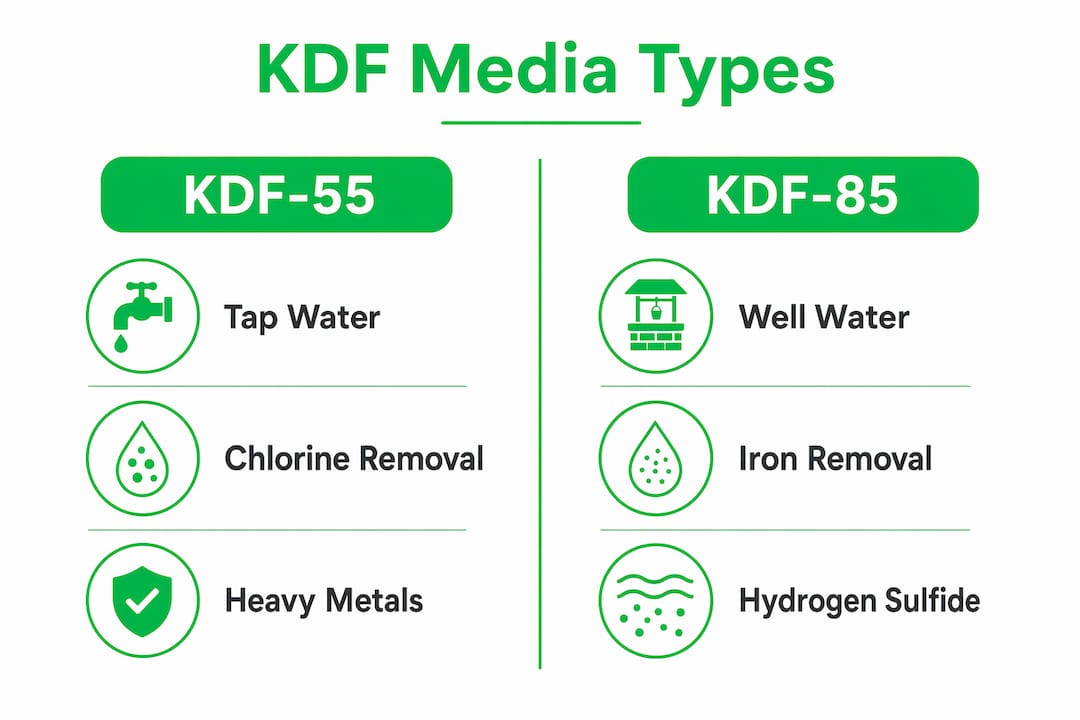
KDF-55 is optimized for municipal tap water. Its primary targets are free chlorine and soluble heavy metals like lead and mercury. If your water comes from a city supply that uses chlorine disinfection, KDF-55 is the correct choice. It removes over 99% of free chlorine and can reduce chlorine removal costs by over 50%, while extending carbon filter life by up to 15 times. That last figure matters because it directly affects how often you need to replace your filter.
KDF-85 is formulated for well water and addresses iron and hydrogen sulfide, the compounds responsible for rust staining and the rotten-egg odor common in private well supplies. Using KDF-55 on well water high in iron will foul the media quickly. Using KDF-85 on municipal water is simply wasteful.
Both formulations operate optimally between 35°F and 212°F and a pH of 6.5–8.5. Most household water falls within this range, but well water with extreme pH levels can degrade media efficiency. Testing your water before selecting a filter is the most reliable way to avoid a mismatch.
| Feature | KDF-55 | KDF-85 |
|---|---|---|
| Best water source | Municipal tap water | Well water |
| Primary targets | Chlorine, soluble heavy metals | Iron, hydrogen sulfide |
| Common application | Shower filters, drinking filters | Whole-house well water systems |
| Operating pH range | 6.5–8.5 | 6.5–8.5 |
| Operating temperature | 35°F–212°F | 35°F–212°F |
How does KDF filtration benefit skin, hair, and overall health?
Chlorine is the most common chemical in municipal water, and it is also one of the most damaging to skin and hair. It strips the natural oils from your scalp, dries out the skin barrier, and can worsen conditions like eczema and psoriasis. Removing it at the point of contact, meaning your shower, produces direct and noticeable results.
The skin and hair benefits of shower filters that use KDF media include reduced dryness, less scalp irritation, and softer hair texture. These are not cosmetic claims. They reflect the straightforward fact that skin and hair behave differently when they are not repeatedly exposed to oxidizing chemicals. Chlorine oxidizes proteins, and hair is made almost entirely of protein.
Heavy metal reduction adds another layer of protection. Lead, mercury, and arsenic are present in trace amounts in many water supplies, particularly in older homes with aging pipes. Long-term skin contact with these metals during bathing contributes to cumulative toxic exposure. KDF media removes them before they reach your skin.
The bacteriostatic properties of KDF media also matter for personal care. Filters that harbor bacterial growth can introduce microorganisms directly onto your skin and scalp. KDF’s electrochemical environment inhibits bacteria and algae growth without chemical additives, keeping the filter hygienic between replacements.
- Chlorine removal reduces skin dryness, irritation, and protein damage to hair
- Heavy metal reduction lowers cumulative toxic exposure during bathing
- Bacteriostatic properties keep the filter itself free from microbial contamination
- Pairing KDF with other media improves overall water quality for both bathing and drinking
Dermatologists and aestheticians increasingly recognize that washing your face with chlorinated water can disrupt the skin barrier and accelerate dryness. Filtering at the source addresses the problem before any topical product can.
What maintenance practices keep KDF media performing at its best?
KDF media requires specific installation and care conditions to maintain its effectiveness. The most critical concept is Empty Bed Contact Time, or EBCT. This refers to the time water spends in contact with the media bed. Undersized filter housings reduce EBCT below the threshold needed for complete redox reactions, which means contaminants pass through without being neutralized.
Flow rate directly affects EBCT. Running water too fast through a KDF bed shortens contact time and reduces removal efficiency. Shower filters are designed with this constraint in mind, but undersized or poorly matched housings will underperform regardless of media quality.
Backwashing is the primary maintenance procedure for KDF media in larger systems. Backwashing to expand the media bed by 20–40% prevents compaction, which reduces the active surface area available for redox reactions. Compacted media loses efficiency quickly. For shower filters, this translates to following the manufacturer’s replacement schedule rather than waiting for visible performance decline.
- Check your water source and match the correct KDF formulation before installation
- Verify the filter housing provides adequate EBCT for your flow rate
- Backwash larger KDF systems regularly to prevent media bed compaction
- Protect the media from exposure to acids, strong oxidizers, and direct sunlight
- Replace filter cartridges on schedule, not just when water quality visibly degrades
Pro Tip: Maintaining your water filter on a fixed schedule, rather than waiting for noticeable changes in water quality, prevents gradual performance loss that is easy to miss. KDF media does not give obvious warning signs before it stops working effectively.
Extreme water conditions accelerate media degradation. Very low pH or high oxidizer exposure degrades KDF efficiency faster than normal use. If your water is unusually acidic or has been treated with strong oxidizers, the media will need more frequent replacement.
Key Takeaways
KDF filtration media is a copper-zinc alloy that removes chlorine, heavy metals, and bacteria through redox reactions, delivering measurable benefits for skin, hair, and water safety.
| Point | Details |
|---|---|
| Core mechanism | KDF uses electrochemical redox reactions to convert chlorine to chloride and neutralize heavy metals. |
| Two main types | KDF-55 targets municipal water chlorine; KDF-85 targets well water iron and hydrogen sulfide. |
| Skin and hair benefits | Removing chlorine and heavy metals reduces dryness, scalp irritation, and protein damage to hair. |
| Best used in combination | Pairing KDF with activated carbon covers both inorganic and organic contaminants more completely. |
| Maintenance matters | Correct EBCT, regular backwashing, and scheduled replacement preserve filtration performance over time. |
Why I think most people underestimate KDF media
People researching shower filters tend to focus on what a filter removes and ignore how it removes it. That distinction matters more than most product descriptions suggest.
KDF’s redox mechanism is genuinely different from mechanical filtration or activated carbon adsorption. It does not trap contaminants in a physical matrix that gradually fills up. It chemically transforms them. That means KDF media maintains its effectiveness more consistently over time, provided the operating conditions are right.
The most common mistake I see is treating KDF as a standalone solution. It is not. KDF handles inorganic contaminants with precision, but it does not remove organic compounds, chloramines, or fluoride. A filter built on KDF alone will leave gaps. The right approach is a multi-stage system where KDF and activated carbon each handle what they do best.
The second mistake is choosing the wrong formulation. KDF-55 and KDF-85 are not interchangeable. Using KDF-55 on iron-heavy well water will foul the media in weeks. The 2026 shower filtration trends point toward multi-media systems precisely because single-media filters cannot address the full range of contaminants in modern water supplies.
My practical advice: test your water first, match the KDF type to your water chemistry, and pair it with activated carbon or Vitamin C filtration for complete coverage. Realistic expectations and correct setup will get you far better results than any single filter technology on its own.
— Sara
Vitacleanhq’s approach to KDF-based shower filtration
Vitacleanhq builds its shower filtration systems around the principle that water quality directly affects skin and hair health. Its products combine multiple filtration stages to address the full spectrum of contaminants that single-media filters miss.
The Vitamin C shower filter shots from Vitacleanhq pair Vitamin C neutralization with complementary filtration media to tackle chlorine and heavy metals at the point of use. For those looking to build a complete shower setup, the shower accessories collection includes compatible components designed for easy installation and straightforward filter replacement. Vitacleanhq also offers a filter refill subscription so maintenance stays on schedule without the guesswork of tracking replacement dates manually.
FAQ
What does KDF stand for in water filtration?
KDF stands for Kinetic Degradation Fluxion. It describes a copper-zinc alloy media that uses electrochemical redox reactions to remove chlorine, heavy metals, and inhibit bacteria in water.
Is KDF media safe for drinking water and skin contact?
KDF media meets NSF Standard 42 and does not leach harmful metals into water. The copper-zinc alloy acts as a catalyst in the redox process, leaving water safe for both drinking and skin contact.
What are the limitations of KDF filtration?
KDF-55 and KDF-85 do not remove fluoride or organic compounds like chloramines. Pairing KDF with activated carbon is necessary for comprehensive contaminant removal.
How long does KDF media last?
KDF media lifespan depends on water quality, flow rate, and maintenance. Regular backwashing and correct EBCT management extend media life, while exposure to acids or strong oxidizers shortens it.
Can KDF media replace activated carbon in a filter?
KDF media cannot replace activated carbon. The two media types target different contaminants, and combining them produces more complete filtration than either can achieve alone.