
How to Choose Skin-Friendly Filters for Your Family
TL;DR:
- Skin-friendly filters are designed to minimize skin irritation and chemical exposure, supporting the skin’s natural barrier. Choosing proper shower water and sunscreen filters involves understanding their chemistry and suitability for sensitive skin or children. Consistent maintenance, verified performance, and filter selection based on specific skin needs are essential for effective skin protection over time.
Skin-friendly filters are defined as filtration media or UV-blocking agents selected to minimize irritation, reduce harmful chemical exposure, and support the skin’s natural barrier. Knowing how to choose skin-friendly filters matters whether you are picking a shower filter to protect your family from chlorine or selecting a sunscreen with safe UV filters for your children. Both categories share a common principle: the chemistry of what touches your skin determines the health outcome. This guide covers water filters and sunscreen filters together because most families need both, and the selection criteria overlap more than most people realize.
What are the main types of skin-friendly filters?
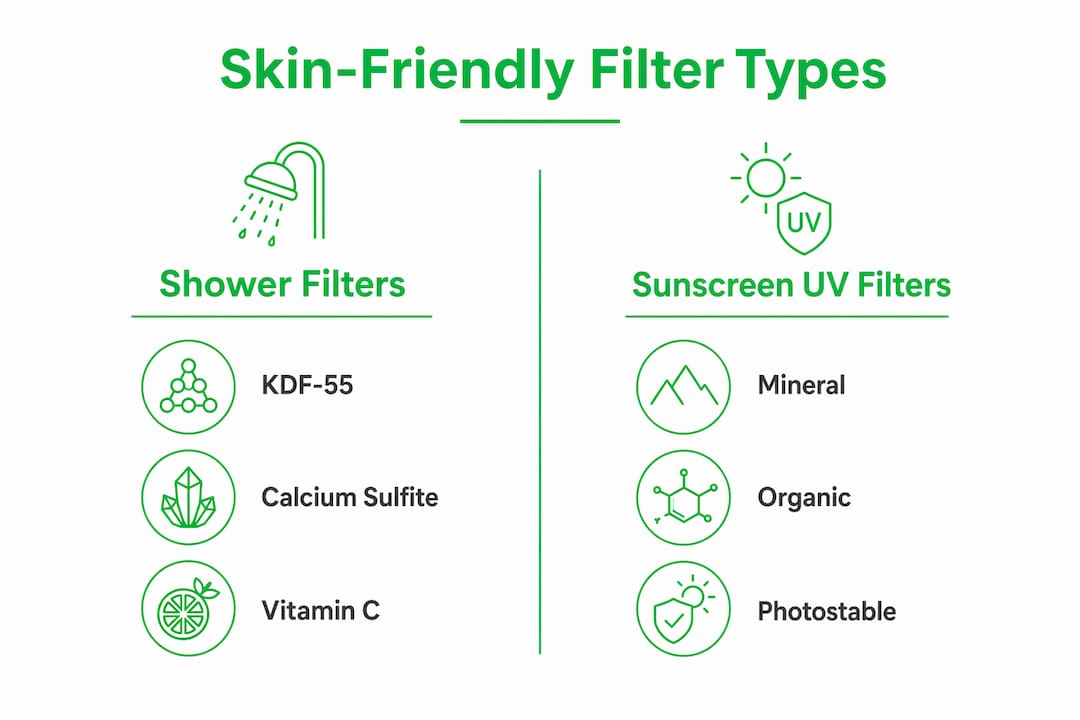
Skin-friendly filtration falls into two distinct categories: shower water filters and sunscreen UV filters. Understanding both gives you a complete picture of what your family’s skin encounters daily.
Shower water filter types
Shower water filters that reduce chlorine most effectively use KDF-55, calcium sulfite, activated carbon, or vitamin C as their active media. KDF-55 uses a redox reaction to neutralize chlorine and heavy metals. Calcium sulfite works faster than activated carbon and performs well in both hot and cold water. Vitamin C filters neutralize chlorine and chloramines almost instantly, making them one of the most thorough options for sensitive skin. Filters combining physical and chemical neutralization deliver better cumulative skin health results than simple mesh screens alone.
Sunscreen UV filter types
UV filters in sunscreens divide into two groups: mineral and organic. Mineral filters, specifically zinc oxide and titanium dioxide, sit on the skin’s surface and reflect UV rays. Dermatological guidance for 2025–2026 emphasizes mineral and advanced organic UV filters with minimal skin penetration and high photostability. Organic filters like Mexoryl XL, Tinosorb S, and Tinosorb M absorb UV energy and convert it to heat. Oxybenzone and octinoxate remain on the avoid list due to allergy risk and hormonal concerns.

Filter comparison at a glance
| Filter type | Penetration risk | Allergy risk | Photostability | Best for |
|---|---|---|---|---|
| Zinc oxide (mineral) | Very low | Low | High | Sensitive skin, children |
| Titanium dioxide (mineral) | Very low | Low | High | Daily use, fair skin |
| Tinosorb S / Tinosorb M | Negligible | Low | Very high | Broad-spectrum coverage |
| Mexoryl XL | Low | Low | High | UVA protection |
| KDF-55 (shower) | N/A | Very low | N/A | Chlorine and heavy metal removal |
| Vitamin C (shower) | N/A | Very low | N/A | Chlorine and chloramine removal |
| Oxybenzone | High | Moderate to high | Moderate | Not recommended |
How to evaluate water filters that support healthy skin
Choosing a shower water filter for skin health requires more than picking the cheapest option on the shelf. Four criteria separate filters that genuinely protect skin from those that simply look the part.
- Chlorine and heavy metal reduction. Chlorine strips the skin’s lipid barrier, causing dryness and irritation over time. Chlorine reduction through filtered water directly supports skin hydration and barrier repair. Look for filters that list chlorine reduction as a verified performance claim, not just a marketing phrase.
- Third-party certification. NSF/ANSI 177 certification is the key differentiator for shower filters guaranteeing chlorine reduction performance. No federal law requires this standard, so voluntary certification is the clearest signal of a trustworthy product.
- Filter media lifespan. Cartridge replacement every 3–6 months is the standard for most shower filters. Delayed replacement leads to microbial buildup and loss of filtration efficiency, which can worsen skin conditions rather than improve them.
- Water flow and installation. A filter that restricts water pressure below comfortable levels gets removed. KDF-55 and calcium sulfite media require plumber’s tape during installation to prevent leaks. Compact filter housings may need more frequent cartridge changes because they hold less filtration media than larger models.
Pro Tip: Set a phone reminder every three months to check your filter cartridge. Consistent replacement is the single most reliable way to maintain the skin benefits of filtered water.
Shower filter benefits are cumulative. Reduced dryness and a stronger lipid barrier typically appear over weeks, not after a single shower. Setting realistic expectations keeps families committed to the habit long enough to see real results.
How to choose sunscreen filters safe for sensitive skin and children
Selecting a skin-friendly sunscreen filter starts with molecular weight. UV filters with molecular weights above 500 Daltons show negligible systemic absorption, meaning they do not meaningfully enter the bloodstream. This threshold is the primary safety benchmark used in current dermatological guidance for children’s sunscreens.
- Prioritize high-molecular-weight filters. Mexoryl XL, Uvinul A Plus, Tinosorb M, and Tinosorb S all meet the 500 Dalton threshold. These filters provide broad-spectrum UVA and UVB coverage with minimal penetration risk.
- Avoid oxybenzone and octinoxate. Oxybenzone is linked to allergy and hormonal concerns and has a low molecular weight that allows skin penetration. Octinoxate carries similar concerns. Both appear on the avoid list in current guidance for children and people with sensitive skin.
- Check photostability. A UV filter that degrades in sunlight stops protecting within hours. Bemotrizinol offers broad-spectrum UVA1 coverage with strong photostability and a lighter cosmetic feel, which encourages consistent daily use.
- Read the full ingredient list. The active UV filter is only part of the formula. Fragrances, preservatives, and solvents in the base can cause irritation even when the UV filter itself is inert. The role of sunscreen formulation in real-world skin health depends as much on these supporting ingredients as on the active filter.
Pro Tip: Apply sunscreen 15 minutes before sun exposure and reapply every two hours. Even the most photostable filter loses effectiveness without consistent reapplication.
Cosmetic elegance matters more than most parents expect. Filters with a lighter feel and no white cast increase the likelihood that children and adults actually use the product daily. A technically superior filter that sits unused in a cabinet provides zero protection.
Common misconceptions when choosing and using skin-friendly filters
Several widespread beliefs lead families to make filter choices that do not deliver the results they expect.
Misconception 1: All mineral sunscreens are irritation-free. Mineral UV filters like zinc oxide and titanium dioxide are generally well tolerated, but formulation vehicle ingredients such as fragrances, preservatives, and solvents cause irritation even when the active filter is inert. A mineral label does not guarantee a gentle product. Always check the full ingredient list, not just the active section.
Misconception 2: Soft water equals filtered water. Soft water has had calcium and magnesium removed through ion exchange, but it still contains chlorine and chloramines. Filtered water, produced by KDF-55, vitamin C, or activated carbon media, specifically targets the chemicals that damage the skin barrier. The two processes address different problems and are not interchangeable.
Misconception 3: Nano-sized mineral particles always penetrate skin. The nano designation in sunscreen ingredients concerns many parents, but molecular weight, not particle size alone, determines penetration risk. Current evidence shows that nano zinc oxide and nano titanium dioxide do not penetrate intact skin to a meaningful degree.
“The ‘skin-friendly’ trait depends not only on active filter ingredients but critically on the formulation vehicle. Avoiding sensitizing agents in the base formula is as important as choosing the right active filter for long-term skin barrier health.”
Troubleshooting common filter problems:
- Early clogging in shower filters usually signals high sediment levels in your tap water. A sediment pre-filter installed before the main cartridge extends its life significantly.
- Skin reactions after switching sunscreens are more often caused by a new fragrance or preservative than by the UV filter itself. Switch to a fragrance-free formula before changing the active filter.
- Interpreting ingredient lists requires looking past the active ingredient section. If you see “parfum,” “benzyl alcohol,” or “methylisothiazolinone” in a product marketed for sensitive skin, those ingredients are worth researching before you commit. If you experience persistent irritation, soothing irritated skin requires addressing the ingredient source, not just treating the symptom.
Key takeaways
Choosing skin-friendly filters requires matching filter chemistry to your family’s specific skin needs, verifying third-party certifications, and maintaining replacement schedules consistently.
| Point | Details |
|---|---|
| Match filter type to the problem | Use KDF-55 or vitamin C shower filters for chlorine; use high-molecular-weight UV filters for sun protection. |
| Verify certifications | NSF/ANSI 177 certification confirms a shower filter’s chlorine reduction performance. |
| Replace cartridges on schedule | Shower filter cartridges need replacement every 3–6 months to prevent microbial buildup and maintain skin benefits. |
| Check the full formula, not just the active filter | Fragrances and preservatives in sunscreen bases cause irritation independent of the UV filter chosen. |
| Prioritize cosmetic elegance for compliance | Filters and sunscreens that feel good get used consistently, which is the only way they deliver real skin protection. |
What I’ve learned from living with skin-friendly filters every day
Most articles on this topic treat filter selection as a one-time research project. My experience says it is an ongoing practice, and the mindset shift matters as much as the initial choice.
I spent years advising parents who had done everything right on paper: they chose mineral sunscreens, installed certified shower filters, and read every label. Yet they still reported skin irritation or disappointment. Almost every time, the problem was not the filter. It was the base formula, a delayed cartridge change, or a product that felt so heavy that no one in the family actually used it consistently.
The uncomfortable truth is that the “best” filter on a specification sheet is not the best filter for your family if it sits unused. Cosmetic elegance and ease of maintenance are not secondary concerns. They are the primary factors that determine whether a filter choice actually protects skin over months and years.
Formulations evolve quickly. Bemotrizinol and the Tinosorb family represent a generation of UV filters that were not widely available to consumers five years ago. Staying informed means revisiting your choices annually, not treating a single purchase as a permanent solution. The same applies to shower filters: a cartridge that worked well for your water supply last year may need a different media type if your municipality changes its treatment process.
My honest advice is to start with the simplest change that addresses your biggest concern, maintain it consistently, and add complexity only when the results justify it. One well-maintained vitamin C shower filter and one fragrance-free mineral sunscreen will outperform a cabinet full of products that never get used.
— Sara
Vitacleanhq’s approach to skin-friendly shower filtration
Vitacleanhq builds its shower filter line around the principle that consistent, easy maintenance produces better skin outcomes than complex systems that get neglected.
The Vitamin C shower filter shots from Vitacleanhq neutralize chlorine and chloramines at the point of contact, supporting skin hydration from the first shower. The ceramic filter option adds a layer of impurity reduction for households with harder water. Both systems install without tools in minutes. For families who want to stay on schedule without thinking about it, the filter refill plan delivers replacement cartridges automatically, removing the most common reason filters stop working: a forgotten replacement date.
FAQ
What does “skin-friendly” mean in a shower filter?
A skin-friendly shower filter reduces chlorine, chloramines, and heavy metals that strip the skin’s natural lipid barrier. Filters using KDF-55, calcium sulfite, or vitamin C media are the most common options for achieving this.
How often should I replace a shower filter cartridge?
Most shower filter cartridges require replacement every 3–6 months. Delayed replacement causes microbial buildup and loss of filtration efficiency, which can worsen skin dryness and irritation.
Are mineral sunscreens always safe for sensitive skin?
Mineral UV filters like zinc oxide and titanium dioxide are generally low-risk, but the base formula matters equally. Fragrances and preservatives in the product can cause irritation even when the active filter is inert.
What UV filters are safest for children?
UV filters with molecular weights above 500 Daltons, including Mexoryl XL, Tinosorb M, and Tinosorb S, show negligible systemic absorption and are recommended in current dermatological guidance for children. Oxybenzone should be avoided due to allergy and hormonal concerns.
Does a compact shower filter work as well as a larger one?
Compact shower filter housings hold less filtration media than larger models, which means they may need more frequent cartridge changes to maintain the same level of chlorine reduction. Performance depends on consistent maintenance, not housing size alone.