
The Role of Water Quality in Beauty and Skin Health
TL;DR:
- Water quality significantly impacts skin and hair health by depositing minerals and contaminants that clog pores and disrupt pH levels. Using filtered or soft water improves product absorption, reduces dryness, and enhances hair shine, leading to better skincare and beauty results. Installing targeted water filters can prevent mineral buildup, optimize product performance, and promote healthier skin and hair.
Water quality is a foundational factor in beauty, directly shaping how your skin looks, how your hair behaves, and how well your skincare products actually work. Most people spend hundreds of dollars on serums, shampoos, and moisturizers while ignoring the one thing that touches their skin every single day: tap water. The role of water quality in beauty is not a niche concern. Over 85% of American households live in hard water areas, meaning the majority of people wash their faces and hair with mineral-laden water that actively works against their beauty goals. Understanding this is the first step toward doing something about it.
How do minerals and contaminants in water impact skin health?
Hard water contains high concentrations of calcium and magnesium. These minerals bond with soap and cleanser residue to form a film on the skin’s surface. That film clogs pores, traps bacteria, and prevents moisturizers from absorbing properly.
The damage goes deeper than surface residue. Hard water’s alkalinity pushes skin pH well above its optimal level of 5.5. When skin pH rises, protective enzymes lose their balance, the skin barrier weakens, and water loss through the skin accelerates. The result is dryness, redness, and sensitivity that no moisturizer can fully correct because the root cause is still in the water.
Contaminants make the problem worse. The Environmental Working Group (EWG) has identified 324 contaminants in U.S. tap water, including chlorine, lead, fluoride, PFAS, and volatile organic compounds. These chemicals strip the skin’s natural oils and trigger chronic low-grade inflammation. Over time, that inflammation accelerates visible aging.
The most common skin effects of poor water quality include:
- Dryness and flaking caused by mineral residue blocking moisture absorption
- Breakouts and clogged pores from calcium and magnesium film left on skin
- Redness and sensitivity linked to disrupted skin pH and barrier function
- Premature aging driven by chlorine and other oxidizing contaminants
- Eczema flares worsened by alkaline water disrupting the skin’s protective layer
Pro Tip: If your moisturizer stops working as well as it once did, check your local water report before buying a new product. Hard water may be the reason your skin feels tight again an hour after applying cream.
What effects does water quality have on hair appearance and scalp health?
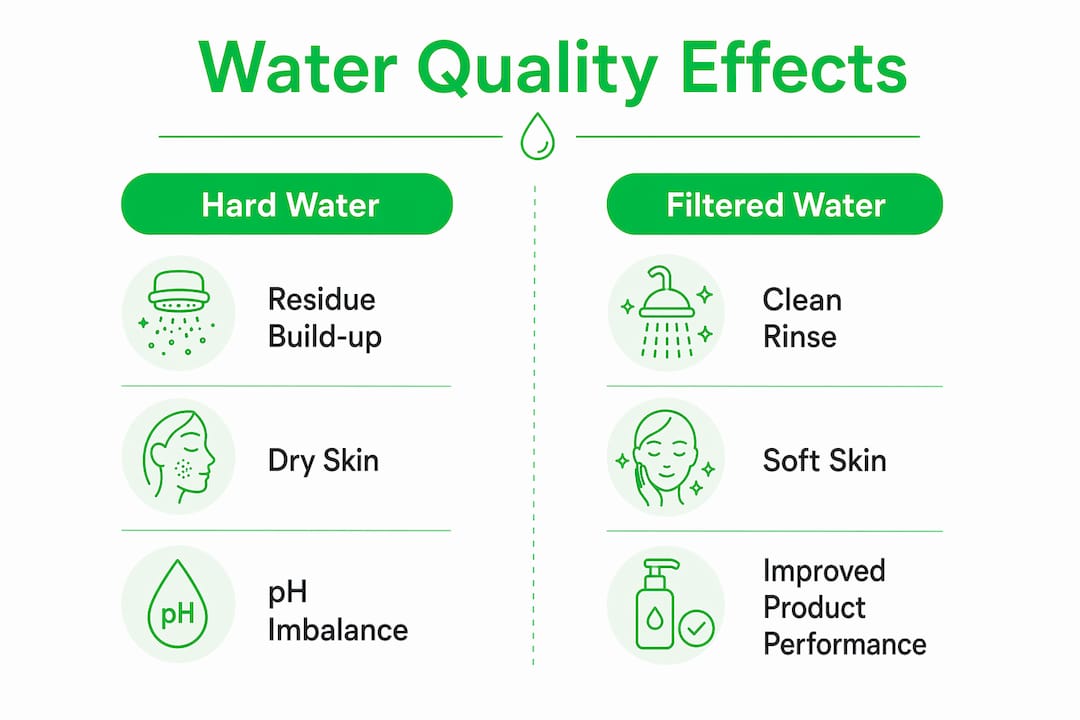
Hard water minerals coat individual hair fibers with a thin layer of calcium and magnesium. That coating makes hair feel rough, look dull, and tangle more easily. Color-treated hair loses vibrancy faster because mineral buildup interferes with how pigment molecules sit inside the hair shaft.

Mineral buildup also reduces shampoo foaming, which leads people to use more product to get a lather. Using excess shampoo strips the scalp further, creating a cycle of dryness and irritation. Chlorine compounds the problem by drying out the scalp and weakening the hair fiber itself.
Filtered water breaks that cycle. When mineral residue is removed from shower water, shampoo lathers with less product, hair rinses cleaner, and the scalp retains its natural moisture balance. The difference in texture and shine is noticeable within a few weeks of switching to filtered water.
- Dull, flat hair caused by mineral coating that blocks light reflection
- Scalp irritation and flaking from chlorine and alkaline mineral exposure
- Reduced product performance because hard water neutralizes shampoo and conditioner
- Color fade accelerated by mineral interference with hair dye molecules
- Breakage and fragility from weakened hair fibers stripped by chlorine
Pro Tip: After coloring your hair, do a final rinse with filtered or bottled water. It seals the cuticle without mineral interference and extends color vibrancy by several washes.
How does water quality affect the stability and performance of beauty products?
The water you use does not just affect your skin and hair directly. It also changes how your beauty products perform. Mineral ions in tap water chemically destabilize cosmetic emulsions and preservatives. That is why professional cosmetic labs use deionized or ultra-pure water as a manufacturing standard. The same principle applies at home.
When you mix a face mask, dilute a cleanser, or apply a product to skin still wet from a hard water rinse, mineral ions interfere with the product’s chemistry. Emulsions can separate. Preservatives lose effectiveness. Active ingredients like vitamin C and retinol oxidize faster when exposed to metal ions from tap water.
| Water Type | Effect on Skin | Effect on Products |
|---|---|---|
| Hard tap water | Residue, dryness, pH disruption | Destabilizes emulsions, reduces foam |
| Chlorinated water | Strips oils, causes inflammation | Degrades preservatives, oxidizes actives |
| Soft or filtered water | Rinses cleanly, supports hydration | Maintains product consistency and absorption |
| Deionized water | Neutral, no mineral interference | Industry standard for cosmetic manufacturing |
Mineral ions cause product instability issues that are commonly blamed on the product itself, including foam loss, graininess, and separation. That expensive serum may not be failing because of its formula. It may be failing because of what is in your water.
How can consumers improve their water quality at home?
Improving your water quality does not require a whole-house softening system. Targeted solutions at the point of use, specifically the shower and sink, deliver real results at a fraction of the cost.
-
Install a showerhead filter. Modern shower filters retain strong water flow while reducing hard water minerals and chlorine. Vitamin C-based filters neutralize chlorine on contact. Ceramic ball filters reduce heavy metals and bacteria. Both types install in minutes without tools.
-
Use filtered water for your final face rinse. Filtered water for the final rinse removes mineral scum that blocks active ingredients from penetrating the skin. This single change improves the absorption of serums and moisturizers applied immediately after.
-
Choose the right filter for your water type. People in cities with heavily chlorinated water benefit most from activated carbon or Vitamin C filters. People in hard water regions need filters that specifically target calcium and magnesium. Your local water quality report, available from your municipality, tells you exactly what you are dealing with.
-
Replace filter cartridges on schedule. A clogged or expired filter can release trapped contaminants back into the water. Most shower filter cartridges need replacement every one to three months depending on usage and local water hardness.
-
Consider a handheld filtered showerhead. Handheld models let you control water direction, which is useful for rinsing hair thoroughly without soaking your face in unfiltered water. They also make it easier to do targeted scalp rinses with conditioned water.
Pro Tip: Keep a small pitcher filter or a bottle of distilled water near your bathroom sink. Use it for your final face rinse every morning. Your skin will feel noticeably smoother within two weeks, and your serums will absorb faster.
Localized improvements like showerhead filters significantly improve skin and hair health without the cost or complexity of whole-home systems. For renters especially, a showerhead filter is the most practical and affordable upgrade available.
Hard water vs. filtered water: what actually changes for your skin and hair?
The difference between washing with hard water and washing with filtered water is not subtle. Hard water leaves a physical residue on skin and hair that accumulates with every shower. Filtered water rinses completely clean, leaving no mineral film behind.
| Factor | Hard water | Filtered water |
|---|---|---|
| Skin feel after washing | Tight, dry, slightly rough | Soft, smooth, hydrated |
| Hair texture | Dull, tangled, brittle | Shiny, manageable, strong |
| Product lather | Reduced, requires more product | Full lather with less product |
| Skincare absorption | Blocked by mineral residue | Direct contact with skin |
| Scalp condition | Irritated, flaky | Balanced, comfortable |
The effects on skin and hair between water types are measurable in texture, shine, and how long your skincare results last. Switching to filtered water does not replace your skincare routine. It makes everything in that routine work the way it was designed to.
Key takeaways
Water quality is the most overlooked factor in beauty routines, and addressing it at the source delivers better results than adding more products.
| Point | Details |
|---|---|
| Hard water affects most Americans | Over 85% of U.S. households have hard water that leaves mineral residue on skin and hair. |
| pH disruption drives skin damage | Hard water raises skin pH above 5.5, weakening the barrier and accelerating moisture loss. |
| Product performance depends on water | Mineral ions destabilize emulsions and degrade active ingredients before they reach your skin. |
| Shower filters are the practical fix | Vitamin C and ceramic filters reduce chlorine and minerals without reducing water pressure. |
| Final rinse with filtered water matters | Using filtered water for the last rinse improves absorption of serums and moisturizers. |
Water quality was the missing piece in my beauty routine
The most common mistake I see people make is spending more money on products when their results plateau. A new retinol, a pricier cleanser, a different brand of shampoo. The water never comes up. But water is the first thing that touches your skin every morning and the last thing that touches your hair every night.
I started paying attention to water quality after noticing that my skin felt drier in winter, even though my routine had not changed. The culprit was not the season. It was that my building’s water pressure dropped in cold months, which changed how the pipes flushed and increased mineral concentration at the tap. Once I added a Vitamin C shower filter, the seasonal dryness stopped.
The other thing most people miss is the connection between water and product efficacy. Ignoring water quality undermines expensive products because mineral residue on skin acts as a physical barrier. Your $80 serum is sitting on top of a calcium film, not on your skin. That is not a product failure. That is a water problem.
Filtered water is not a luxury upgrade. It is the baseline your skin and hair need to respond to everything else you are doing. The benefits of shower filtration for skin and hair are well documented, and the cost of a quality filter is a fraction of what most people spend on serums in a single month.
— Sara
What Vitacleanhq offers for better water and better skin
If your skin feels tight after washing, your hair looks dull despite conditioning, or your serums seem to stop working, your shower water is likely the cause.
Vitacleanhq’s Vitamin C Shots shower filters neutralize chlorine on contact and reduce mineral buildup without cutting water pressure. The ceramic filter collection targets heavy metals and bacteria for a deeper level of water conditioning. Both systems install in minutes and come with a subscription option for easy cartridge replacement, so your water stays clean without any guesswork. If you want to understand exactly how filtration works at the shower level, Vitacleanhq’s guide on how filtration improves shower quality breaks it down clearly.
FAQ
Does hard water cause acne and breakouts?
Hard water leaves a mineral film on skin that clogs pores and traps bacteria, which can trigger or worsen acne. Switching to filtered water reduces this residue and supports clearer skin over time.
What is the best water to use for washing your face?
Filtered or soft water is the best option for face washing because it rinses completely clean without leaving mineral deposits. A final rinse with filtered water also improves how well serums and moisturizers absorb.
How does water quality affect hair color?
Hard water minerals interfere with hair dye molecules and accelerate color fade by coating the hair fiber. Using filtered water for rinsing after coloring extends vibrancy and keeps color looking fresh longer.
Can a shower filter really make a difference for skin and hair?
Yes. Modern shower filters reduce chlorine and hard water minerals without reducing water pressure, and the improvement in skin softness and hair texture is typically noticeable within a few weeks of consistent use.
Why do beauty products perform differently in different cities?
Water mineral content varies significantly by location, and those minerals destabilize product emulsions and reduce lather. The same shampoo or cleanser can perform very differently depending on whether local water is hard or soft.