
Sediment Filters in Water Systems: What Homeowners Need to Know
Sediment filters are mechanical screens that physically block suspended solids — sand, silt, rust, and debris — from passing through your water lines. They are the right first-stage treatment when water tests show elevated turbidity or visible particles, and they protect every downstream filter and appliance you own. The CDC recommends testing your water before choosing any filtration method; sediment filtration is only the correct answer when suspended solids are actually the problem. In professional stormwater applications, properly maintained sediment systems can remove 40–90% of total suspended solids. For shower-focused skin and hair goals, a sediment pre-filter pairs with a point-of-use solution like Vitacleanhq’s vitamin C shower filters to address both particles and dissolved chlorine.
Quick guide to when you need what:
- High turbidity or visible particles: Install a point-of-entry (POE) sediment filter first
- RO or UV system: A 5-micron sediment pre-filter is typically required upstream
- Chlorine, VOCs, or dissolved metals: Add activated carbon or a vitamin C shower filter — sediment filtration alone will not touch these
- Bacteria or pathogens: UV disinfection or reverse osmosis, not sediment filtration
Table of Contents
- How sediment filters work in your home water system
- What filter types fit which part of your home system
- What sediment filters do NOT remove — and why that matters for skin and hair
- How to choose the right sediment filter for your home
- Installation, maintenance, and what to do when pressure drops
- How sediment filtration affects your skin, hair, and scalp
- Which water tests to run and what to do with the results
- Key Takeaways
- Why sediment filtration is only half the shower story
- Cleaner shower water starts with the right filter combination
- Useful sources and resources
How sediment filters work in your home water system
Sediment filtration is purely mechanical: no chemistry, no adsorption — just water pressure forcing flow through a porous medium that traps particles larger than its pore size. The finer the pore, the more it captures, but also the more resistance it creates.
Micron ratings tell you exactly what a filter stops. A 5-micron filter traps anything 5 microns or larger. RO pre-filters are typically rated at 5 microns; private wells may need ratings anywhere from 2 to 15 microns depending on whether the problem is fine clay or coarser sand. For micron rating guidance, the particle-size table below is your starting point.
| Particle Type | Approximate Size | Suggested Filter Rating |
|---|---|---|
| Sand | — | spin-down |
| Silt | 2 microns | 10 micron cartridge |
| Clay | 2 microns | 1–5 micron or microfiltration |
| Rust flakes | 5 microns | 5 micron cartridge |
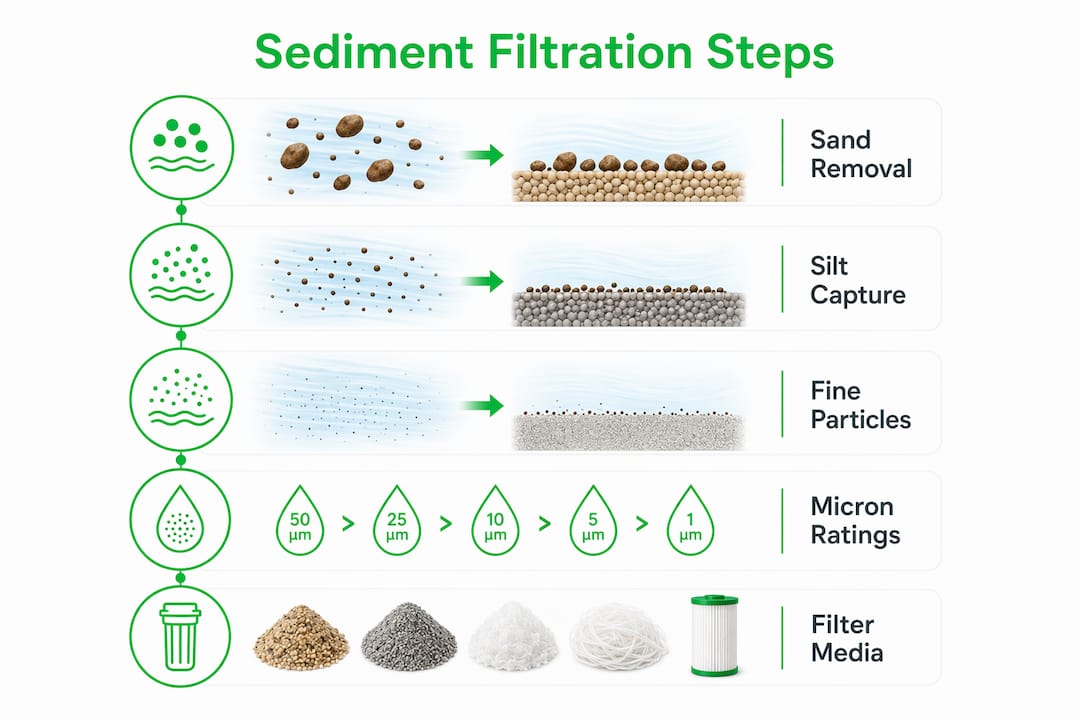
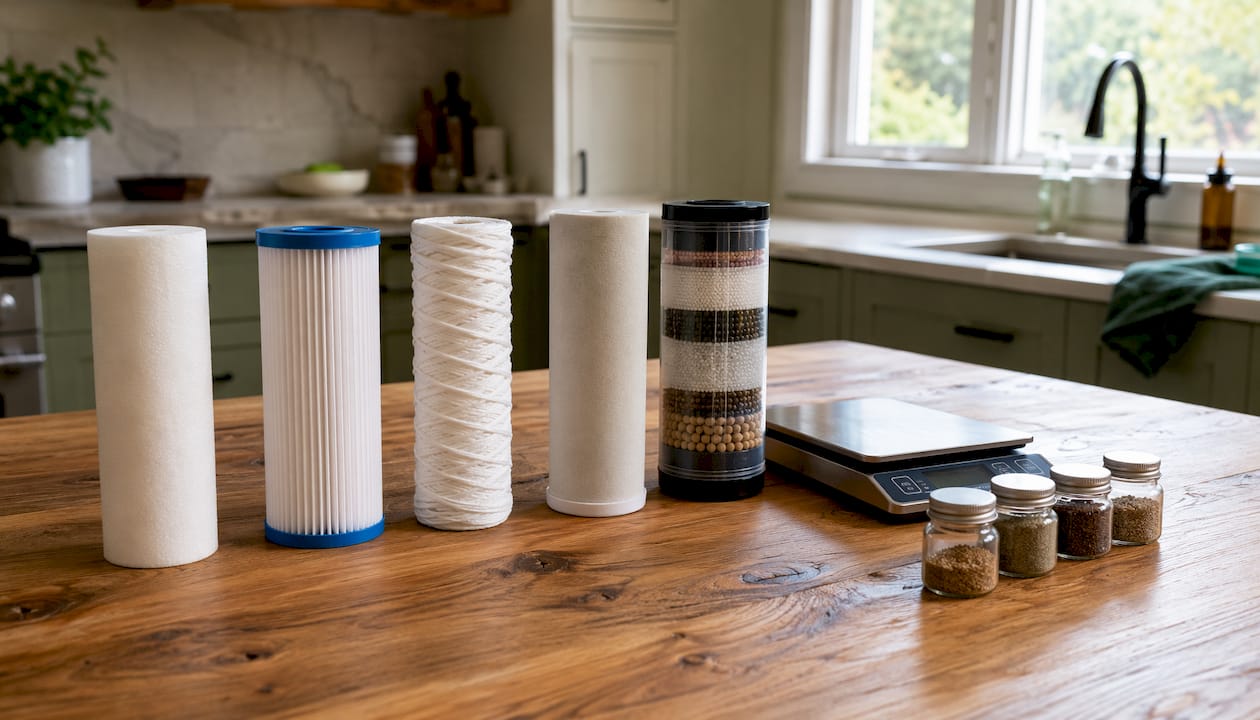
Common filter media include spun polypropylene, pleated polyester, wound/string, ceramic, and multimedia beds. Pleated cartridges offer more surface area and longer service life between changes. Multimedia filters use layered beds of different materials and can be backwashed and reused, which reduces ongoing cartridge costs.
Pro Tip: Don’t reflexively choose the smallest micron rating. A 2-micron cartridge can noticeably reduce household flow if your system pressure is insufficient. Check your static pressure first.
What filter types fit which part of your home system
The right filter type depends on your water source and what you are protecting downstream. Well water with heavy sand needs a different approach than municipal water with occasional rust.
| Filter Type | Best Use Case | Flow Rate | Maintenance Style |
|---|---|---|---|
| Spin-down / screen | Heavy sand, large debris, well water | High | Flush manually or auto-flush |
| Pleated cartridge | Routine POE, moderate sediment | Medium–high | Replace every 3–6 months |
| Spun polypropylene | Fine particles, RO/UV pre-filter | Medium | Replace every 1–3 months |
| Multimedia / sand | High-volume POE, well systems | High | Backwash periodically |
| Bag filter | Industrial or high-flow residential | Very high | Replace bag |
Mechanical filtration methods like multimedia filters work well at point-of-entry because they handle high flow and can be backwashed rather than discarded. For under-sink or shower pre-filtration, a small spun polypropylene cartridge is the standard choice.
Placement rules that matter:
- Sediment filter goes first — before carbon, softener, RO, or UV
- POE placement protects appliances (water heater, dishwasher, washing machine)
- POU placement (under-sink, shower line) targets specific use points
- Never install a sediment filter downstream of carbon or a softener; it will consume adsorption and resin capacity rapidly
What sediment filters do NOT remove — and why that matters for skin and hair
Sediment filters remove suspended particles only. They do not touch dissolved chlorine, heavy metals, VOCs, nitrates, or bacteria. This is the most common misunderstanding homeowners have, and it directly affects skin and hair outcomes.
If your skin feels dry or irritated after showering, particles are rarely the sole cause. Dissolved chlorine strips the skin’s natural oils and disrupts the scalp’s moisture balance. A sediment filter will not fix that. You need a carbon block or a vitamin C-based shower filter to neutralize chlorine at the point of use. Understanding how water quality affects skin helps clarify which treatment actually addresses the cause.
What sediment filters leave behind:
- Dissolved chlorine and chloramines
- VOCs and trihalomethanes
- Heavy metals (lead, arsenic, dissolved iron)
- Bacteria, viruses, and protozoa
- Dissolved nitrates and pesticides
There is one indirect benefit worth noting: removing particles protects downstream carbon or vitamin C cartridges from clogging, so those treatments work longer and more effectively. That protection is often the more valuable economic benefit than the aesthetic improvement alone.
Pro Tip: If skin or hair issues persist after installing a sediment filter, test specifically for chlorine and dissolved metals. The CDC’s testing-first guidance applies here — match the treatment to what your test actually finds.
How to choose the right sediment filter for your home
Start with your water test results, not a product page. Match the micron rating to the particle sizes present, then check whether your household pressure can handle the restriction.
- Run a water test first. Order a certified lab test or request your municipality’s annual water quality report. Look for turbidity, TSS, iron, manganese, and chlorine.
- Match micron to particle size. Whole-house with light rust: 15–20 microns. Drilled well: 10–15 microns. Fine clay or RO/UV pre-filter: 2–5 microns.
- Check your water pressure. Measure static pressure at an outdoor spigot. Sub-5-micron cartridges need adequate pressure to maintain flow.
- Decide POE vs. POU. Appliance protection = POE whole-house. Shower skin/hair focus = POU on the shower line or under-sink for drinking water.
- Estimate flow demand. A family of four typically needs 8–12 gpm at POE. Confirm the filter’s rated flow matches your peak demand.
- Plan your maintenance budget. Disposable cartridges cost less upfront; backwashable multimedia costs more initially but less over time.
Pro Tip: For heavy sediment, use a staged approach: a coarse spin-down upstream of a fine cartridge extends cartridge life significantly and prevents constant replacements.
Installation, maintenance, and what to do when pressure drops
Install the sediment filter as the first device after the meter or pressure tank. Everything else — carbon, softener, RO, UV — goes downstream.
Basic DIY cartridge swap:
- Shut off the water supply to the filter housing
- Relieve pressure by opening a downstream faucet
- Unscrew the filter housing with the provided wrench
- Remove the spent cartridge and rinse the housing
- Insert the new cartridge, hand-tighten the housing, and restore water supply
- Check for leaks at the housing threads before walking away
Maintenance and troubleshooting:
- Persistent low flow: Clogged cartridge or micron rating too fine for your pressure — replace or upsize
- Discoloration after a cartridge change: Plumbing debris dislodged during installation; flush for 2–3 minutes
- Bacterial smell or biofilm: Replace the cartridge immediately and test for coliform — neglected cartridges can become a contamination source
- Spin-down screen: Flush weekly if sediment load is high; inspect monthly otherwise
- Multimedia filter: Backwash per manufacturer schedule, typically every 1–4 weeks depending on load
Cartridge lifespan varies widely. Light municipal sediment: 6–12 months. Moderate well sediment: 3–6 months. Heavy sand or iron: monthly or more. Monitor pressure drop rather than relying on a fixed calendar.
How sediment filtration affects your skin, hair, and scalp
Sediment filters can indirectly improve skin and hair by removing abrasive particles and protecting the downstream treatments that actually address chemical causes of dryness and irritation. On their own, they rarely resolve chlorine-related complaints.
Direct benefits are real but limited: less grit in shower water, reduced appliance scaling, and cleaner water appearance. The bigger gain comes from what sediment pre-filtration enables. When particles are removed first, a vitamin C or carbon shower filter works at full capacity instead of spending its media on trapping debris. That means more chlorine neutralization per cartridge, which is what shower filters deliver for hair and skin.
Treatment train for skin and hair goals:
- Stage 1: POE sediment filter (removes particles, protects appliances)
- Stage 2: Point-of-use carbon or vitamin C shower filter (neutralizes chlorine, addresses dissolved irritants)
- Stage 3 (optional): Specialty media — RO for drinking water, softener for hard water scaling
For colored or treated hair, reducing abrasive particles at the shower head matters. Fewer particles mean less mechanical friction on the hair shaft during washing, which helps protect hair extensions and color-treated strands from premature damage. When water quality improves, topical products like a copper peptide serum also absorb more effectively on skin that isn’t being stripped by chlorine and grit.
Which water tests to run and what to do with the results
Test before you buy. The CDC’s guidance is consistent: match your treatment to what your test actually finds.
- Get your municipal water quality report. Available free from your water utility — it covers regulated contaminants and annual averages.
- Order a certified lab test for TSS, turbidity, iron, manganese, chlorine, lead, and coliform bacteria. NSF-certified labs are listed at nsf.org.
- Read the results: High TSS or turbidity → sediment filter. Dissolved chlorine or VOCs → carbon or vitamin C shower filter. Elevated lead or arsenic → RO. Coliform detected → UV or boil advisory first.
- Install in the correct order: POE sediment filter first, then downstream specialty treatment.
- Retest after 3–6 months to confirm the system is performing and no new issues have developed.
Recommended tests:
- Turbidity and total suspended solids (TSS)
- Iron and manganese (dissolved and particulate)
- Free chlorine and chloramines
- Lead and copper
- Coliform bacteria
Sediment filters work with oxidizing treatments for dissolved iron: aeration or chlorination converts dissolved iron to particulate form that the filter can then trap. If your test shows dissolved iron, plan for oxidation upstream of the sediment filter.
Key Takeaways
Sediment filters are a first-stage mechanical treatment that protect downstream equipment and extend the life of specialty media, but they require complementary treatment to address dissolved chlorine, metals, or pathogens.
| Point | Details |
|---|---|
| Particles only | Sediment filters stop suspended solids; they do not remove chlorine, heavy metals, bacteria, or dissolved chemicals. |
| Test water first | CDC guidance recommends testing before choosing any filter — match treatment to what your results show. |
| Micron selection matters | Match micron rating to particle size and system pressure; too fine a rating reduces flow without added benefit. |
| Sediment goes first | Always install the sediment filter before carbon, softener, RO, or UV to protect downstream media and membranes. |
| Vitacleanhq shower filters | A Vitacleanhq vitamin C or ceramic shower filter slots downstream of a sediment pre-filter to address chlorine and improve skin and hair outcomes. |
Why sediment filtration is only half the shower story
Most homeowners who install a sediment filter and expect softer skin or shinier hair are going to be disappointed — not because the filter failed, but because particles were never the main problem. Chlorine is. It’s in virtually every municipal water supply, and it’s the primary driver of dry skin, scalp irritation, and brittle hair after showering.
Sediment filtration earns its place as the foundation of a good home water system. It protects your appliances, extends the life of every downstream filter, and removes the grit that makes water feel harsh. But it is a support player for skin and hair, not the solution itself. The treatment that actually changes how your skin and hair feel is the one neutralizing chlorine at the point of use.
The upgrade path that makes sense for most households: start with a coarse POE sediment filter if your water shows turbidity, then add a vitamin C or carbon shower filter for the chemical side of the problem. That two-stage approach addresses both the mechanical and chemical causes, and it is far more effective than either alone.
Cleaner shower water starts with the right filter combination
If your water test shows particles plus chlorine — which describes most U.S. municipal supplies — a sediment pre-filter alone will not get you to the skin and hair results you are after. That is exactly where Vitacleanhq’s vitamin C shower filter shots fit in. They slot downstream of a sediment pre-filter and neutralize chlorine directly at the shower head, which is where it matters most for your skin and scalp.
The handheld shower filter installs in minutes with no tools, and the filter refill plan keeps replacement cartridges arriving on schedule so you never let a spent filter sit and accumulate bacteria. Pre-filtration extends cartridge life, which means your subscription goes further. Browse the full range at Vitacleanhq and find the shower filter that fits your system.
Useful sources and resources
Use these to verify claims, find certified testing labs, and read the primary guidance behind the recommendations in this article.
- CDC — Choosing home water filters: cdc.gov/drinking-water — testing guidance and filter type comparisons
- Nebraska Extension G1492 — Sediment Filtration: extensionpubs.unl.edu — cartridge types, replacement schedules, and limitations
- NDSU Extension WQ1029 — Filtration: ndsu.edu — micron selection and pressure guidance
- UGA CAES — Mechanical filtration methods: fieldreport.caes.uga.edu — media types and backwash operation
- UGA Extension C819 — Iron and manganese removal: fieldreport.caes.uga.edu — oxidation and sediment filter pairing
- NSF International — Certified product listings: nsf.org/certified-products — find NSF-certified filters and labs
- EPA — Water quality and stormwater resources: epa.gov — performance data and BMP guidance for sediment systems