
The Role of Activated Carbon in Filters Explained
TL;DR:
- Activated carbon removes chlorine, VOCs, and taste/odor compounds through surface adsorption but needs regular replacement to prevent contaminant breakthrough. It cannot reliably remove bacteria, nitrates, fluoride, or heavy metals, requiring additional treatment methods for those issues. Proper design, certification verification, and maintenance are essential for effective filtration in both household and municipal water systems.
Activated carbon removes chlorine, many organic chemicals, and taste/odor compounds from water and air by trapping them onto a massive internal surface through a process called adsorption. That single mechanism explains why it shows up in everything from municipal treatment plants to the cartridge in your shower head.
- What it removes: Free chlorine, chloramines, volatile organic compounds (VOCs), trihalomethanes (THMs), hydrogen sulfide, many pesticides, and taste/odor compounds
- What it does not remove: Bacteria, viruses, nitrates, fluoride (standard carbon only), dissolved salts, and most heavy metals unless the carbon is specially treated
- Maintenance reality: A saturated carbon bed releases previously captured contaminants back into your water, a phenomenon called breakthrough. Scheduled replacement is not optional.
Products certified to NSF/ANSI standards 42, 53, or 401 have been independently tested against specific contaminant claims. On the engineering side, empty bed contact time (EBCT) — the time water spends in contact with the carbon — is the single most important design variable for predicting how well a filter performs.
Table of Contents
- How activated carbon actually works in filters
- Which contaminants activated carbon removes — and which it misses
- What forms does activated carbon come in?
- What actually determines how well a carbon filter performs?
- How long does activated carbon last, and when should you replace it?
- What activated carbon cannot do — and what fills the gaps
- Where activated carbon is actually used
- U.S. certifications and standards you should actually check
- Engineering insights: breakthrough, contact time, and what practitioners actually watch
- Vitacleanhq and carbon filtration: where it fits your shower
- Key Takeaways
How activated carbon actually works in filters
Adsorption is not the same as absorption. When a sponge soaks up water, that is absorption — the water enters the material’s bulk. Adsorption is a surface phenomenon: contaminant molecules are attracted to and held on the carbon’s surface by van der Waals forces and chemical affinity. No bulk uptake happens. The contaminant sticks, the water moves on.

What makes this work at scale is surface area. One gram of commercial activated carbon carries roughly 1,000 m² of internal surface area. To put that in perspective, a single teaspoon of activated carbon has more surface area than a football field. That is why a compact shower cartridge can meaningfully reduce chlorine exposure.
Pore architecture matters. Activated carbon contains three pore classes:
- Macropores (>50 nm): highways that carry water and contaminants into the particle
- Mesopores (2–50 nm): transition zones where diffusion slows and uptake begins
- Micropores (<2 nm): where the vast majority of adsorption actually happens, because surface area is densest here
The feedstock and activation method determine which pore classes dominate. Coconut shell carbon is micropore-rich and excels at chlorine and small organics. Coal-based carbon has a broader pore distribution and handles larger molecules better. Activation itself — typically steam at around 2,300°F without oxygen — burns away volatile material and opens the pore network. Some manufacturers follow with an acid wash or surface coating to target specific contaminants.
Catalytic reduction is a separate mechanism that matters for chloramine removal. Standard adsorption is slow at pulling chloramines off water; catalytic carbons use surface chemistry to convert chloramine into harmless nitrogen gas and chloride ions. Catalytic and impregnated carbons expand what a carbon filter can do without adding a separate treatment stage.
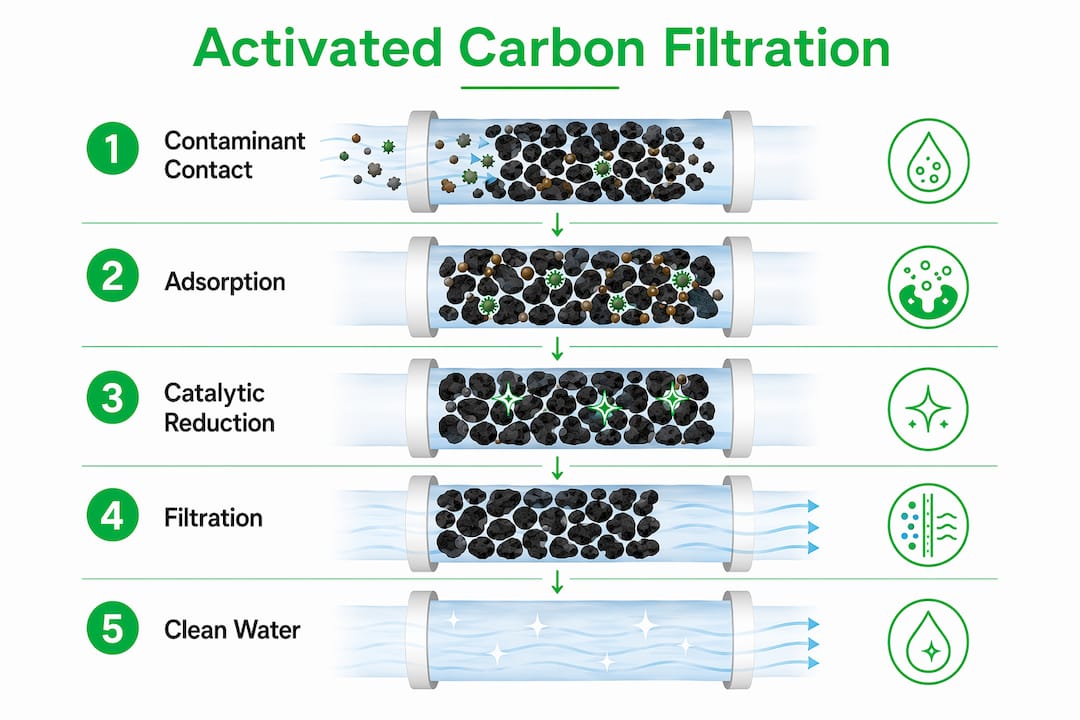
Pro Tip: Smaller carbon particles increase contact surface and speed up uptake, but they also raise pressure drop across the filter. A shower filter running at high flow with very fine carbon can blind quickly if the water carries sediment. Match particle size to your flow rate and pre-filter for solids first.
Which contaminants activated carbon removes — and which it misses
The activated carbon filtration process is highly effective against organic molecules and disinfectants, but it has clear blind spots that consumers often overlook.
Reliably removed:
- Free chlorine and chloramines (catalytic carbon for the latter)
- Taste and odor compounds (geosmin, 2-methylisoborneol, hydrogen sulfide)
- VOCs: benzene, trichloroethylene, carbon tetrachloride, vinyl chloride
- THMs and other disinfection byproducts
- Many pesticides, including atrazine
- Radon (under some conditions, particularly with POE GAC)
- Some PFAS compounds, particularly longer-chain variants (with caveats on short-chain removal)
Not reliably removed by standard carbon:
- Bacteria, viruses, and other pathogens
- Nitrates and nitrites
- Fluoride (standard carbon only — bone char is the exception)
- Dissolved salts and hardness minerals (calcium, magnesium)
- Most heavy metals, unless the carbon is impregnated with a chelating agent or used alongside a dedicated medium
The fluoride misconception is worth addressing directly. Standard activated carbon does not remove fluoride to any meaningful degree. Bone char — a carbon made from animal bones — removes fluoride through ion exchange with its carbonate phases, but it is a specialized product, not a standard filter cartridge. If fluoride is your concern, verify that the product is specifically bone char or uses a dedicated ion-exchange resin.
Impregnated carbons add targeted chemistry on top of the base adsorption. Silver impregnation suppresses bacterial growth within the carbon bed itself. Potassium permanganate impregnation targets hydrogen sulfide and some metals. These are not general-purpose upgrades — they address specific problems and cost more. Know what is in your water before choosing one.
For shower applications, the primary targets are chlorine and chloramines, which affect skin and hair health through direct contact during every wash. Standard activated carbon handles free chlorine well; if your municipality uses chloramines, you need catalytic carbon.
What forms does activated carbon come in?
The physical form of the carbon determines how it is deployed, how long it lasts, and what it can realistically remove.

| Form | Description | Typical Use | Contact Time Sensitivity | Rough Lifespan |
|---|---|---|---|---|
| GAC (granular) | Loose granules | Whole-house POE beds, municipal polishing | High — slow flow needed | Months to years |
| SBAC (solid block) | Compressed block, sub-micron pores | POU cartridges (faucet, shower, countertop) | Moderate — fixed geometry | 3–6 months typical |
| PAC (powdered) | Fine powder | Episodic dosing in treatment plants | Very high — contact is brief | Single-use dose |
| Catalytic carbon | Modified GAC or block | Chloramine removal, municipal and POU | High | Similar to GAC/SBAC |
| Bone char | Granular, animal-bone derived | Fluoride removal, some metals | High | Months |
| Impregnated carbon | GAC or block with added chemistry | Targeted contaminants (H₂S, metals, bacteria) | Varies by impregnant | Varies |
GAC beds are the workhorse of municipal water treatment and whole-house point-of-entry (POE) systems. Water flows through a tank of loose granules, and contact time is controlled by bed depth and flow rate. They can be backwashed to remove trapped solids and eventually reactivated thermally, which makes them economical at scale.
Solid block carbon (SBAC) is what most consumer cartridges use. The compressed structure creates a tortuous path that increases contact time even at moderate flow rates, and the tighter pore geometry can physically block cysts like Giardia and Cryptosporidium at sub-micron ratings. This is why NSF/ANSI 53-certified block filters can carry a cyst-reduction claim that loose GAC cannot.
PAC dosing is not a household technology. Water utilities inject powdered carbon upstream of clarifiers during episodic taste/odor events or algal bloom seasons, then remove it with the settled solids. PAC is typically dosed at 10–200 mg/L depending on the target contaminant.
For shower head filters specifically, SBAC or catalytic carbon block cartridges are the practical choice. A line-bypass or dedicated shower filter treats only the shower flow rather than all household water, which slows the carbon’s saturation rate and can extend cartridge life.
What actually determines how well a carbon filter performs?
Performance is not a fixed property of the carbon. It shifts with every variable in the system.
Empty Bed Contact Time (EBCT) is the ratio of bed volume to flow rate, expressed in minutes. It tells you how long water theoretically sits in contact with the carbon. Taste and odor removal is forgiving — short EBCT works. Micropollutants like THMs or PFAS need much longer contact. Municipal systems typically design for 10–30 minutes EBCT for micropollutant control; taste and odor removal can work at shorter intervals.
| Target Contaminant | Typical EBCT Guidance |
|---|---|
| Taste and odor (geosmin, MIB) | 3–10 minutes |
| Chlorine / chloramine | 5–10 minutes |
| THMs and disinfection byproducts | 10 minutes |
| Micropollutants (PFAS, trace organics) | 10–30 minutes |
The Mass Transfer Zone (MTZ) is the active band within the carbon bed where adsorption is occurring. Fresh carbon has its MTZ near the inlet. As that zone saturates, the MTZ moves toward the outlet. When it exits the bed, breakthrough happens — contaminant concentrations in the effluent rise sharply. Deeper beds push the MTZ exit point further out in time, buying more service life.
Flow rate and bed depth are the two levers operators control most directly. Slower flow increases EBCT; deeper beds extend the distance the MTZ must travel. Both delay breakthrough. In a consumer shower filter, you cannot change bed depth, but you can choose a model with a larger cartridge volume.
Competing organics are a hidden performance killer. Natural organic matter (NOM), measured as total organic carbon (TOC) or UV absorbance at 254 nm (UV254), competes with target contaminants for adsorption sites. High-NOM source water exhausts carbon faster. Suspended solids and iron physically clog pores, a condition called blinding, which reduces effective surface area without any visible sign of failure.
Temperature and pH both affect adsorption kinetics. Lower water temperatures slow diffusion into micropores, which can reduce removal efficiency at cold-water flow rates. Higher pH generally reduces adsorption of many organic acids because their charge state changes. For most household applications these effects are secondary, but they matter in industrial and municipal design.
Pro Tip: Install a sediment pre-filter upstream of any carbon cartridge. Suspended solids blind carbon pores and exhaust capacity far faster than dissolved contaminants alone. A 5-micron sediment stage costs almost nothing and can double the effective life of a carbon cartridge.
How long does activated carbon last, and when should you replace it?
Carbon does not announce when it is exhausted. That is the core maintenance problem.
Typical replacement intervals by application:
- Consumer POU cartridges (shower, faucet, countertop): 3–6 months under normal use, though high-chlorine or high-NOM water shortens this
- Whole-house GAC tanks: 6 months to several years, depending on bed volume and influent quality
- Municipal GAC beds: 1–5 years before reactivation or replacement, with continuous monitoring
The University of Nebraska Extension is direct about breakthrough risk: when the carbon bed saturates, effluent contaminant concentrations can actually exceed influent levels as previously adsorbed compounds desorb. That is not a theoretical edge case. It happens in under-maintained consumer filters.
Signs that a carbon filter needs replacement:
- Return of chlorine taste or smell in filtered water
- Noticeable drop in water pressure through the filter (blinding from solids)
- Visible discoloration or particulate in filtered output
- Exceeding the manufacturer’s rated gallon capacity or time interval
Maintenance best practices:
- Follow the manufacturer’s replacement schedule as a ceiling, not a target — replace sooner if water quality changes
- Use a sediment pre-filter to protect the carbon stage
- For GAC tanks, periodic backwashing removes trapped solids and restores flow, but does not regenerate adsorption capacity
- Spent carbon cartridges from household use can typically go in regular trash; spent industrial or municipal carbon containing hazardous contaminants requires disposal at a licensed facility
- Reactivation (thermal regeneration at high temperature) is economically viable for large municipal beds but not for consumer cartridges
Pro Tip: Track both calendar time and water volume. A household that runs 10-minute showers twice daily exhausts a small shower cartridge faster than the calendar suggests. Many Vitacleanhq filter refill plans are structured around usage volume, which is a more accurate trigger than a fixed monthly interval.
What activated carbon cannot do — and what fills the gaps
Knowing the limits of the activated carbon filtration process prevents costly mistakes and real health risks.
Clear limitations:
- Not a disinfectant. Carbon does not kill bacteria or viruses and can actually harbor bacterial growth in a stagnant, exhausted bed
- Does not remove nitrates, nitrites, or fluoride (standard carbon)
- Poor performance on dissolved inorganic salts and hardness minerals
- Limited effectiveness on very short-chain PFAS (C4 and shorter), which have lower affinity for carbon surfaces
- Does not remove dissolved heavy metals reliably without impregnation or a dedicated medium
Complementary technologies that fill the gaps:
- Sediment filters: Remove particulates that blind carbon; always upstream
- UV disinfection: Kills bacteria and viruses without chemistry; pairs well with carbon post-treatment
- Reverse osmosis (RO): Removes dissolved salts, nitrates, fluoride, most metals, and many PFAS; carbon is often used as a polishing stage after RO
- Ion exchange: Targets specific ions (nitrate, fluoride, hardness, some metals) that carbon cannot address
- Bone char: The specific carbon type for fluoride reduction via ion exchange
- Advanced oxidation (AOP): For short-chain PFAS and recalcitrant organics that carbon handles poorly
The practical takeaway for home systems is to treat carbon as one stage in a multi-stage filtration approach, not a complete solution. For shower use, carbon or Vitamin C neutralization handles chlorine and chloramines effectively. For drinking water with nitrate or fluoride concerns, you need additional treatment.
Where activated carbon is actually used
The same core mechanism scales from a shower cartridge to a city-scale treatment plant.
Household point-of-use (POU):
- Shower head filters: remove chlorine and chloramines that contact skin and hair during bathing; skin and hair benefits from chlorine-free water are well-documented among dermatologists and trichologists
- Faucet-mount and under-sink cartridges: taste/odor and VOC removal for drinking water
- Pitcher filters: typically GAC or block carbon for chlorine and taste/odor
Whole-house point-of-entry (POE):
- GAC tanks treat all incoming water, appropriate for VOCs that off-gas in showers and laundry
- POE is the right choice when the contaminant vaporizes from hot water, since a POU drinking filter does nothing for shower vapor exposure
Air purification:
- Activated carbon blankets and panels in HVAC systems and standalone air purifiers capture VOCs, formaldehyde, and odors that HEPA filters cannot touch
- The importance of carbon in air filters is particularly high in new construction, where off-gassing from building materials is significant
Industrial and municipal:
- Polishing beds at the tail end of municipal treatment remove trace organics and disinfection byproducts before distribution
- Pump-and-treat groundwater remediation systems use GAC columns to capture fuel hydrocarbons, PCBs, and solvents
- Food and beverage processing uses carbon to decolorize and deodorize products
For beauty and wellness contexts, the connection between water quality and skin tool hygiene extends beyond the shower. Chlorinated water used to rinse brushes, sponges, and applicators can degrade materials and leave residue — another reason filtered water matters across a daily routine.
U.S. certifications and standards you should actually check
A manufacturer claiming “removes chlorine” means nothing without third-party verification. In the United States, two organizations run the programs that matter: NSF International and the Water Quality Association (WQA).
NSF/ANSI standards for activated carbon filters:
- NSF/ANSI 42: Aesthetic effects — chlorine taste and odor, particulates. This is the baseline certification most carbon filters carry.
- NSF/ANSI 53: Health effects — specific contaminants with health implications, including lead, VOCs, cysts (for sub-micron block carbon), and some disinfection byproducts. A filter certified to 53 has been tested against the specific contaminants listed on its certification, not all possible contaminants.
- NSF/ANSI 401: Emerging contaminants — pharmaceuticals, herbicides, pesticides, and other trace organics not covered by 42 or 53. Relatively few consumer products carry this certification.
What certification does and does not mean:
- Certification is contaminant-specific. A filter certified to NSF/ANSI 53 for lead reduction is not automatically certified for THM reduction unless that claim is also listed.
- Always check the NSF product database directly rather than relying on packaging claims alone.
- For PFAS specifically, the EPA has published guidance on treatment technologies, and NSF is developing specific PFAS certification protocols. As of now, verify PFAS claims carefully and ask for third-party analytical data.
For operational monitoring in larger systems:
- TOC and UV254 measurements serve as surrogate indicators of organic breakthrough
- GC-MS and LC-MS/MS are the analytical methods for confirming specific VOC and PFAS removal
- Pilot column testing before committing to full-scale GAC is standard engineering practice for micropollutant applications
Engineering insights: breakthrough, contact time, and what practitioners actually watch
Practitioners who design and operate carbon systems spend most of their time managing two risks: premature breakthrough and channeling.
Breakthrough is not a gradual decline. The MTZ moves through the bed at a pace set by flow rate, carbon activity, and competing adsorbates. When it reaches the bed exit, effluent quality drops fast — sometimes within hours of the first sign. Monitoring strategies include continuous TOC sensors at the effluent, periodic grab samples for target contaminants, and UV254 as a real-time surrogate. Consumer cartridges have none of this instrumentation, which is exactly why calendar-based replacement schedules exist.
Channeling happens when water finds preferential flow paths through a GAC bed, bypassing large portions of the carbon. It reduces effective bed utilization without any obvious external sign. Causes include improper backwash, fine particle migration, and air binding. Deeper beds with uniform particle size distribution are more resistant to channeling.
Bacterial growth in exhausted or stagnant carbon beds is a real operational concern. Carbon’s porous structure provides an ideal surface for biofilm formation once adsorption capacity is gone. Silver-impregnated carbon suppresses this, but it is not a substitute for timely replacement. A stagnant filter left in place for months can become a source of contamination rather than a solution.
For shower filter design specifically, the choice between a carbon block and loose GAC matters. Block carbon provides more consistent contact geometry and is harder to channel. GAC in a small cartridge can shift and channel under variable shower pressure. If you are evaluating shower filter products, ask whether the carbon stage is block or granular.
Pro Tip: For any carbon filter treating water with significant organic load, run a pilot test before scaling up. Even a small column test with your actual source water over 4–6 weeks will reveal real-world EBCT requirements and carbon usage rates that manufacturer spec sheets cannot predict for your specific water chemistry.
Vitacleanhq and carbon filtration: where it fits your shower
Activated carbon is one of the most effective tools for removing chlorine and organic compounds from shower water, but it works best as part of a layered approach. Vitacleanhq’s Vitamin C filter technology neutralizes chlorine and chloramines through a different mechanism — ascorbic acid reduction — which is fast-acting and effective even at high flow rates where carbon contact time is limited.
For shower applications where contact time is short and flow rates are high, Vitamin C neutralization addresses the core chlorine problem directly. Vitacleanhq’s Vitamin C shower filter shots are designed for exactly this use case: fast, reliable chlorine neutralization without the contact-time constraints that limit carbon performance in high-flow shower environments. Pair them with a replacement filter refill plan to stay ahead of breakthrough and keep your shower water consistently clean.
Key Takeaways
Activated carbon removes chlorine, VOCs, and taste/odor compounds through adsorption onto a massive internal surface, but it requires timely replacement to prevent breakthrough and cannot substitute for disinfection or inorganic removal.
| Point | Details |
|---|---|
| Adsorption drives removal | Contaminants stick to carbon’s internal surface; one gram carries roughly 1,000 m² of area. |
| EBCT controls performance | Taste/odor removal works at 3–10 minutes EBCT; micropollutants need 10–30 minutes. |
| Breakthrough is a real risk | Saturated carbon can release contaminants back into water; scheduled replacement prevents this. |
| Carbon has clear limits | It does not remove bacteria, nitrates, fluoride (standard carbon), or dissolved salts. |
| Certification matters | Check NSF/ANSI 42, 53, or 401 labels and verify claims in the NSF product database directly. |