
How to Use Natural Shower Accessories for Healthier Skin
TL;DR:
- Using Vitamin C-based shower accessories neutralizes chlorine at the showerhead, reducing skin and hair dryness. They do not remove heavy metals, fluoride, or significantly soften hard water, only targeting disinfectants. Proper maintenance and choosing the right cartridge size are essential for effective performance, especially with chloramine-treated water.
The fastest way to reduce chlorine-related skin and hair dryness is to attach a Vitamin C–based inline cartridge or refill shot at your showerhead. Ascorbic acid neutralizes free chlorine on contact, and Vitacleanhq’s filtered shower accessories are designed around exactly that chemistry. One important caveat up front: this is a point-of-use disinfectant treatment, not a whole-house purifier. It will not remove heavy metals, fluoride, or dissolved hardness minerals.
- What it does: Neutralizes chlorine (and, with the right cartridge, chloramines) at the showerhead before water reaches your skin and hair.
- What it doesn’t do: Remove heavy metals, fluoride, bacteria, or significantly soften hard water.
- Who it’s for: Renters and homeowners on municipal water who want a fast, low-effort upgrade with no plumbing work.
- Replacement signal: When the aromatherapy scent fades or the chlorine smell returns, the media is spent.
Table of Contents
- How does Vitamin C filtration actually neutralize chlorine?
- Which type of natural shower accessory is right for you?
- How do you install and use these accessories?
- When should you replace your filter or cartridge?
- What will these accessories actually do for your skin and hair?
- Is it safe, and will it work with your U.S. plumbing?
- Key Takeaways
- The part most guides skip over
- Cleaner shower water, starting today
- Useful sources
How does Vitamin C filtration actually neutralize chlorine?
Ascorbic acid (Vitamin C) chemically reduces free chlorine the moment water contacts the media, converting it into harmless chloride salts. The reaction is nearly instantaneous, which is why even a compact inline cartridge works without slowing your shower to a trickle.
A few variables determine how well it performs in practice:
- Contact time and flow rate: Slower flow gives the media more time to react. High-pressure showers can reduce efficacy if the cartridge is undersized for the flow.
- Chloramine vs. free chlorine: Vitamin C is highly effective against free chlorine but less predictable against chloramines, the disinfectant blend many U.S. utilities use. Larger or hybrid cartridges handle chloramines better.
- Temperature: Hot showers degrade ascorbic acid faster. Manufacturers counter this with sodium ascorbate and encapsulation technologies that stabilize performance under typical shower temperatures.
- What it cannot do: Per USDA water filtration research, Vitamin C targets disinfectants only. Heavy metals, fluoride, and bacteria require different systems entirely.
Pro Tip: Your nose is a reliable performance gauge. When the aromatherapy scent fades or you catch a faint chlorine smell mid-shower, the media is close to exhausted. Don’t wait for a calendar reminder alone.
Which type of natural shower accessory is right for you?
Choose by use case first. Renters who move frequently want portability; homeowners who shower twice daily want longer cartridge life and a subscription refill plan. Vitamin C shots are the most renter-friendly option because they drop into a compatible handle with no tools and no permanent changes to the plumbing.
| Accessory type | Best for | Installation | Replacement interval | Ongoing cost | Extra features |
|---|---|---|---|---|---|
| Vitamin C refill shots | Renters, trial users, color-treated hair | Tool-free, under 5 min | Every 2–4 months | One-off or subscription | Aromatherapy options |
| Inline cartridge housing | Universal compatibility, homeowners | Tool-free, under 10 min | Every 2–4 months | Subscription or one-off | Pairs with any showerhead |
| Integrated filtered showerhead | One-piece simplicity, homeowners | Wrench optional, 10 min | Cartridge every 2–4 months | Subscription refills | Handheld or wall-mount |
| Ceramic bead filter | Sediment/hardness concerns, longer intervals | Tool-free or simple swap | several thousand gallons | Lower per-cycle cost | Mineral softening effect |
| Aromatherapy attachment | Skin/scalp soothing, spa feel | Clip-on or inline | Per aromatherapy pod | Low | Essential oil infusion |
Selection checklist before you buy:
- Water source: Municipal free chlorine responds well to any Vitamin C cartridge. Chloramine-treated water (check your utility’s annual water quality report) needs a larger or hybrid cartridge.
- Skin and hair goals: Dry, itchy skin or color-treated hair that fades fast are the clearest signals that chlorine is the culprit.
- Plumbing constraints: Confirm you have a standard ½" shower thread and enough clearance behind the showerhead for an inline housing.
- Budget: Subscription refill plans cost less per replacement than repeated one-off purchases and remove the risk of forgetting.
Pro Tip: Check your city’s annual Consumer Confidence Report (CCR) — utilities are required to publish it. It tells you whether your water uses free chlorine or chloramines, which directly affects which cartridge size you need.
How do you install and use these accessories?
Most inline cartridges and refill shots use the standard ½" thread common in U.S. shower plumbing, so installation is usually tool-free and takes under 10 minutes.
Installing an inline cartridge
- Turn off the shower and unscrew the existing showerhead by hand (or with a wrench if it’s tight).
- Wrap the pipe threads with Teflon tape for a watertight seal.
- Thread the cartridge housing onto the shower arm, then reattach the showerhead to the housing’s outlet.
- Turn the water on and check for leaks at both connection points.
- Run water for 30–60 seconds to flush any loose media before your first shower.
Replacing a Vitamin C refill shot
- Unscrew or pop open the refill chamber on your handle or canister.
- Remove the spent shot and drop in the new one, noting the correct orientation (most are directional).
- Close the chamber and run water briefly to activate the media.
Installing an integrated filtered showerhead
- Remove the old showerhead and clean the pipe threads.
- Apply Teflon tape, then hand-thread the new filtered head until snug.
- Tighten a quarter-turn with a wrench if needed, but avoid overtightening plastic housings.
- Flush for 30 seconds before use.
Troubleshooting:
- Leaks: Re-seat the rubber washer inside the connection and add a fresh layer of Teflon tape.
- Reduced flow: Check for sediment clogging the inlet screen or an incorrectly oriented cartridge.
- Chlorine smell returns: Flush for 60 seconds first. If it persists, replace the cartridge.
Pro Tip: After installation, do a quick sniff test at showers 3, 5, and 10. If the chlorine smell is gone by shower 3 and stays gone through shower 10, the cartridge is seated and working correctly. Set a monthly calendar reminder to repeat the check.
When should you replace your filter or cartridge?
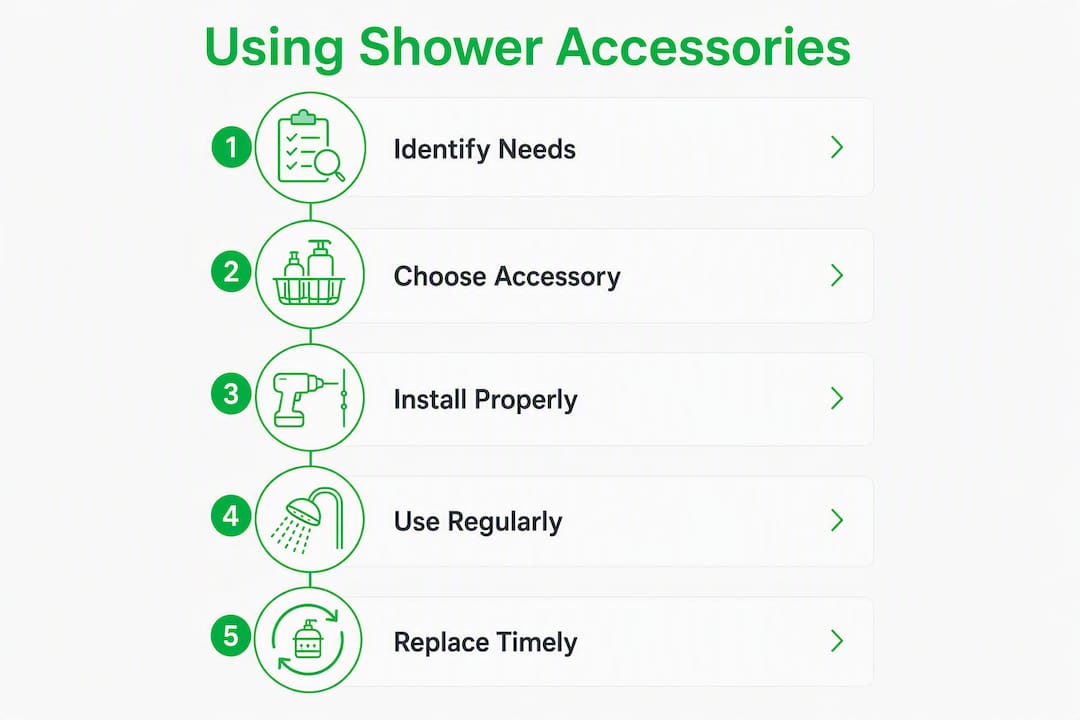
Typical replacement falls every few months for most Vitamin C cartridges, or after several thousand gallons for ceramic bead media, depending on flow rate and disinfectant levels. But the real-world signal beats any calendar date.
Maintenance tasks to build into your routine:
- Note the install date on a sticker placed on the housing itself.
- Check for aromatherapy fading or returning chlorine odor monthly.
- Soak the showerhead in distilled white vinegar for 30–45 minutes every few months to dissolve limescale that restricts flow and reduces media contact time.
- Follow the manufacturer’s flush instructions after every cartridge swap.
| Replacement signal | What it means |
|---|---|
| Chlorine smell returns mid-shower | Media is exhausted; replace immediately |
| Aromatherapy scent fades noticeably | Vitamin C media is near or at depletion |
| Skin or hair dryness returns | Filtration is no longer effective |
| Visible media erosion or discoloration | Physical end-of-life; replace the cartridge |
| Flow drops without a limescale explanation | Possible media compaction; replace and descale |
A subscription refill plan removes the guesswork entirely. Vitacleanhq’s refill plan ships replacement cartridges on a schedule matched to typical household use, so you never shower with a spent filter.
Pro Tip: Two-person households go through cartridges roughly twice as fast as single-person ones. If you share a shower, shorten your replacement interval by 3–4 weeks.
What will these accessories actually do for your skin and hair?
The clearest benefits are for people on chlorinated municipal water. Neutralizing the oxidizing disinfectant before it contacts skin reduces the stripping of natural oils that causes dryness and tightness after showering. Color-treated hair holds pigment longer when chlorine isn’t breaking down the dye. Some people with eczema-prone or sensitive skin report reduced irritation, though individual results vary.
The limits are equally clear:
- No heavy metal removal. Lead, copper, and other dissolved metals require activated carbon or reverse osmosis systems.
- No fluoride removal. That requires reverse osmosis or activated alumina, not Vitamin C.
- No meaningful water softening. Calcium and magnesium stay in the water; ceramic beads offer minor mineral moderation but are not a substitute for a water softener.
- Point-of-use only. The filter treats one showerhead. Your kitchen tap, bathtub, and other fixtures remain unchanged.
The science-backed benefits for skin and hair are real within those limits. Think of a Vitamin C shower accessory as a targeted disinfectant-neutralizer, not a catch-all water purifier.
Pro Tip: If you want broader contaminant coverage, pair a Vitamin C showerhead with a dedicated under-sink or pitcher filter for drinking water. Each solves a different problem.
Is it safe, and will it work with your U.S. plumbing?
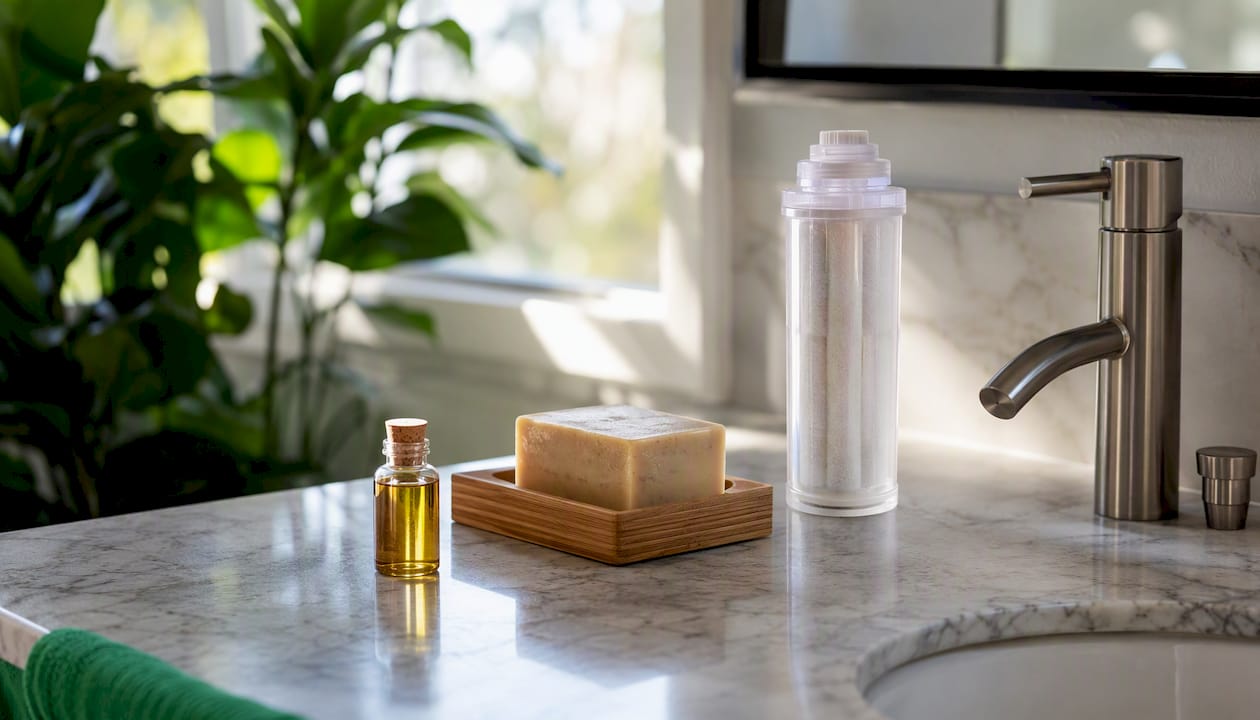
Most inline cartridges and refill shots fit the standard ½" NPT shower thread used in virtually all U.S. residential plumbing, so compatibility is rarely an issue. That said, a few checks are worth doing before you buy.
Pre-installation checklist:
- Confirm your shower arm has a standard ½" thread (nearly universal in U.S. homes built after 1950).
- Check clearance behind the showerhead for an inline housing, especially in tiled enclosures with tight wall clearance.
- Verify the housing won’t obstruct a pressure-balance or anti-scald valve, which some newer shower valves have built into the arm.
- Never install a shower cartridge inline with a hot tub, pool, or non-shower fixture. These systems have different flow rates and temperature ranges that can damage the housing or reduce the media to nothing in hours.
When to test your water or call a plumber:
- You’re on well water with sulfur, iron, or unknown contaminants.
- Your home has older galvanized or lead pipes.
- You notice orange or brown staining in the shower, which signals iron or manganese.
- A Vitamin C cartridge produces no noticeable improvement after two full replacements.
In any of those cases, a professional water test from a certified lab (search the EPA’s certified lab locator) is the right first step before adding any point-of-use device.
Key Takeaways
A Vitamin C–based shower accessory neutralizes chlorine at the showerhead in seconds, reducing skin dryness and hair damage, but it treats disinfectants only and cannot replace whole-house filtration for heavy metals, fluoride, or hardness.
| Point | Details |
|---|---|
| Buy by use case | Renters: Vitamin C shots; homeowners: inline cartridges or integrated filtered showerheads. |
| Install in under 10 minutes | Standard ½" U.S. threads mean most setups are tool-free with no plumber needed. |
| Watch sensory cues | Fading aromatherapy or returning chlorine smell means the cartridge needs replacing now. |
| Know your water type | Check your utility’s CCR to confirm free chlorine vs. chloramine before choosing a cartridge size. |
| Vitacleanhq refill plan | Vitacleanhq’s subscription ships replacement cartridges on schedule so performance never lapses. |
The part most guides skip over
Most how-to articles on this topic treat Vitamin C shower filtration as either a miracle or a gimmick. Neither framing is useful.
The honest picture: ascorbic acid chemistry is well-established and genuinely effective at neutralizing free chlorine. The gap between what people expect and what they get usually comes down to one thing — chloramine. A significant portion of U.S. municipal systems use chloramine instead of free chlorine, and a standard Vitamin C shot handles it less reliably than a larger hybrid cartridge. If you install a basic refill shot in a chloramine-treated home and notice only modest improvement, that’s not the technology failing. It’s a cartridge-sizing mismatch.
The other thing worth saying: the maintenance discipline matters more than the product spec. A premium cartridge left in place three months past its replacement window performs worse than a basic one swapped on schedule. Sensory checks cost nothing and take ten seconds. The Vitacleanhq blog’s Vitamin C shower guide frames this well: the routine around the product is what delivers consistent results, not the product alone. For renters, a removable inline shot is genuinely the right call. For homeowners showering daily, an integrated filtered showerhead with a subscription refill plan removes every friction point from the maintenance side.
Cleaner shower water, starting today
Chlorine-stripped skin and fading hair color are fixable problems, and you don’t need a plumber or a whole-house system to fix them. Vitacleanhq’s Vitamin C refill shots drop into a compatible handle in minutes, making them the lowest-barrier entry point for renters or anyone testing the concept. For a more permanent setup, the handheld filtered shower heads combine integrated Vitamin C filtration with aromatherapy in a single unit.
The piece that most people skip is the refill. A spent cartridge is just a showerhead. Vitacleanhq’s filter refill plan ships replacements on a schedule matched to typical household use, so the filter is always working when you step in. Browse the full range of shower accessories to find the setup that fits your plumbing, your routine, and your skin.
Useful sources
The claims in this guide draw on the following sources. If your results are inconsistent, the single most useful step is checking your utility’s annual Consumer Confidence Report to confirm whether your water uses free chlorine or chloramines.
- Vitamin C Water Filter for Shower Benefits and How It Works — Driplife
- What Is a Vitamin C Shower Filter? — Osmosis Info
- USDA Water Filtration Research
- Benefits of a Vitamin C Filtered Shower Head — Vitacleanhq
- Do Vitamin C Shower Heads Work? Science-Backed Benefits — Vitacleanhq
This article is general information, not medical or plumbing advice. Verify current water quality and product compatibility with your utility’s Consumer Confidence Report or a certified water-testing lab before making treatment decisions.