
Your Guide to Natural Water Purification for Skin and Hair
TL;DR:
- Vitamin C shower filters neutralize chlorine and chloramine, protecting skin and hair from daily damage.
- They achieve this through a fast redox reaction, converting harmful disinfectants into harmless salts.
A highly effective natural shower water purification method for skin and hair is Vitamin C filtration, using specifically ascorbic acid or sodium ascorbate media that neutralize free chlorine and reduce chloramine at the showerhead. Vitacleanhq offers Vitamin C filtered shower heads, replaceable Vitamin C shots, and a refill subscription plan built around exactly this chemistry.
Why it matters for your skin and hair:
- Municipal tap water in the U.S. is routinely disinfected with chlorine or chloramine, both of which strip natural oils from skin and hair during a hot shower.
- Vitamin C neutralizes these oxidants through a redox reaction, converting them into harmless chloride before the water touches your skin.
- Independent and industry testing shows Vitamin C systems can achieve very high reduction in free chlorine during a cartridge’s active life.
- Vitacleanhq’s lineup covers handheld and wall-mounted options with replaceable shots and a subscription refill plan for consistent performance.
Table of Contents
- How does Vitamin C neutralize chlorine in your shower?
- What does testing actually show about chlorine reduction?
- What benefits can you expect for skin, hair, and scalp?
- What form factors are available for Vitamin C shower filters?
- How do you pick the right Vitamin C shower filter?
- How do you install and maintain a Vitamin C shower filter?
- What Vitamin C shower filters do NOT do
- Vitacleanhq options: starter kits, shots, and the refill plan
- Key Takeaways
- Why Vitamin C filtration is the right call for beauty-focused consumers
- Vitacleanhq starter kits and the refill plan
- Useful sources
How does Vitamin C neutralize chlorine in your shower?
Vitamin C neutralizes chlorine through a redox reaction: ascorbic acid or sodium ascorbate donates electrons to free chlorine, converting it into chloride, a harmless salt. The reaction is fast and does not require heat or pressure to work.
Performance depends on several practical factors, including water temperature, flow rate, contact time, and whether your water utility uses free chlorine or chloramine as its disinfectant. Chloramine is a combined form of chlorine and ammonia; it reacts more slowly with Vitamin C and needs longer contact time to neutralize fully.
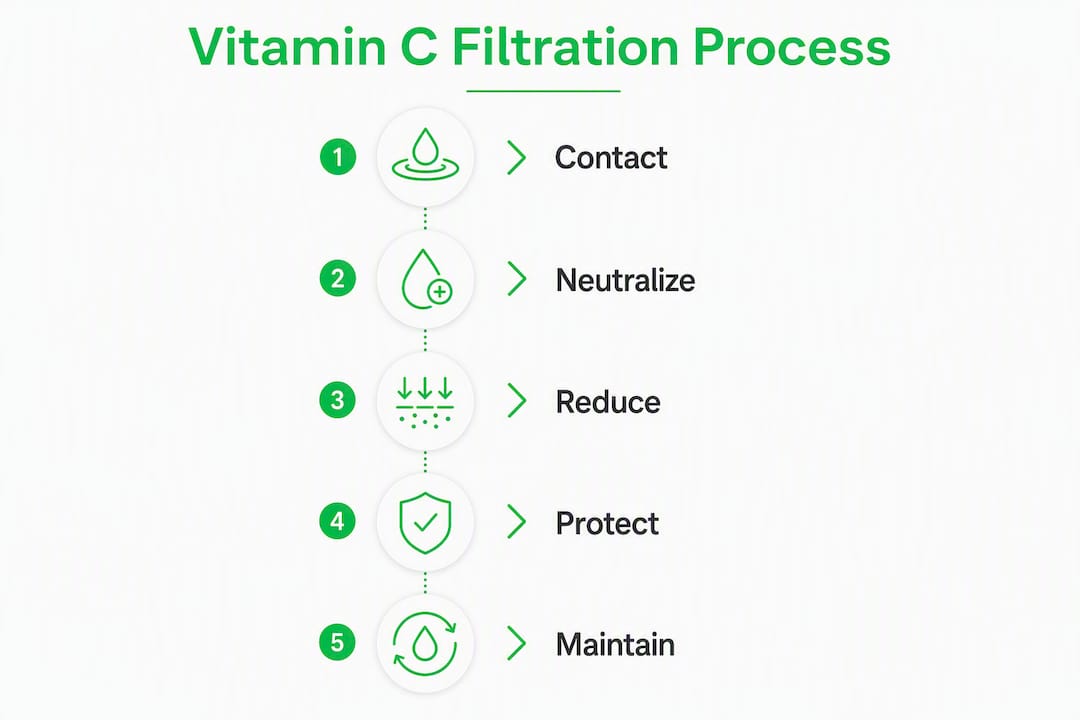
The form of Vitamin C in the cartridge also matters. Sodium ascorbate tends to show better stability under the thermal and oxidative stress of a hot shower compared with raw ascorbic acid, which helps maintain dechlorination effectiveness longer. Encapsulated or polymer-bound Vitamin C media reduces physical erosion during flow spikes, preserving potency across the cartridge’s rated life.
Key factors that affect how well the filter performs:
- Contact time: The single most practical limiter. High flow rates reduce the time water spends touching the media, which can leave chloramine partially unreacted.
- Cartridge size and surface area: Larger media beds give water more exposure time. Small cartridges at high flow are less reliable for chloramine.
- Water temperature: Hot water accelerates the reaction but also degrades ascorbic acid faster; sodium ascorbate holds up better.
- Dose rate: The amount of Vitamin C available per gallon determines how long the cartridge stays effective.
What does testing actually show about chlorine reduction?
Independent and industry testing confirms that well-designed Vitamin C shower filters can achieve very high reduction in free chlorine during a cartridge’s active lifecycle. Some vendor formulations claim very high chlorine neutralization under ideal conditions, though real-world performance depends on flow rate, cartridge design, and your local water chemistry.
Chloramine reduction is possible but more variable. Filter design, dose rate, media surface area, and actual shower flow all determine whether a cartridge handles chloramine reliably. A compact cartridge running at maximum flow is the weakest scenario for chloramine.
| Disinfectant | Vitamin C Reaction Speed | Key Variable |
|---|---|---|
| Free chlorine | Fast | Flow rate and contact time |
| Chloramine | Slower | Cartridge size and media surface area |
Pro Tip: Test your shower water before and after installing a new cartridge. A simple chlorine test strip (available at hardware stores) or a smell test on hot running water gives you a baseline. As a cartridge ages, a faint chlorine smell returning is the clearest sign it needs replacing.
What benefits can you expect for skin, hair, and scalp?
Reduce chlorine exposure in your shower and you remove one of the most consistent daily stressors on your skin barrier and hair cuticle. Chlorine oxidizes the natural oils your skin produces; over time, that shows up as dryness, tightness, and irritation. For hair, it strips the cuticle layer, making strands rough, prone to breakage, and harder to manage. Color-treated hair fades faster because chlorine accelerates dye oxidation.
Filtering chlorine from shower water addresses the source of the problem rather than layering on more moisturizer to compensate. Softer skin, less scalp itch, smoother hair texture, and slower color fade are the practical outcomes most people notice within a few weeks of consistent use.
What you can realistically expect:
- Softer, less dry skin as natural oils are no longer stripped with every shower.
- Reduced scalp irritation and itching, especially for those with sensitive skin or eczema-prone conditions.
- Smoother, more manageable hair with less frizz and breakage.
- Slower color fade for color-treated hair, since chlorine is a primary accelerant of dye oxidation.
- Less inhaled chlorine vapor during hot showers, which matters for anyone with respiratory sensitivity.
For renters who cannot modify plumbing, a handheld Vitamin C filter installs in minutes and moves with you. Parents with young children or anyone with sensitive skin get the most immediate benefit. Color-treated hair is one of the clearest use cases: the skin and hair benefits are well-documented and start showing up quickly.
What form factors are available for Vitamin C shower filters?

The same Vitamin C chemistry runs across several product types. Your choice comes down to installation constraints and how convenient you want cartridge replacement to be.
| Form Factor | Ease of Install | Typical Cartridge Life | Best For |
|---|---|---|---|
| Integrated filtered showerhead | Easy (replaces existing head) | Several months | Homeowners wanting a clean setup |
| Handheld with refill cartridge | Very easy | Several months | Renters, families, flexible use |
| Inline cartridge (arm to head) | Easy (fits between arm and head) | Several months | Keeping your existing showerhead |
| Replaceable ‘shot’ refills | Snap-in, no tools | Varies by shot size | Minimal-hassle replacement |
- Replaceable shots — are the simplest refill format: swap the spent shot for a fresh one, no cartridge disassembly needed.
How do you pick the right Vitamin C shower filter?
Prioritize in this order: (1) compatibility with your shower fittings and anti-scald devices, (2) cartridge capacity in gallons or months, (3) flow-rate rating, (4) replacement ease and cost including subscription options, and (5) verified test claims for chlorine and chloramine reduction.
Capacity is where most buyers underestimate their real usage. Larger households or more frequent showers use water faster than single-person or infrequent showering. Hot showers also consume more Vitamin C per gallon because the reaction runs faster at higher temperatures, shortening effective cartridge life.
Typical replacement cadences run several months depending on household size and local disinfectant levels. A subscription plan removes the guesswork entirely.
Watch for these red flags when evaluating any filter:
- Vague capacity claims with no gallon count or month estimate.
- No third-party or independent testing cited for chlorine/chloramine reduction.
- Inconsistent flow specs that do not match your shower’s pressure.
- Any design that bypasses or disables anti-scald or pressure-balance valves.
How do you install and maintain a Vitamin C shower filter?
Most Vitamin C shower filters are a straightforward DIY install that takes under 10 minutes. No plumber needed for standard setups.
- Turn off the water supply or simply note that no shutoff is required for showerhead swaps on most U.S. fixtures.
- Remove the existing showerhead by turning it counterclockwise; use a cloth to protect the finish.
- Wrap the shower arm threads with Teflon tape (2–3 wraps) to prevent leaks.
- Thread on the new filtered showerhead or inline cartridge by hand, then snug it with a wrench using a cloth buffer.
- Run water for 30–60 seconds to flush the cartridge and check for leaks at the connection.
- Note the install date so you know when the cartridge is due for replacement.
For replacement cadence, 3–6 months is the standard range, but check your cartridge’s rated gallon capacity against your household’s actual usage. A returning chlorine smell or reduced water pressure are the two clearest signs a cartridge is spent.
Pro Tip: Signing up for a refill subscription means a fresh cartridge arrives before the old one runs out. You never have to remember the install date or notice the smell first.
What Vitamin C shower filters do NOT do
Vitamin C shower filters are point-of-use devices that treat only the water at the shower. They are not whole-house systems and are not drinking-water treatment.
Limitations to keep in mind:
- No water softening: Vitamin C does not remove calcium or magnesium hardness.
- Limited heavy-metal removal: Unless combined with carbon or ceramic media, Vitamin C alone does not reliably remove lead, iron, or other metals.
- No bacterial sterilization: Vitamin C neutralizes chemical disinfectants; it does not kill pathogens.
- Point-of-use only: Other faucets, the kitchen tap, and the rest of your plumbing are unaffected.
- Not for drinking water: This guide covers shower water only. Do not use a shower filter cartridge as a drinking-water solution.
Do not bypass or disable anti-scald or pressure-balance valves during installation. Follow the manufacturer’s instructions and keep spare cartridges sealed in storage until use.
Vitacleanhq options: starter kits, shots, and the refill plan
Vitacleanhq’s lineup matches the buying checklist directly. Vitamin C shots and starter kits cover easy installation, verified capacity, and a subscription refill option that keeps performance consistent.
What Vitacleanhq offers:
- Handheld shower filter: A handheld starter kit with a refill-compatible cartridge housing, ideal for renters and families.
- Replaceable Vitamin C shots: — Snap-in refills that make cartridge replacement as simple as swapping a pod.
The science-backed benefits for skin and hair are documented on the Vitacleanhq blog, and product pages list compatibility, flow ratings, and cartridge specs for each model.
Key Takeaways
Vitamin C shower filtration is the most practical natural method for reducing chlorine and chloramine at the shower, with direct benefits for skin, hair, and scalp health.
| Point | Details |
|---|---|
| Vitamin C neutralizes chlorine fast | Ascorbic acid or sodium ascorbate converts free chlorine to harmless chloride via a redox reaction. |
| Chloramine needs more contact time | Small cartridges at high flow are less reliable for chloramine; choose a filter with adequate media surface area. |
| Replace cartridges every 3–6 months | Household size and local disinfectant levels affect how quickly a cartridge is spent; a subscription removes the guesswork. |
| Not for drinking water | Vitamin C shower filters are point-of-use only and do not treat whole-house or drinking water. |
| Vitacleanhq covers every form factor | Starter kits, handheld filters, replaceable shots, and a refill plan match the checklist for easy install and consistent performance. |
Why Vitamin C filtration is the right call for beauty-focused consumers
The conventional wellness advice is to fix dry skin and damaged hair with better products: richer conditioners, more moisturizer, gentler shampoo. That advice is not wrong, but it skips the variable that runs every single day before any product touches your hair or skin. Hot chlorinated water is not a background condition you work around. It is an active stressor you can remove.
What I find underappreciated is the chloramine angle. Most people know chlorine is in tap water. Fewer realize that many U.S. utilities have shifted to chloramine because it is more stable in distribution pipes, and chloramine is harder to neutralize than free chlorine. A filter that handles free chlorine well but stalls on chloramine is doing half the job. That is why cartridge design, media surface area, and contact time matter more than the marketing headline on the box.
For renters, a handheld Vitamin C filter is the obvious choice: no permanent changes, packs up when you move. For families, a wall-mounted filtered showerhead with a subscription refill plan is the lower-maintenance path. Either way, the step that matters most after installation is the one most people skip: test your water, note the date, and subscribe so the cartridge never runs dry.
Vitacleanhq starter kits and the refill plan
Cleaner shower water for your skin and hair does not require a plumber or a complicated setup. Vitacleanhq’s Vitamin C filtered shower heads and replaceable Vitamin C shots install in minutes and start neutralizing chlorine from the first shower.
The refill subscription takes the only friction point out of the equation: a fresh cartridge arrives on schedule, matched to your replacement cadence, so performance stays consistent without you tracking install dates. Subscription benefits include predictable cost, on-time delivery, and cartridges that arrive sealed and ready to swap.
Pick your form factor on the Vitacleanhq site, check the compatibility and flow specs for your shower, and sign up for the refill plan at checkout to keep your filter working at full capacity from day one.
Useful sources
- Vitamin C Water Filter for Shower Benefits and How It Works — Driplife
- Chemical Stability of Vitamin C in Hot Shower Filtration Systems Explained — Driplife
- Vitamin C Shower Filter: 3 Things It Does for You — waterfilterlab.com
- Vitamin C Water Filter for Shower Benefits and Installation — CUOLL
- How To Choose and Install the Right Bathroom Shower System With Vitamin C Filter — Storables
- Do Vitamin C Shower Heads Work? Science-Backed Benefits for Skin, Hair — Vitacleanhq Blog
- Filter Refill Plan — Vitacleanhq